
A typical garden hose can deliver anywhere from 5 to 12 gallons per minute (GPM) from your faucet. This water flow rate is influenced by several key factors, primarily water pressure and the hose diameter. Let’s dive deeper into what determines your hose output and how you can estimate or even measure it.
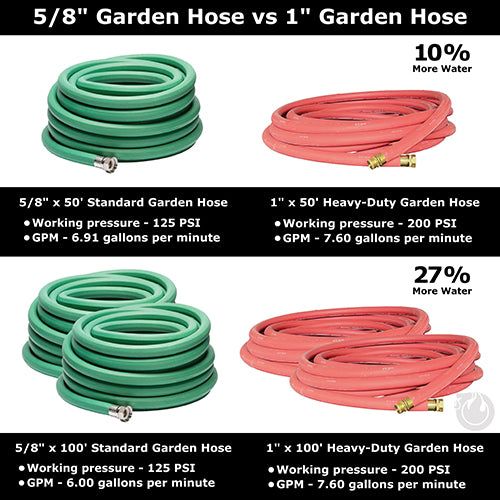
Image Source: firehosedirect.com
Fathoming Your Garden Hose’s Water Flow Rate
The amount of water that gushes from your garden hose is a crucial factor for many outdoor tasks. Whether you’re watering delicate plants, washing your car, or filling a pool, knowing your irrigation GPM helps you work more efficiently and effectively. This hose output isn’t a fixed number; it’s a dynamic value that changes based on a few significant elements.
The Pillars of GPM: Water Pressure and Hose Diameter
Two primary components dictate how much water your hose can deliver: the water pressure available at your faucet and the hose diameter. Think of it like this: water pressure is the “push” behind the water, and the hose diameter is the “size of the door” it has to go through.
Water Pressure: The Driving Force
Water pressure is typically measured in pounds per square inch (PSI). Most residential water systems operate within a range of 40 to 60 PSI, though it can sometimes be higher or lower depending on your location and municipal supply.
- Higher PSI = More Force: When your home’s water pressure is higher, the water is pushed with more force, leading to a potentially higher faucet flow.
- Lower PSI = Less Force: Conversely, low water pressure will restrict the amount of water that can be pushed through the hose, resulting in a lower hose output.
Factors affecting your home’s water pressure include:
- Municipal Water Supply: The pressure provided by your local water company.
- Your Plumbing: Older pipes, kinks, or blockages in your home’s plumbing can reduce pressure.
- Elevation: If you live at a higher elevation, you might experience lower water pressure.
- Time of Day: Pressure can sometimes fluctuate depending on overall water usage in your neighborhood. Peak usage times can lead to a temporary drop in pressure.
- Well Systems: If you rely on a well, the pump’s capacity and the pressure tank settings are critical.
Hose Diameter: The Pathway for Water
Garden hoses come in various diameters, most commonly 1/2 inch, 5/8 inch, and 3/4 inch. The diameter significantly impacts the water flow rate.
- Larger Diameter = More Water: A wider hose (e.g., 3/4 inch) offers less resistance to water flow. This means more water can pass through per minute, resulting in a higher GPM calculation.
- Smaller Diameter = Less Water: A narrower hose (e.g., 1/2 inch) creates more friction and restricts the flow, leading to a lower hose output.
Here’s a general comparison of how diameter affects flow, assuming consistent water pressure:
| Hose Diameter | Approximate GPM Range (at 50 PSI) | Notes |
|---|---|---|
| 1/2 inch | 5-7 GPM | Best for light watering, general use. |
| 5/8 inch | 8-10 GPM | Most common, good balance of flow and weight. |
| 3/4 inch | 10-12+ GPM | Ideal for higher flow needs, larger areas. |
It’s important to note that these are approximate ranges. The actual faucet flow can vary.
The Role of Length and Kinks
Beyond pressure and diameter, other factors can influence your irrigation GPM:
- Hose Length: While not as significant as diameter, a longer hose can introduce more friction. Water has to travel further, and the cumulative effect of friction can slightly reduce the flow rate at the nozzle end compared to a shorter hose of the same diameter. For most typical garden lengths (25-100 feet), the impact is minimal, but for very long hoses (200+ feet), you might see a noticeable difference.
- Kinks and Obstructions: Even the best hose can have its flow choked off by a simple kink. Any sharp bend or twist that restricts the internal passage of water will drastically reduce your hose output. Ensure your hose is laid out smoothly without any tight bends.
Calculating Your Garden Hose’s GPM
So, how do you get a precise number for your GPM calculation? There are a few methods, ranging from simple estimations to more direct measurements.
Method 1: The Bucket Test (Simple Measurement)
This is a straightforward way to measure your actual faucet flow at the source, before it even enters the hose.
What You’ll Need:
- A clean bucket with a known volume (e.g., a 5-gallon bucket).
- A stopwatch or your phone’s timer.
Steps:
- Turn on the faucet fully: Ensure the faucet is completely open.
- Start the timer and fill the bucket: Place the bucket directly under the faucet and start your timer simultaneously.
- Stop the timer when the bucket is full: As soon as the bucket reaches its marked capacity (e.g., 5 gallons), stop the timer.
-
Calculate GPM:
- Divide the volume of the bucket by the time it took to fill it in seconds.
- Multiply the result by 60 (to convert seconds to minutes).
Formula: GPM = (Bucket Volume in Gallons / Fill Time in Seconds) * 60
Example: If a 5-gallon bucket fills in 30 seconds:
GPM = (5 gallons / 30 seconds) * 60 = 0.167 gallons/second * 60 = 10 GPM
This measurement gives you the maximum faucet flow available. Your actual hose output might be slightly less due to the hose and any attached accessories.
Method 2: Using a Flow Rate Calculator (Estimation)
If you have a general idea of your home’s water pressure and your hose diameter, you can use an online flow rate calculator to get an estimated GPM. These calculators use established formulas that relate pressure, diameter, and flow.
You’ll typically need to input:
- Water Pressure (PSI): This is the critical input.
- Hose Diameter (inches): Choose from 1/2, 5/8, 3/4, etc.
- Hose Length (feet): Some calculators may include this as a factor.
- Nozzle Type (optional): Some advanced calculators might factor in nozzle restriction.
These calculators provide a good estimate, but the bucket test is generally more accurate for your specific setup.
Method 3: Checking Your Water Meter (Less Practical for Hoses)
While not a direct way to measure hose flow, knowing your home’s total water supply capacity can be informative. Your water meter has a dial that indicates the flow rate. You can time how long it takes for a certain amount of water to pass through it, but this is usually more for gross household usage rather than precise hose output.
What GPM is Best for Garden Watering?
The ideal garden watering GPM depends on what you’re watering and how you’re watering it.
- General Garden Watering: For most garden beds, lawns, and shrubs, a flow rate between 5 and 10 GPM is perfectly adequate. This allows for controlled watering without causing soil erosion or overwhelming plants.
- Sprinkler Systems: Different types of sprinklers have different GPM requirements. A small oscillating sprinkler might only need 2-3 GPM, while a larger impact sprinkler could require 5-10 GPM or more. If you’re running multiple sprinklers, you need to ensure your total irrigation GPM can supply them all. The total sprinkler GPM requirement will be the sum of the GPM of each individual sprinkler.
- High-Demand Tasks: For tasks like washing a large vehicle, filling a small inflatable pool, or cleaning a patio, a higher hose output (8-12 GPM or more) is beneficial, as it gets the job done faster.
Matching Hose Output to Your Needs
If your hose output is too low, you might find yourself spending too much time watering or struggling to power certain cleaning tools. If it’s excessively high, you might be wasting water or damaging delicate plants.
Troubleshooting Low GPM:
- Check Faucet Opening: Ensure the faucet is fully open.
- Inspect for Kinks: Lay out the hose and ensure there are no kinks.
- Test Water Pressure: Perform the bucket test to see your actual faucet flow. If it’s low, the issue might be with your home’s plumbing or municipal supply.
- Consider Hose Diameter: If you consistently need more water, investing in a wider diameter hose (e.g., upgrading from 1/2 inch to 5/8 inch or 3/4 inch) can make a significant difference.
- Nozzle Restriction: Some spray nozzles are very restrictive. Try removing the nozzle entirely to see if the flow increases dramatically. If it does, the nozzle itself might be the limiting factor.
Troubleshooting High GPM (and managing it):
- Use a Shut-off Valve/Nozzle: Employ a good quality spray nozzle with adjustable settings or a shut-off valve to control the flow when needed.
- Watering Wands: These can help direct the water more precisely and often have flow-control features.
- Consider Aeration: For very high flow, especially with sprinklers, you might need to consider how the water is distributed to avoid oversaturation or runoff.
The Impact of Nozzles and Attachments
While we’ve focused on the hose itself, the nozzle or attachment at the end also plays a vital role in the final hose output.
- Spray Nozzles: These are designed to shape the water stream. Some, like jet nozzles, can create a focused stream with high velocity, but they might restrict the overall GPM calculation compared to a wide-open hose. Adjustable nozzles offer versatility.
- Sprinklers: As mentioned, sprinklers are designed to distribute water over an area and have specific GPM requirements for optimal coverage.
- Pressure Washers (Low End): Some entry-level pressure washers attach to a garden hose and rely on the hose’s GPM and the unit’s pump to increase pressure. The irrigation GPM directly impacts the performance of these units.
If you’re looking to optimize your garden watering GPM, experimenting with different nozzles can be as impactful as changing your hose.
Frequently Asked Questions (FAQ)
Q1: What is a good GPM for a garden hose?
A good general GPM for a garden hose is between 5 and 10 gallons per minute. This range provides enough water for most garden watering tasks without being excessive.
Q2: Can I increase the GPM from my garden hose?
Yes, you can increase the GPM by:
* Ensuring your water pressure is adequate.
* Using a wider hose diameter (e.g., 3/4 inch instead of 1/2 inch).
* Minimizing hose length and avoiding kinks.
* Using a nozzle with less flow restriction.
Q3: How do I calculate my faucet’s flow rate?
You can calculate your faucet flow rate using the bucket test: time how long it takes to fill a 5-gallon bucket. Then, use the formula: GPM = (5 gallons / Fill Time in Seconds) * 60.
Q4: How much GPM does a 5/8 inch garden hose typically have?
A 5/8 inch garden hose typically delivers between 8 to 10 gallons per minute, assuming adequate water pressure (around 50 PSI).
Q5: Does hose length affect GPM?
Yes, while less impactful than diameter or pressure, longer hoses can increase friction and slightly reduce the hose output at the nozzle.
Q6: What is the difference between faucet flow and hose output?
Faucet flow is the maximum amount of water available directly from the faucet. Hose output is the actual amount of water delivered from the end of the hose, which can be lower than the faucet flow due to hose diameter, length, kinks, and nozzle restrictions.
Q7: What GPM is needed for a sprinkler?
The GPM needed for a sprinkler GPM varies greatly by sprinkler type. Check the manufacturer’s specifications. Some require as little as 2 GPM, while others need 10 GPM or more. Ensure your total system irrigation GPM meets the needs of all sprinklers operating simultaneously.
In conclusion, the water flow rate from your garden hose is a dynamic measure influenced by water pressure, hose diameter, and other minor factors. By employing simple measurement techniques or using a flow rate calculator, you can accurately determine your hose output and optimize your garden watering and other outdoor tasks for efficiency and effectiveness.