
A yard of mulch covers approximately 100 square feet at a depth of 3 inches. This guide will help you calculate how much mulch you need for your landscaping projects, ensuring you buy the right amount for effective coverage.
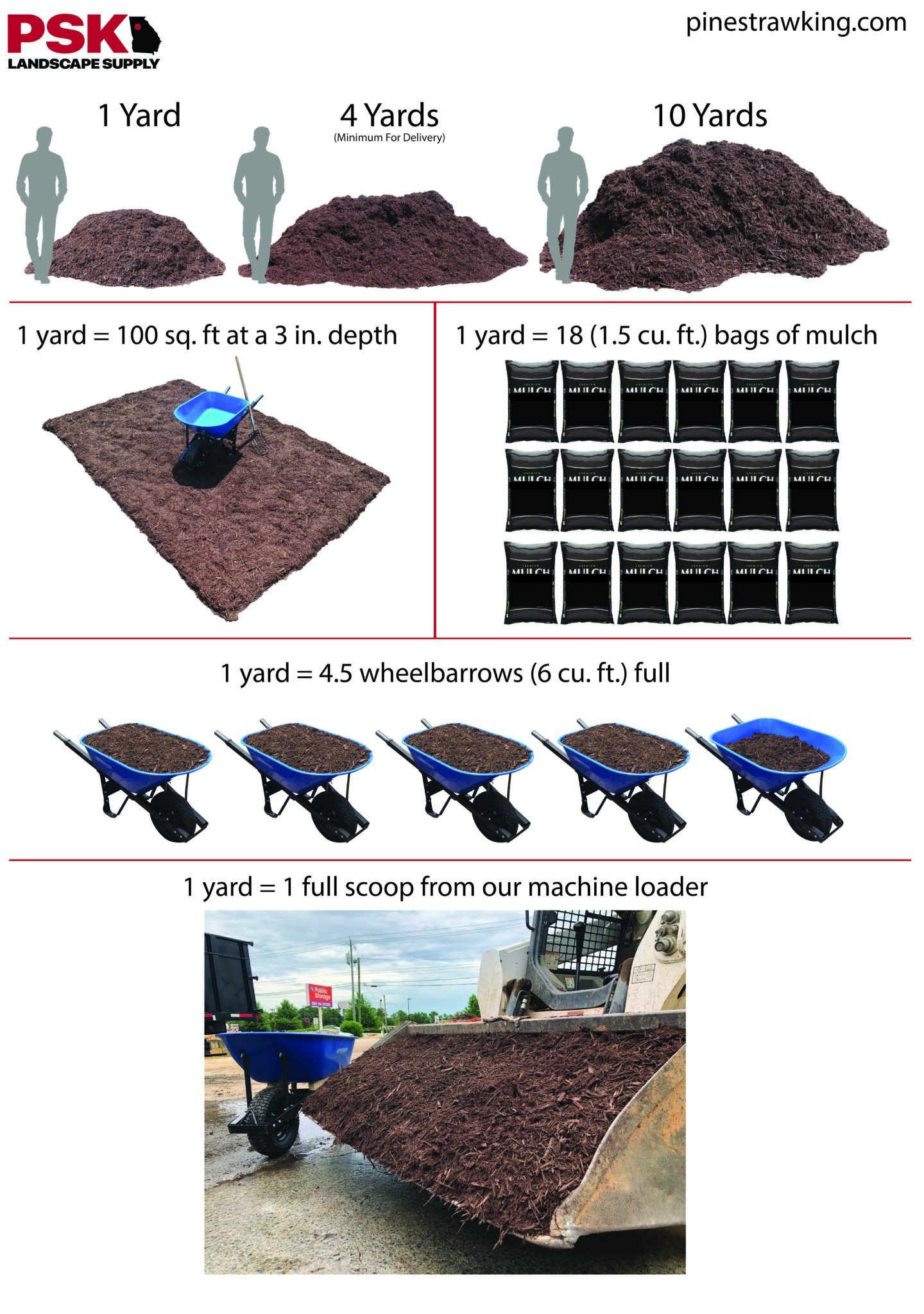
Image Source: pinestrawking.com
Calculating Your Mulch Needs: A Comprehensive Approach
Choosing the right amount of mulch for your garden beds is crucial for both the health of your plants and the aesthetic appeal of your landscape. Too little mulch can leave your soil exposed to harsh elements, while too much can suffocate plant roots. This guide will walk you through the process of calculating mulch needs, ensuring you achieve optimal landscape mulch coverage. We’ll delve into the factors that influence how much area a yard of mulch covers, explore various tools like a mulch coverage calculator and mulch volume calculator, and discuss the importance of mulch depth coverage and spread rate.
The Fundamentals of Mulch Coverage
At its core, understanding mulch coverage involves grasping a few key concepts. The primary unit of measurement for bulk mulch is the cubic yard. A cubic yard coverage refers to the volume of mulch within a 3-foot by 3-foot by 3-foot cube. When you purchase mulch by the yard, this is the volume you are receiving.
The key to determining how much area this volume will cover lies in the desired depth. The most commonly recommended depth for mulch is 3 to 4 inches. This depth provides effective weed suppression, moisture retention, and temperature regulation for plant roots.
Standard Coverage Metrics
- One Cubic Yard of Mulch: Typically covers 100 square feet at a depth of 3 inches.
- One Cubic Yard of Mulch: Typically covers 81 square feet at a depth of 4 inches.
It’s important to note that these are general guidelines. The actual cubic yard coverage can vary slightly depending on the type of mulch and how densely it is packed. Some mulches, like finer wood chips, might spread a bit further than coarser barks.
Converting Bagged Mulch to Bulk: Understanding the Math
Many homeowners opt for bagged mulch for smaller projects. While convenient, it’s essential to know how bagged mulch relates to bulk purchases. Mulch is typically sold in bags that contain 2 or 3 cubic feet of material.
Bagged Mulch Equivalents
- 1 Cubic Yard = 27 Cubic Feet
This means:
- A 2 cubic foot bag covers approximately 0.74 square feet at 3 inches deep (2 / 27).
- A 3 cubic foot bag covers approximately 1.11 square feet at 3 inches deep (3 / 27).
To calculate how many bags you need, divide your total square footage by the coverage per bag. For example, if you have a 200 sq ft area to cover at 3 inches deep, and you’re using 2 cubic foot bags:
- Total square feet to cover: 200 sq ft
- Coverage per 2 cubic foot bag at 3 inches deep: ~0.74 sq ft
- Number of bags needed: 200 / 0.74 ≈ 270 bags.
This demonstrates why buying in bulk, when applicable, can be more cost-effective for larger areas. Your mulch bag coverage is significantly less than bulk, so how much mulch to buy depends heavily on the scale of your project.
Tools to Simplify Your Calculations
Manually calculating mulch square footage can be tedious. Fortunately, several online tools can help.
Mulch Coverage Calculator
A mulch coverage calculator is an invaluable resource. These online tools typically ask for:
- The dimensions of the area you want to mulch (length and width).
- The desired depth of mulch.
The calculator then instantly provides the total volume of mulch needed, often in both cubic yards and bags. These calculators streamline the process of calculating mulch needs.
Mulch Volume Calculator
Similarly, a mulch volume calculator focuses on determining the volume required. You input your measurements, and it outputs the necessary volume, helping you translate your garden’s dimensions into a tangible amount of mulch.
The Importance of Mulch Depth Coverage
The mulch depth coverage is arguably the most critical factor in determining how much mulch you need. While 3 inches is a good general recommendation, some situations might call for slightly more or less.
- Weed Control: A deeper layer (3-4 inches) is more effective at blocking sunlight, preventing weed seeds from germinating.
- Moisture Retention: Adequate depth helps keep the soil moist by reducing evaporation, especially during hot weather.
- Temperature Regulation: Mulch acts as an insulator, keeping soil cooler in summer and warmer in winter, protecting plant roots from extreme temperatures.
- Erosion Control: A consistent depth helps prevent soil from washing away during heavy rains.
Recommended Mulch Depths for Different Situations:
- General Landscaping Beds: 3 inches
- Areas with Aggressive Weeds: 4 inches
- Around Established Trees: 2-3 inches (keeping mulch away from the trunk to prevent rot)
- Vegetable Gardens: 2-3 inches (adjust based on plant needs)
When you use a mulch coverage calculator, always ensure you input the desired depth accurately. Incorrect depth input will lead to miscalculations, impacting your mulch square footage calculation.
Understanding Spread Rate
The spread rate refers to how far a given volume of mulch will extend at a specific depth. While 1 cubic yard covering 100 sq ft at 3 inches is a standard, this can be influenced by the mulch’s composition.
- Finer Mulches: Might spread slightly further due to less void space.
- Coarser Mulches: May require a bit more volume to achieve the same depth over the same area.
When calculating, it’s always wise to account for a small buffer, perhaps an extra 5-10%, to account for settling and uneven application. This ensures you have enough to achieve the desired mulch depth coverage across your entire project.
Step-by-Step: How to Calculate Mulch Needs
Let’s break down the process of calculating mulch needs with a practical example.
Scenario: You have a garden bed that is 20 feet long and 5 feet wide. You want to apply mulch at a depth of 3 inches.
Step 1: Calculate the Area in Square Feet
Area = Length × Width
Area = 20 feet × 5 feet
Area = 100 square feet
Step 2: Determine the Required Volume
We know that 1 cubic yard covers 100 square feet at a 3-inch depth.
Since your area is 100 square feet, you will need 1 cubic yard of mulch.
Step 3: Convert Depth to Feet
Mulch depth is usually measured in inches. To use it in volume calculations, you need to convert it to feet:
Depth in Feet = Depth in Inches / 12
Depth in Feet = 3 inches / 12
Depth in Feet = 0.25 feet
Step 4: Calculate the Volume in Cubic Feet
Volume = Area × Depth (in feet)
Volume = 100 sq ft × 0.25 ft
Volume = 25 cubic feet
Step 5: Convert Cubic Feet to Cubic Yards
Since 1 cubic yard = 27 cubic feet:
Volume in Cubic Yards = Volume in Cubic Feet / 27
Volume in Cubic Yards = 25 cubic feet / 27
Volume in Cubic Yards ≈ 0.93 cubic yards
In this case, you would round up to 1 cubic yard to ensure adequate landscape mulch coverage.
Practical Considerations for Different Shapes
Not all garden beds are simple rectangles. For irregularly shaped areas, it’s best to break them down into simpler geometric shapes (rectangles, squares, circles, triangles) and sum their areas.
-
Circular Beds:
- Area = π × radius²
- Where π (pi) is approximately 3.14, and the radius is half the diameter.
-
Triangular Beds:
- Area = 0.5 × base × height
Using a Mulch Volume Calculator for Complex Shapes
For very intricate or multiple irregularly shaped areas, a mulch volume calculator or mulch coverage calculator becomes even more essential. These tools can often handle more complex inputs or allow you to input multiple measurements for a total calculation.
Factors Influencing Coverage Beyond Depth
While depth is primary, other factors affect how much mulch to buy and its actual coverage:
Type of Mulch
- Wood Chips/Bark: Generally provide good coverage. Coarser bark might require slightly more to achieve the same depth as finer chips.
- Shredded Bark: Tends to pack down well and offers excellent coverage.
- Compost: Can be denser and may cover less area by volume than wood-based mulches.
- Rubber Mulch: Has a consistent particle size and offers predictable cubic yard coverage.
Compaction and Settling
As mulch is applied, and especially after rain, it will settle and compact. This means the initial fluffy volume will decrease. This is another reason why adding a small percentage to your calculated amount is a good practice. The spread rate can change as mulch settles.
Existing Mulch Layer
If you are refreshing an existing mulch bed, you only need to add enough to bring it back to the desired depth, rather than starting from scratch. Measure the existing depth and subtract it from your target depth.
When to Consider Different Mulch Depths
- Establishing New Plantings: A slightly deeper layer (4 inches) can be beneficial initially for weed suppression and moisture retention as plants establish their root systems.
- Mature Plantings: 2-3 inches is often sufficient for established plants, and too much mulch can be detrimental.
Mulch Depth Coverage Table
| Desired Depth (Inches) | Coverage per Cubic Yard (Sq Ft) |
|---|---|
| 1 | 300 |
| 2 | 150 |
| 3 | 100 |
| 4 | 75 |
This table gives you a quick reference for mulch coverage based on depth.
Buying Mulch: Bulk vs. Bags
The decision to buy mulch in bulk (by the cubic yard) or in bags depends on the size of your project.
Bulk Mulch
- Pros: More cost-effective for larger areas, delivered directly to your home, less plastic waste.
- Cons: Requires a space to store it if you don’t use it all at once, may need to estimate more precisely as you can’t easily return excess.
When buying in bulk, you are primarily concerned with cubic yard coverage. Ensure you know the approximate spread rate for the type of mulch you choose.
Bagged Mulch
- Pros: Convenient for small projects, easy to transport and store, can be more precise for very small areas.
- Cons: Less economical for large areas, can be more expensive per cubic yard, generates more plastic waste.
For bagged mulch, mulch bag coverage is your primary concern. You’ll need to do the math to figure out how many bags cover your area.
Common Mistakes to Avoid
- Mulching Too Close to Trunks/Stems: This can lead to rot, disease, and pest problems. Maintain a small gap.
- Mulching Too Thinly: Ineffective weed suppression and poor moisture retention.
- Mulching Too Deeply: Can suffocate plant roots and create a barrier that water can’t penetrate.
- Forgetting to Measure: Guessing can lead to over or under-buying.
Frequently Asked Questions (FAQ)
Q1: What is the average coverage of a yard of mulch?
A yard of mulch typically covers 100 square feet at a depth of 3 inches, or about 75-81 square feet at a depth of 4 inches.
Q2: How do I calculate mulch coverage for an irregular shape?
Break the irregular shape into smaller, regular shapes (rectangles, circles). Calculate the area of each shape and add them together. Then, use the total area and your desired depth to calculate the mulch volume. Online calculators can also assist with this.
Q3: How many cubic feet are in a yard of mulch?
There are 27 cubic feet in one cubic yard.
Q4: Can I reuse leftover bulk mulch?
Yes, you can reuse leftover bulk mulch. Store it in a covered area or tarp it to keep it dry and prevent it from blowing away. It will compact over time, but it’s still usable for future projects.
Q5: How much mulch do I need for a pathway?
For pathways, a depth of 2-3 inches is usually sufficient. Calculate the length and width of the pathway and then determine the volume needed based on your desired depth, using the same principles outlined in this guide.
Q6: What is the difference between bulk mulch and bagged mulch coverage?
Bulk mulch is sold by the cubic yard, offering a larger volume and generally better cubic yard coverage per dollar for larger areas. Bagged mulch is sold in smaller volumes (typically 2 or 3 cubic feet per bag), and you’ll need to calculate mulch bag coverage to determine how many bags are needed.
By following these guidelines and utilizing the provided tools, you can confidently calculate your mulch needs, ensuring your landscape projects are both beautiful and successful. Proper mulch depth coverage is key to healthy plants and a well-maintained garden.