
So, how much does a cubic yard of mulch cover? A single cubic yard of mulch, when applied at a common depth of 3 inches, will cover approximately 108 square feet. This guide will help you precisely calculate your needs and ensure you have enough mulch for your gardening projects.
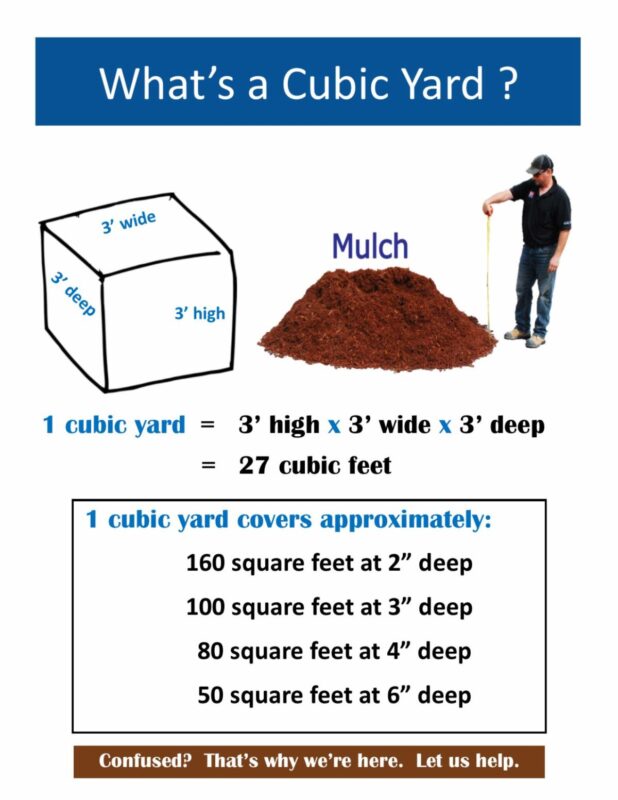
Image Source: stonegarden-nc.com
Deciphering Mulch Coverage: The Cubic Yard Conundrum
Gardeners often wonder about the coverage of mulch. Buying mulch in bulk, typically by the cubic yard, is economical and efficient for larger landscaping projects. However, the question of mulch coverage per cubic yard is central to successful garden planning. This guide aims to provide a comprehensive answer, helping you avoid under or over-buying. We’ll delve into the factors influencing coverage and offer practical tools for calculating mulch needed.
The Science Behind Mulch Coverage: Volume to Area Conversion
At its core, determining mulch coverage is a volume to area mulch calculation. A cubic yard is a unit of volume, while garden beds and landscaping areas are measured in square feet (area). To bridge this gap, we need to consider the depth at which you’ll apply the mulch.
Standard Mulch Depths for Optimal Results
The ideal mulch depth and coverage depend on the type of mulch and its intended purpose.
- General Landscaping & Weed Suppression: A depth of 2-3 inches is typically recommended. This depth is sufficient to suppress weeds, retain soil moisture, and regulate soil temperature.
- Erosion Control: For slopes or areas prone to erosion, a thicker layer of 3-4 inches might be necessary.
- Around Established Trees: A 2-3 inch layer is usually best, keeping mulch a few inches away from the trunk to prevent rot.
- Around New Plantings: A 2-inch layer is often sufficient.
Table 1: Mulch Coverage Based on Depth (Per Cubic Yard)
| Mulch Depth (Inches) | Area Covered (Square Feet) |
|---|---|
| 1 | 324 |
| 2 | 162 |
| 3 | 108 |
| 4 | 81 |
| 5 | 64.8 |
| 6 | 54 |
Key Takeaway: The deeper you spread the mulch, the less area a cubic yard will cover.
Factors Influencing Mulch Coverage
While the depth is the primary determinant, other elements can subtly affect mulch coverage estimate.
Mulch Type and Compaction
Different types of mulch have varying densities and particle sizes.
- Wood Chips and Bark Mulches: These tend to be bulkier and may spread slightly more easily initially. However, they can compact over time, especially finer grades.
- Shredded Mulches (e.g., Pine Bark, Hardwood Mulch): These can compact more readily, potentially reducing the actual spread area compared to larger chips if not applied carefully.
- Organic Mulches (e.g., Straw, Compost): Straw can be very light and spread widely, but it decomposes quickly and may require more frequent application. Compost can vary greatly in density.
How to account for this: When purchasing, consider the “fluffiness” of the mulch. If it looks very airy, you might get slightly more coverage than anticipated. If it’s already heavily compacted in the bag or pile, the coverage might be closer to the lower end of estimates.
Site Preparation and Application Technique
The way you prepare your garden beds and how to spread mulch per yard directly impacts coverage.
- Existing Mulch: If you are topping up an existing mulch layer, you’ll need less new mulch.
- Weed Removal: Thoroughly removing weeds before applying mulch ensures the mulch is spread effectively on the soil surface, not just on top of weeds.
- Even Spreading: Aim for a consistent depth. Uneven spreading means some areas will be too thin (ineffective) and others too thick (wasteful).
Your Go-To Tool: The Cubic Yard Mulch Coverage Calculator
To simplify calculating mulch needed, online tools, often referred to as a cubic yard mulch coverage calculator, are invaluable. These calculators typically ask for:
- Area to be Covered: This is usually measured in square feet.
- Desired Mulch Depth: You’ll input this in inches.
The calculator then performs the volume to area mulch calculation for you, telling you precisely how many cubic yards of mulch you need.
Manual Calculation: Fathoming the Numbers
If you prefer to do the math yourself, here’s the breakdown for how many square feet a yard of mulch covers:
- A cubic yard is 3 feet x 3 feet x 3 feet = 27 cubic feet.
- We want to convert cubic feet to square feet by dividing by the desired depth in feet.
- Desired Depth in Feet = Desired Depth in Inches / 12
Formula:
Coverage (Square Feet) = 27 cubic feet / (Desired Depth in Feet)
Let’s use our standard 3-inch depth as an example:
- Desired Depth in Feet = 3 inches / 12 inches/foot = 0.25 feet
- Coverage = 27 cubic feet / 0.25 feet = 108 square feet
This confirms that one cubic yard of mulch, applied at 3 inches deep, covers approximately 108 square feet.
Estimating Mulch for Garden Beds: A Practical Approach
When estimating mulch for garden beds, measure the length and width of each bed.
Steps for Estimating:
- Measure Your Beds:
- For rectangular beds: Length (ft) x Width (ft) = Area (sq ft)
- For irregular shapes: Break them down into simpler shapes (rectangles, triangles, circles) or use a measuring wheel for larger, more complex areas.
- Calculate Total Area: Add up the areas of all your garden beds.
- Determine Desired Depth: Decide on your preferred mulch depth (e.g., 3 inches).
- Use the Calculator or Formula: Input your total area and desired depth into an online calculator or use the manual formula.
Example Scenario:
Let’s say you have two garden beds:
- Bed 1: 10 feet long x 4 feet wide = 40 sq ft
- Bed 2: 15 feet long x 3 feet wide = 45 sq ft
- Total Area: 40 sq ft + 45 sq ft = 85 sq ft
You want to apply mulch at a 3-inch depth.
- Using our table or formula, 1 cubic yard covers 108 sq ft at 3 inches.
- Since your total area is 85 sq ft, which is less than 108 sq ft, you will need less than one cubic yard of mulch.
What if you need more than one cubic yard?
Suppose your total area is 200 sq ft, and you want a 3-inch depth.
- Calculation: 200 sq ft / 108 sq ft per cubic yard = 1.85 cubic yards.
- Rounding Up: You would need to purchase 2 cubic yards to ensure you have enough. It’s always better to have a little extra than not enough.
Optimizing Mulch Application Rate
The mulch application rate is essentially the depth at which you spread it. Choosing the right rate balances effectiveness with material usage.
- Too thin: Weeds will germinate, and moisture will escape quickly.
- Too thick: Can suffocate plants, prevent water penetration, and harbor pests.
Stick to the recommended 2-3 inches for most applications. This sweet spot provides the benefits of mulching without the drawbacks of over-application.
Spreading Mulch Effectively: Tips for Gardeners
Knowing how to spread mulch per yard efficiently is crucial for achieving even coverage and maximizing your purchase.
Step-by-Step Mulching Process:
- Prepare the Area: Remove weeds, debris, and excess grass. Loosen any compacted soil.
- Mark Your Edges: Use a spade or hose to define the boundaries of your mulched area.
- Deliver the Mulch: If buying bagged mulch, bring it close to your work area. For bulk mulch delivered by truck, use a wheelbarrow to transport it.
- Initial Placement: Spread the mulch in piles across the area, rather than dumping it all in one spot. This makes spreading easier.
- Rake and Spread: Using a garden rake or shovel, spread the mulch evenly, working from the piles outwards.
- Measure Depth: Periodically check the depth with a ruler or tape measure to ensure consistency.
- Maintain Proper Clearance: Keep mulch a few inches away from the base of tree trunks and plant stems to prevent rot and disease.
What to Do with Extra Mulch?
If you’ve accurately calculated your needs and ended up with a bit extra, it’s not a problem!
- Top Up Later: Mulch will settle and decompose over time. You can use the extra to top up beds in the spring or fall.
- New Projects: Have a small planting area or a bare patch in the lawn? Use your surplus mulch there.
- Compost Pile: If it’s organic mulch, it can eventually be added to your compost bin.
Common Mulch Coverage Scenarios
Let’s look at a few more examples to solidify your mulch coverage estimate.
Scenario 1: A Small Flower Bed
- Dimensions: 8 feet long x 3 feet wide
- Area: 8 x 3 = 24 sq ft
-
Desired Depth: 3 inches
-
Calculation: 24 sq ft / 108 sq ft per cubic yard = 0.22 cubic yards.
- Recommendation: You’ll need to buy a small bag or consider a “half-yard” if available. Most suppliers sell in full cubic yard increments, so you’d likely purchase 1 cubic yard and have plenty left over.
Scenario 2: A Larger Garden Perimeter
- Dimensions: 50 feet long x 2 feet wide (around a house or fence)
- Area: 50 x 2 = 100 sq ft
-
Desired Depth: 2 inches
-
Coverage at 2 inches: 1 cubic yard covers 162 sq ft.
- Calculation: 100 sq ft / 162 sq ft per cubic yard = 0.62 cubic yards.
- Recommendation: Again, you’ll likely need to purchase 1 cubic yard.
Scenario 3: A Tree Ring
- Tree Trunk Diameter: 1 foot
- Desired Mulch Ring Diameter: 3 feet (extending 1 foot out from the trunk)
- Area of a circle: π * r² (where r is the radius)
- Radius of mulch ring: 3 feet / 2 = 1.5 feet
- Area: 3.14 * (1.5 ft)² = 3.14 * 2.25 sq ft = 7.065 sq ft
-
Desired Depth: 3 inches
-
Calculation: 7.065 sq ft / 108 sq ft per cubic yard = 0.065 cubic yards.
- Recommendation: For small areas like tree rings, buying a full cubic yard is usually impractical. You’d typically use leftover mulch from larger projects or buy a smaller bag specifically for this.
Frequently Asked Questions (FAQ)
Q1: How many square feet does a cubic yard of mulch cover at 2 inches?
A1: A cubic yard of mulch covers approximately 162 square feet when applied at a 2-inch depth.
Q2: Can I calculate mulch needs if my area is not a simple rectangle?
A2: Yes, you can break down irregular shapes into smaller, measurable geometric shapes (rectangles, circles, triangles) and sum their areas. For very complex areas, a measuring wheel can be helpful.
Q3: Who is most likely to benefit from a cubic yard mulch coverage calculator?
A3: Anyone undertaking a landscaping project involving mulch, from small garden bed renovations to large-scale yard makeovers, will benefit from using a calculator to accurately estimate their mulch needs.
Q4: What is the average mulch coverage per cubic yard?
A4: The average mulch coverage per cubic yard is generally cited around 108 square feet when applied at a standard 3-inch depth. However, this can vary based on the desired depth.
Q5: How does mulch depth and coverage interact?
A5: Mulch depth and coverage have an inverse relationship. The deeper you spread the mulch, the smaller the area a given volume (like a cubic yard) will cover.
Q6: What is the best way to spread mulch per yard?
A6: The best way to spread mulch per yard is to distribute it evenly across the prepared area, using a rake or shovel, and regularly checking the depth with a measuring tool to ensure consistency. Keep mulch a few inches away from plant stems and tree trunks.
Q7: How do I start estimating mulch for garden beds?
A7: To start estimating mulch for garden beds, measure the length and width of each bed to calculate its square footage. Sum the square footage of all beds to get your total area. Then, determine your desired mulch depth and use a mulch calculator or formula to find the total cubic yards needed.