
A yard of wet concrete typically weighs between 3,800 and 4,200 pounds. This weight can vary based on the mix design, aggregate type, and water content.
Figuring out how much concrete weighs is crucial for many projects. Whether you’re a contractor planning a foundation, a homeowner thinking about a patio, or just curious about building materials, knowing the weight of concrete is important. This article will dive deep into the question: “How much does a yard of wet concrete weigh?” We’ll explore the factors that influence this weight, discuss concrete density, and provide you with the information you need to accurately estimate wet concrete weight.
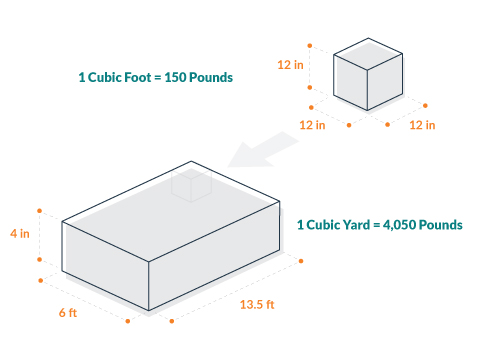
Image Source: www.dumpsters.com
Fathoming Concrete’s Weight: Key Factors
The weight of concrete isn’t a single, fixed number. Several elements come into play, influencing the final bulk density concrete. Let’s break down these essential factors:
Aggregate’s Role
Aggregates are the bulk of concrete, making up about 60-80% of its volume. These are typically sand (fine aggregate) and gravel or crushed stone (coarse aggregate).
- Density of Aggregate: Different types of rock have different densities.
- Limestone and granite: These are common and relatively dense.
- Lighter aggregates: Some lightweight aggregates, like expanded shale or clay, are much less dense and can significantly reduce the overall weight of the concrete. However, for standard concrete, we usually see denser aggregates.
- Size and Shape of Aggregate: While less impactful than density, the size and shape can influence how tightly the aggregates pack together, which can slightly affect the overall density. Well-graded aggregates (a mix of different sizes) tend to create denser concrete.
Cement Content
Cement is the binder that holds everything together. While it’s a smaller proportion of the mix by volume, its weight contributes to the overall mass. The type of cement and the amount used in the mix will have a minor effect on the final weight.
Water-Cement Ratio
The amount of water in the mix is vital.
- More Water: Adding more water makes the concrete easier to work with (more fluid) but can make it weaker and slightly less dense once cured.
- Less Water: A lower water-cement ratio results in stronger, denser concrete. However, too little water can make the concrete difficult to mix and place properly.
Air Entrapment
Air bubbles can be intentionally introduced into concrete (air-entrained concrete) to improve its resistance to freeze-thaw cycles. These air voids, even though small, reduce the overall density of the concrete. Standard concrete mixes usually contain a small amount of entrapped air naturally.
Deciphering Concrete Density
Concrete density is a measure of how much mass is contained within a given volume. It’s typically expressed in pounds per cubic foot (pcf) or kilograms per cubic meter (kg/m³).
- Standard Concrete: For typical structural concrete, the density often falls in the range of 140 to 150 pcf.
- Lightweight Concrete: This can be as low as 90 pcf or even less.
- Heavyweight Concrete: Used for radiation shielding, this can weigh 200 pcf or more.
When we talk about wet concrete weight, we are referring to the concrete in its freshly mixed state, before it has hardened. The density of wet concrete is very similar to its hardened density, as the aggregates and cement paste make up the vast majority of the mass, and the small amount of water doesn’t drastically change the density compared to the solid components.
The Cubic Yard Calculation
A cubic yard concrete weight calculation involves converting the density from a per-cubic-foot measurement to a per-cubic-yard measurement.
- There are 3 feet in a yard.
- Therefore, there are 3 x 3 x 3 = 27 cubic feet in 1 cubic yard.
To find the weight of a cubic yard, you multiply the density per cubic foot by 27.
- If standard concrete has a density of 145 pcf:
145 pcf * 27 cubic feet/cubic yard = 3,915 pounds per cubic yard.
This calculation is the basis for estimating concrete weight.
How Much Does A Yard Of Wet Concrete Weigh? A Closer Look
So, to answer the question directly: How much does a yard of wet concrete weigh?
A standard cubic yard of wet concrete weighs approximately 3,800 to 4,200 pounds.
This range accounts for the variations in mix design, aggregate types, and water content that we discussed earlier. For most common construction purposes, using a figure around 4,000 pounds per cubic yard is a good general estimate.
Let’s look at some typical scenarios:
Table: Typical Wet Concrete Weights per Cubic Yard
| Concrete Type | Typical Density (pcf) | Approximate Weight per Cubic Yard (lbs) | Notes |
|---|---|---|---|
| Standard Concrete | 140 – 150 | 3,780 – 4,050 | Common for foundations, slabs, driveways. |
| High-Strength Concrete | 150 – 160 | 4,050 – 4,320 | Uses denser aggregates and lower water-cement ratio. |
| Lightweight Concrete | 90 – 115 | 2,430 – 3,105 | Uses expanded shale, clay, or pumice as aggregate. |
| Reinforced Concrete | 150 – 160 | 4,050 – 4,320 | Steel rebar adds some weight, but the concrete itself is denser. |
| Self-Consolidating Concrete | 145 – 155 | 3,915 – 4,185 | Often has a higher cement content and superplasticizers. |
Note: These are approximations. Actual weights can vary.
Weight of Fresh Concrete: Why It Matters
Knowing the weight of fresh concrete is not just a trivia fact; it has practical implications:
- Transportation Costs: Concrete is heavy! Understanding the weight per yard helps in calculating how much concrete your truck can carry and the associated fuel costs. A standard concrete mixer truck typically holds around 9-11 cubic yards.
- Structural Load Calculations: For engineered structures, knowing the exact weight of the concrete used is crucial for structural engineers to calculate the loads on foundations, walls, and beams.
- Ordering Accuracy: Ordering the correct amount of concrete is vital. While knowing the weight isn’t directly about volume ordering, understanding the density helps confirm that the mix you’ve ordered will perform as expected. Most suppliers sell concrete by the cubic yard.
- Equipment Capacity: When mixing concrete on-site or handling pre-cast elements, knowing the weight helps ensure your equipment (like loaders, forklifts, or cranes) can safely handle the load.
- Budgeting: Material costs often factor in weight, especially for bulk purchases of aggregates or when considering shipping.
Calculating Your Concrete Needs: The Role of a Concrete Weight Calculator
While we’ve provided general figures, sometimes you need a more precise answer for your specific project. This is where a concrete weight calculator can be helpful, though they typically focus on volume. However, understanding the principles behind them is key.
If you need to estimate the weight for a specific mix, you would ideally know its density. Many concrete suppliers can provide the approximate density for their standard mixes.
Let’s say you’re ordering concrete for a simple backyard patio. You might calculate the volume needed:
- Patio Dimensions: 10 feet long x 10 feet wide x 4 inches thick (0.333 feet)
- Volume in Cubic Feet: 10 ft * 10 ft * 0.333 ft = 33.3 cubic feet
- Volume in Cubic Yards: 33.3 cubic feet / 27 cubic feet/cubic yard = 1.23 cubic yards
Now, using our average weight of 4,000 lbs/cubic yard:
- Estimated Weight: 1.23 cubic yards * 4,000 lbs/cubic yard = 4,920 pounds
This gives you a rough idea of the total weight of the concrete for your patio.
Estimating Concrete Weight for Projects
When estimating concrete weight, always err on the side of caution. It’s better to slightly overestimate than to run out of concrete during a pour.
Consider these points for better estimation:
- Mix Design: Does your project require a special mix? High-strength or lightweight mixes will have different densities.
- Reinforcement: If you’re using a significant amount of steel rebar or mesh, this adds to the overall weight of the finished product, but not the weight of the fresh concrete itself.
- Subgrade: The ground beneath your concrete pour can affect how much concrete you actually need due to settling or irregularities.
The Nuances of “Wet” vs. “Dry” Concrete
It’s important to distinguish between the weight of “wet” concrete and “dry” concrete.
- Wet Concrete: This is the freshly mixed material. Its weight is dominated by the solid components (cement, aggregates) and the water. The density is high.
- Dry Concrete (or Cured Concrete): Once the concrete hardens and some of the water evaporates over time, its weight per cubic yard can slightly decrease, though the change is usually minimal for structural calculations. The primary difference in weight comes from the initial mix design.
The term “wet concrete weight” usually refers to the weight of the concrete as it is mixed and poured.
Frequently Asked Questions (FAQ)
Q1: What affects the weight of a cubic yard of concrete?
A1: The main factors influencing the weight of a cubic yard of concrete are the type and density of the aggregates used (sand and gravel), the amount of cement, and the water content in the mix. Different mix designs will yield different densities and therefore different weights.
Q2: Is there a difference between the weight of wet and hardened concrete?
A2: Yes, there is a slight difference. Wet concrete contains all its mixing water. As concrete cures and dries out over time, some of the water evaporates, leading to a small reduction in weight. However, for most practical purposes and calculations, the weight of wet concrete is used.
Q3: Can I use a concrete weight calculator to figure out how much concrete to order?
A3: You can use volume calculations to determine how much concrete to order. Most concrete suppliers sell by the cubic yard. While a “concrete weight calculator” might exist, it’s more common to use volume calculators to determine the amount of concrete needed. Knowing the weight per yard helps you estimate the total mass once you have the volume.
Q4: What is the typical density of concrete?
A4: The typical density of standard concrete is around 140 to 150 pounds per cubic foot (pcf). This translates to approximately 3,780 to 4,050 pounds per cubic yard.
Q5: If I use lightweight aggregates, how much does a yard of concrete weigh?
A5: If you use lightweight aggregates, the weight of a cubic yard of concrete can be significantly lower, typically ranging from 2,430 to 3,105 pounds per cubic yard, depending on the specific lightweight aggregate used and the mix design.
Q6: How much does a cubic yard of concrete weigh if it has rebar?
A6: The rebar (steel reinforcement) itself has weight, but it’s typically accounted for separately in structural design. The weight of the concrete itself remains within the standard range. If you are calculating the total weight of a reinforced concrete element, you would add the weight of the steel to the weight of the concrete. However, when asking “how much does a yard of wet concrete weigh,” we refer to the concrete material only.
Q7: Why is it important to know how much concrete weighs?
A7: Knowing the weight of concrete is important for transportation planning and costs, structural load calculations by engineers, equipment capacity, and budgeting for construction projects. It helps ensure safety and accuracy in planning and execution.
By now, you should have a solid grasp on the weight of concrete. Remember, while 4,000 pounds per cubic yard is a good general figure, the exact weight depends on the specific mix. Always consult with your concrete supplier for precise specifications if your project requires exact weight calculations.