
Figuring out how many sacks of cement in a yard is a common question for anyone planning a concrete project. Generally, you can expect to need approximately five to six 94 lb sacks of cement for one cubic yard of concrete, though this number can vary based on the specific mix ratio. This guide will help you navigate the calculations, understand the factors involved, and ensure you have the right amount of cement for your needs.
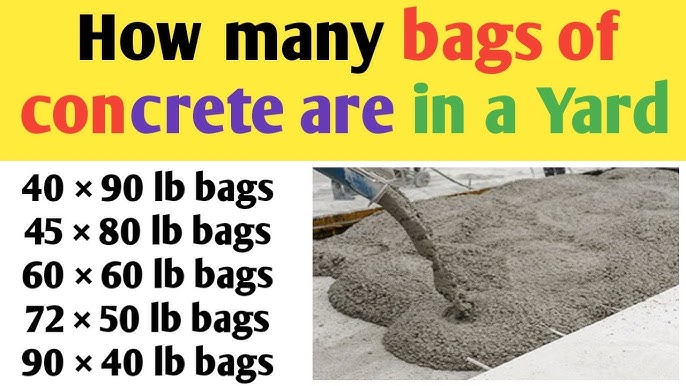
Image Source: i.ytimg.com
Deciphering Concrete Volume: From Yards to Bags
When you’re mixing concrete, the fundamental unit of measurement you’ll encounter is the cubic yard. A cubic yard represents a volume of space that is three feet long, three feet wide, and three feet high (3′ x 3′ x 3′). This is a substantial amount, and it’s crucial to know how many bags of cement are required to create it.
The Role of Cement in Concrete
Cement is the binder in concrete. It reacts with water and aggregate (sand and gravel) to form a hard, durable material. The amount of cement used directly impacts the strength and workability of the concrete. More cement generally means stronger concrete, but it also increases cost and can affect how easily the concrete can be mixed and placed.
Common Concrete Mix Ratios
Concrete is typically mixed using proportions of cement, sand, and gravel. These ratios are often expressed as cement:sand:gravel. Common mixes include:
- 1:2:3: A general-purpose mix, good for sidewalks, patios, and most common applications.
- 1:2:4: A slightly leaner mix, suitable for non-structural elements or when a less strong concrete is acceptable.
- 1:1.5:2.5: A richer mix, used for high-strength applications like structural columns or beams.
The higher the proportion of cement in the mix, the more bags of cement you’ll need per cubic yard.
Calculating Cement Needs: A Practical Approach
The question of how many 94 lb bags in a yard or how many 80 lb bags in a yard often comes down to the desired strength and purpose of your concrete. The standard American cement bag is typically 94 pounds. However, in some regions or for specific products, you might encounter 80-pound bags or even 60-pound bags. It’s always best to check the weight of the bags you are purchasing.
Estimating Cement Bags for a Cubic Yard
To estimate cement bags in concrete mix, we can use common mix ratios and the volume of a standard cement bag.
Key Information:
- Volume of a standard 94 lb cement bag: Approximately 1 cubic foot.
- Volume of a standard 80 lb cement bag: Approximately 0.75 cubic feet.
- A cubic yard is equal to 27 cubic feet.
Let’s look at how these numbers play out for a typical 1:2:3 mix.
Fathoming Bags for a 1:2:3 Mix (94 lb Bags)
For a 1:2:3 mix (one part cement, two parts sand, three parts gravel), the total parts are 1 + 2 + 3 = 6 parts.
- Cement’s proportion: 1/6 of the total mix.
- Volume of concrete needed: 1 cubic yard = 27 cubic feet.
- Volume of cement required: (1/6) * 27 cubic feet = 4.5 cubic feet.
Since a 94 lb bag of cement is roughly 1 cubic foot, you would need approximately 4.5 bags of cement. However, in practice, to account for waste, compaction, and slight variations, it’s common to round up. Therefore, for a 1:2:3 mix, you’ll likely need about 5 to 6 bags of 94 lb cement per cubic yard.
Comprehending Bags for a 1:2:3 Mix (80 lb Bags)
If you are using 80 lb bags, which are about 0.75 cubic feet:
- Volume of cement required: 4.5 cubic feet.
- Number of 80 lb bags: 4.5 cubic feet / 0.75 cubic feet/bag = 6 bags.
So, for a 1:2:3 mix, you’ll need approximately 6 to 7 bags of 80 lb cement per cubic yard.
Interpreting Bags for a 1:2:4 Mix (94 lb Bags)
For a 1:2:4 mix, the total parts are 1 + 2 + 4 = 7 parts.
- Cement’s proportion: 1/7 of the total mix.
- Volume of cement required: (1/7) * 27 cubic feet ≈ 3.86 cubic feet.
This translates to approximately 4 to 5 bags of 94 lb cement per cubic yard.
Interpreting Bags for a 1:2:4 Mix (80 lb Bags)
For a 1:2:4 mix using 80 lb bags:
- Volume of cement required: 3.86 cubic feet.
- Number of 80 lb bags: 3.86 cubic feet / 0.75 cubic feet/bag ≈ 5.15 bags.
So, for a 1:2:4 mix, you’ll need approximately 5 to 6 bags of 80 lb cement per cubic yard.
Examining Bags for a 1:1.5:2.5 Mix (94 lb Bags)
For a 1:1.5:2.5 mix, the total parts are 1 + 1.5 + 2.5 = 5 parts.
- Cement’s proportion: 1/5 of the total mix.
- Volume of cement required: (1/5) * 27 cubic feet = 5.4 cubic feet.
This translates to approximately 5 to 6 bags of 94 lb cement per cubic yard.
Examining Bags for a 1:1.5:2.5 Mix (80 lb Bags)
For a 1:1.5:2.5 mix using 80 lb bags:
- Volume of cement required: 5.4 cubic feet.
- Number of 80 lb bags: 5.4 cubic feet / 0.75 cubic feet/bag = 7.2 bags.
So, for a 1:1.5:2.5 mix, you’ll need approximately 7 to 8 bags of 80 lb cement per cubic yard.
The Cement Volume Calculator Concept
To simplify these calculations, many resources offer a cement volume calculator. These calculators take your project’s volume (in cubic yards) and your desired mix ratio to provide a precise estimate of the materials needed, including cement. While you can do the math yourself, a calculator is a quick way to get a reliable figure.
Factors Affecting Cement Quantity
Several factors can influence the exact number of bags of cement per cubic yard. It’s not always a simple fixed number.
Water-Cement Ratio
The water-cement ratio is critical for concrete strength and durability. A lower water-cement ratio (less water) generally results in stronger concrete. However, too little water can make the concrete difficult to work with. The required cement quantity might be adjusted slightly based on the water needed to achieve the desired consistency and strength.
Aggregate Properties
The size, shape, and type of aggregates (sand and gravel) can affect the volume of cement needed. Well-graded aggregates that pack efficiently can reduce the void space between particles, potentially requiring slightly less cement paste to fill those voids.
Admixtures
Admixtures are chemicals added to concrete to modify its properties, such as workability, setting time, or strength. Some admixtures, like water reducers, can allow for a lower water-cement ratio while maintaining workability, which could indirectly influence the cement quantity required for a specific strength target.
Compaction and Waste
During mixing and placement, some material can be lost due to spillage or incomplete mixing. It’s always prudent to order a small surplus (usually 5-10%) to account for these factors.
Calculating How Much Cement for Concrete: Beyond the Bag Count
When you ask how much cement for concrete, you’re not just asking about bags. You’re asking about the volume and weight of cement needed to create a specific quantity of concrete.
Weight vs. Volume
While we often think in terms of bags, cement is fundamentally measured by weight in the industry. The standard cement bag weight in North America is 94 pounds (approximately 42.6 kg). Understanding this helps in more precise calculations, especially when dealing with different bag sizes or bulk purchases.
Cubic Yard to Bag Cement Conversion
Here’s a summary table to help with cubic yard to bag cement conversion for common mixes, assuming 94 lb bags:
| Mix Ratio (Cement:Sand:Gravel) | Approx. Cement Volume (cu ft) | Approx. 94 lb Bags per Cu. Yd. | Approx. 80 lb Bags per Cu. Yd. |
|---|---|---|---|
| 1:2:3 | 4.5 | 5-6 | 6-7 |
| 1:2:4 | 3.86 | 4-5 | 5-6 |
| 1:1.5:2.5 | 5.4 | 5-6 | 7-8 |
Note: These are approximate figures. Actual quantities may vary based on specific aggregate properties and site conditions.
Using a Cement Bag Calculation Tool
If you’re undertaking a larger project, using a cement bag calculation tool or spreadsheet can be incredibly helpful. You input the dimensions of your concrete pour (length, width, depth) to get the total cubic yards needed. Then, you select your mix ratio, and the calculator tells you the estimated quantity of cement, sand, and gravel, often in both volume and weight. This is a robust way to manage your material procurement.
Practical Steps for Your Project
To ensure you have enough cement for your concrete project:
1. Determine Your Project Needs
- What are you building? (e.g., patio, foundation, wall)
- What strength concrete do you need? Check local building codes or project specifications. A stronger mix requires more cement.
- How much concrete do you need? Calculate the volume in cubic yards. For example, a 10 ft x 10 ft patio that is 4 inches thick (0.33 ft) needs (10 * 10 * 0.33) / 27 = 1.22 cubic yards.
2. Select Your Mix Ratio
Based on your project needs, choose an appropriate mix ratio. A good starting point for most DIY projects is 1:2:3.
3. Use a Reliable Calculator or Formula
Use the provided information or an online cement volume calculator to determine how many sacks of cement in a yard for your specific mix. If your project requires 1.22 cubic yards of concrete and a 1:2:3 mix, and you use 94 lb bags, you’ll need roughly 1.22 * 5.5 bags/cu.yd. = 6.71 bags. It’s best to round this up to 7 bags.
4. Consider Bag Weight
Always confirm the standard cement bag weight you are purchasing. If you are using 80 lb bags instead of 94 lb bags, you will need more of them to achieve the same volume of cement.
5. Account for Waste and Contingencies
Add a buffer of 5-10% to your total cement bag calculation. It’s better to have a little extra than to run out mid-pour.
Frequently Asked Questions (FAQ)
Q: How many 94 lb bags of cement are in one cubic yard of concrete?
A: For a standard 1:2:3 mix, you’ll typically need between 5 and 6 bags of 94 lb cement per cubic yard of concrete. This can vary with different mix ratios.
Q: What is the standard weight of a bag of cement in the US?
A: The standard weight of a bag of cement in the US is 94 pounds.
Q: Can I use 80 lb bags of cement instead of 94 lb bags?
A: Yes, you can use 80 lb bags, but you will need more of them to achieve the same amount of cement. For example, if a mix requires 5 bags of 94 lb cement, you might need around 6-7 bags of 80 lb cement.
Q: How do I calculate how much cement I need for my project?
A: First, calculate the total volume of concrete needed for your project in cubic yards. Then, determine the appropriate mix ratio (e.g., 1:2:3). Use a cement volume calculator or the approximate bag counts per cubic yard for your chosen mix ratio to estimate the total number of bags required, adding a small buffer for waste.
Q: What is the difference between cement and concrete?
A: Cement is a fine powder that acts as the binder in concrete. Concrete is a composite material made from cement, aggregate (sand and gravel), and water.
Q: How many 80 lb bags of cement are in a cubic yard?
A: For a typical 1:2:3 mix, you will need approximately 6 to 7 bags of 80 lb cement per cubic yard of concrete.
Q: What is a good mix ratio for a concrete patio?
A: A common and effective mix ratio for a concrete patio is 1:2:3 (cement:sand:gravel). This provides good strength and workability for this type of application.
By following this guide, you can confidently determine how many sacks of cement in a yard you need for your next concrete project, ensuring a strong and successful outcome.