
A standard garden hose typically delivers between 5 to 12 gallons per minute (GPM). This flow rate, however, can vary significantly based on several factors.
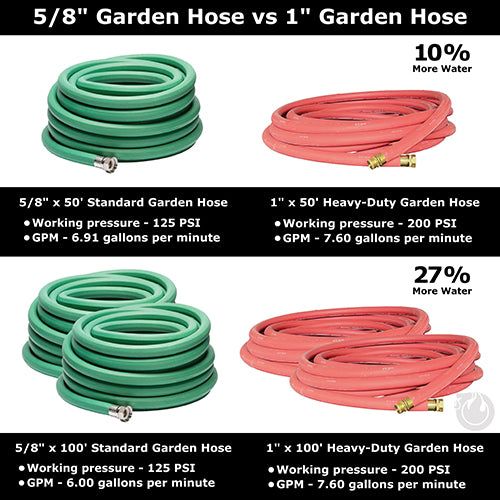
Image Source: firehosedirect.com
Gauging Your Garden Hose’s Water Flow
Many gardeners wonder about the exact amount of water their trusty garden hose delivers. This curiosity isn’t just about idle numbers; it directly impacts how efficiently you can water your plants, clean your car, or fill a kiddie pool. Knowing your garden hose flow rate helps you choose the right attachments, understand your water usage garden hose, and even troubleshoot potential water pressure issues. So, how much water does a garden hose actually move per minute? Let’s dive into the factors that determine your water flow per minute garden hose.
The Faucet’s Role: The Starting Point
The journey of water from your home’s supply to your garden begins at the faucet, or spigot. The faucet GPM garden hose connects to is a critical determinant of the overall flow. Your home’s water pressure, influenced by factors like your municipal water supply, the condition of your pipes, and the elevation of your home, dictates the initial volume of water available.
Testing Your Faucet’s GPM
Before even attaching a hose, you can get a good idea of your water source’s capacity. Here’s a simple way to test your faucet’s GPM:
- Grab a Bucket: Find a bucket with a known volume (e.g., a 5-gallon bucket).
- Turn on the Faucet Fully: Open the faucet completely.
- Time the Fill: Use a stopwatch to time how long it takes to fill the bucket.
- Calculate GPM:
- If it took 30 seconds to fill a 5-gallon bucket, that’s half a minute.
- (5 gallons / 0.5 minutes) = 10 GPM.
- If it took 20 seconds to fill a 5-gallon bucket, that’s one-third of a minute.
- (5 gallons / (20/60) minutes) = 15 GPM.
This test provides a baseline. Even if your faucet can supply 20 GPM, your hose might not deliver that much.
The Hose Itself: Diameter and Length Matter
The physical characteristics of your garden hose play a significant role in its standard garden hose flow. Two primary factors are diameter and length.
Hose Diameter Flow Rate
Hose diameter is arguably the most influential factor after the faucet’s output. The wider the hose, the more water it can carry.
- 1/2-inch diameter hoses: These are common for lighter-duty tasks. They generally have a lower flow rate, often in the range of 5-8 GPM.
- 5/8-inch diameter hoses: This is the most popular size, offering a good balance between flow and ease of handling. Expect flow rates of 8-12 GPM with these.
- 3/4-inch diameter hoses: These are designed for higher volume tasks, like filling pools or running sprinklers for larger areas. They can deliver 12-20 GPM or more.
The hose diameter flow rate relationship is straightforward: larger diameter means less resistance to water flow, allowing more gallons to pass through per minute.
The Impact of Hose Length
While less impactful than diameter, hose length can also affect flow. The longer a hose is, the more friction the water encounters as it travels. This friction, often referred to as “friction loss,” can reduce the water flow per minute garden hose at the nozzle end.
- Shorter hoses (25-50 feet): Experience less friction loss, maintaining a flow rate closer to the faucet’s potential.
- Longer hoses (75-100 feet or more): Can see a noticeable drop in GPM, especially if they also have a smaller diameter.
If you have a long run to your garden, opting for a wider diameter hose can help mitigate this effect.
Attachments: The Nozzle Factor
What you attach to the end of your hose—the nozzle—also dictates how much water is delivered.
Nozzle Types and Their Impact
- Adjustable Nozzles: These allow you to control the spray pattern and, by extension, the flow rate. A “shower” or “mist” setting will have a lower GPM than a “jet” or “full” stream.
- Spray Guns: Often designed for specific tasks, their internal mechanisms can restrict or allow for higher flow.
- Sprinklers: The design of sprinklers varies wildly. Some are low-flow, designed for gentle watering of plants (specific GPM for watering plants), while others are high-volume, designed to cover large areas quickly. The irrigation flow rate of a sprinkler can be quite different from a hand-held nozzle.
A restrictive nozzle can significantly reduce the average gpm garden hose output, even if your faucet and hose can supply more. Conversely, a wide-open nozzle will allow the maximum flow your hose and faucet combination can provide.
What is the Average GPM for a Garden Hose?
The average gpm garden hose typically falls between 5 and 12 gallons per minute. This range accounts for the most common hose sizes (1/2-inch and 5/8-inch) and typical household water pressures. However, as we’ve discussed, this average can easily be exceeded with a wider hose and strong water pressure, or be much lower with a narrow, long hose and a restrictive nozzle.
Factors Summarized for Easy Reference
Let’s break down the key contributors to your hose’s flow rate:
| Factor | Impact on GPM |
|---|---|
| Faucet GPM | The absolute maximum flow your system can provide. |
| Hose Diameter | Wider diameter allows for significantly higher flow rates. |
| Hose Length | Longer hoses can reduce flow due to increased friction. |
| Hose Material | Smoother interior materials reduce friction loss. |
| Nozzle/Attachment | Restrictive attachments can significantly lower GPM. |
| Water Pressure | Higher pressure generally leads to higher flow rates. |
| Water Temperature | Very cold water can be slightly more viscous, potentially reducing flow a bit. |
Fathoming Friction Loss
Friction loss is a concept that affects any fluid moving through a pipe or hose. The water molecules rub against the inner walls of the hose, creating resistance. This resistance slows the water down and reduces the pressure and volume at the end.
- Hose Interior: A hose with a smooth interior will have less friction loss than one with a rougher or kinked interior.
- Kinks and Bends: Even temporary kinks or sharp bends in the hose can create significant temporary friction, drastically reducing flow.
When considering how much water garden hose you’re getting, think of it as a chain. Each link – faucet, hose diameter, hose length, and nozzle – can be a weak point that limits the overall flow.
Deciphering Your Water Usage Garden Hose
Knowing your water usage garden hose can be important for several reasons. For instance, if you’re trying to be water-wise, understanding your hose’s GPM helps you estimate how much water you’re using for various tasks.
Estimating Watering Times
If you know your hose’s GPM, you can better estimate how long it will take to water a specific area or fill a container.
- Example: Your hose delivers 8 GPM.
- To apply 1 inch of water to 100 sq ft of garden bed, you might need approximately 62.3 gallons.
- (62.3 gallons / 8 GPM) = 7.79 minutes of watering.
This gives you a more accurate picture than just guessing.
GPM for Watering Plants
When it comes to GPM for watering plants, different plants and situations call for different flow rates.
- Gentle Watering: For delicate seedlings or plants prone to rot, a low-flow shower or mist setting on your nozzle is ideal. This typically means a lower GPM from your hose.
- Soaking Deeply: For established trees or shrubs, a slower, consistent flow that allows water to penetrate deep into the soil is preferred. This might involve a steady stream from the hose, allowing a higher GPM to soak in without runoff.
- Drip Irrigation vs. Hose: Drip irrigation systems deliver water directly to the plant roots at a much lower, controlled GPM, minimizing evaporation and runoff. While a garden hose can’t replicate this precision, choosing the right nozzle and watering duration can help.
The goal for plant watering is often to deliver the right amount of water to the root zone, not just blast water everywhere. Your hose’s flow rate is a key component in achieving this.
Filling and Cleaning Tasks
For tasks like filling a swimming pool or washing a car, a higher GPM is desirable to complete the job faster. A 3/4-inch hose might be a better choice here than a standard 1/2-inch one if speed is a priority.
Can I Increase My Garden Hose Flow Rate?
While you can’t magically make your hose deliver more than your faucet can supply, you can optimize your setup.
Optimizing Your Setup
- Check Your Faucet: Ensure the valve is fully open.
- Inspect Your Hose: Look for kinks, cracks, or internal damage that could restrict flow. Replace old, brittle hoses.
- Use the Right Diameter: If you consistently need more flow, consider upgrading to a wider diameter hose (e.g., from 1/2-inch to 5/8-inch or 3/4-inch).
- Choose an Efficient Nozzle: Select a nozzle that doesn’t overly restrict flow, especially if you need higher volumes.
- Minimize Hose Length: If possible, use the shortest hose length necessary for your task.
- Consider a Booster Pump: For very low household pressure or long distances, a water booster pump could be an option, though this is a more significant investment.
The Role of Water Pressure
Your home’s water pressure is a significant factor. Residential water pressure typically ranges from 40 to 60 PSI (pounds per square inch). If your pressure is significantly lower, you’ll naturally have a lower GPM, even with the best hose and faucet.
FAQ: Common Questions About Garden Hose Flow
What is a good GPM for a garden hose?
A good GPM for a garden hose is generally considered to be between 5 and 12 gallons per minute. This range is suitable for most common household watering and cleaning tasks.
How does hose diameter affect flow rate?
A larger hose diameter allows more water to flow through, increasing the GPM. For example, a 3/4-inch hose will have a higher GPM than a 1/2-inch hose, assuming all other factors are equal.
Can a kinked hose reduce GPM?
Yes, a kinked hose significantly restricts water flow, drastically reducing the GPM and water pressure at the nozzle.
How do I measure my garden hose’s GPM?
You can measure your garden hose’s GPM by timing how long it takes to fill a container of a known volume (like a 5-gallon bucket) with the hose fully open and then calculating gallons per minute.
Is higher GPM always better?
Not necessarily. While higher GPM is useful for tasks like filling pools quickly, lower GPM with a fine spray is often better for delicate plant watering to prevent damage and water waste.
What is the typical flow rate for a sprinkler?
The flow rate for sprinklers, often referred to as the irrigation flow rate, varies greatly by type and design. Some low-volume sprinklers might deliver as little as 1-3 GPM, while larger impact sprinklers can deliver 10-20 GPM or more.
By understanding these factors, you can better appreciate the flow from your garden hose and make informed choices for all your watering and outdoor tasks.