
A yard of concrete is measured in volume. Specifically, it refers to a cubic yard. This is the standard unit used in the construction industry to quantify the amount of concrete needed for a project. If you’re wondering how much concrete to order, knowing this fundamental measurement is key.
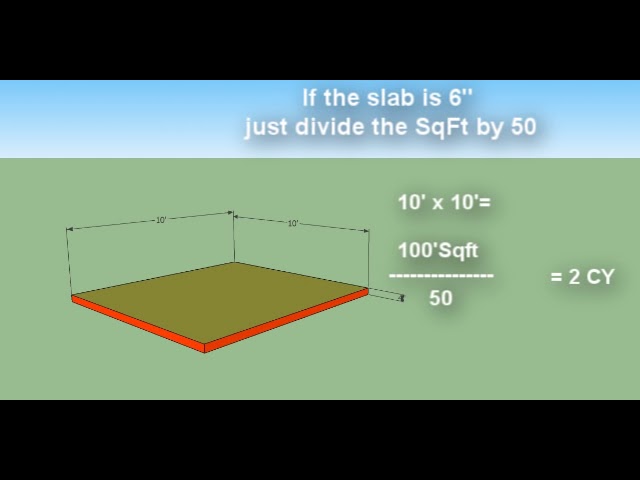
Image Source: i.ytimg.com
Deciphering Concrete Measurement: The Cubic Yard Explained
When you need to pour a patio, build a foundation, or create a sidewalk, you’ll be dealing with concrete. But how do you ensure you order the right amount? The answer lies in understanding concrete volume and how it’s measured. The industry standard is the cubic yard.
What Exactly is a Cubic Yard?
Imagine a cube. If each side of that cube is exactly three feet long, then the total volume inside that cube is one cubic yard.
- Length: 3 feet
- Width: 3 feet
- Height: 3 feet
To calculate this volume, we multiply length by width by height: 3 ft * 3 ft * 3 ft = 27 cubic feet. So, one cubic yard is equal to 27 cubic feet. This is a crucial piece of information for all your concrete calculations.
Why Cubic Yards?
The use of cubic yards for concrete volume is a widespread convention. It provides a consistent and manageable way to talk about large quantities of material. Whether you’re dealing with a small DIY project or a large commercial development, everyone in the concrete business speaks the language of cubic yards. This ensures clarity and prevents costly mistakes when ordering concrete.
Calculating Your Concrete Needs: From Simple Shapes to Complex Projects
The most common challenge for anyone undertaking a concrete project is figuring out how much concrete is actually required. This involves measuring the space you want to fill and converting those measurements into cubic yards.
Simple Shapes: Squares, Rectangles, and Slabs
Most basic concrete projects, like driveways, patios, or small foundations, are essentially rectangular slabs. The formula for calculating the volume of a rectangular prism (which is what a slab is) is:
Volume = Length × Width × Depth
However, there’s a catch. Your measurements for length and width are usually in feet, but the depth (or thickness) of your concrete pour is typically in inches. You need to have all your measurements in the same unit before calculating the volume.
Step-by-Step Slab Calculation
Let’s walk through an example. Suppose you want to pour a rectangular patio that is 10 feet long, 8 feet wide, and 4 inches thick.
-
Convert Depth to Feet: Since length and width are in feet, we need to convert the depth from inches to feet.
- There are 12 inches in 1 foot.
- So, 4 inches = 4 / 12 feet = 0.333 feet.
-
Calculate Volume in Cubic Feet: Now, use the volume formula:
- Volume = 10 feet × 8 feet × 0.333 feet
- Volume = 266.4 cubic feet
-
Convert Cubic Feet to Cubic Yards: Remember, 1 cubic yard = 27 cubic feet.
- Volume in cubic yards = 266.4 cubic feet / 27 cubic feet per cubic yard
- Volume in cubic yards = 9.87 cubic yards
The Importance of Extra Concrete
It’s almost always recommended to order slightly more concrete than your exact calculation. This accounts for:
- Uneven subgrade: The ground beneath your pour might not be perfectly level, requiring more concrete to fill low spots.
- Spillage: Some concrete can inevitably be lost during the pouring and finishing process.
- Settlement: Concrete can settle slightly after it’s poured.
- Slight measurement inaccuracies: Small errors in measuring or cutting can occur.
A good rule of thumb is to add an extra 5-10% to your calculated concrete quantity. In our patio example, adding 10% to 9.87 cubic yards would mean ordering approximately 10.86 cubic yards. This is where a concrete calculator can be incredibly helpful.
Dealing with Different Shapes: Circles, Cylinders, and More
Not all concrete projects involve simple rectangles. You might be pouring a circular column, a circular foundation, or even a curved path.
Circular Slabs
For a circular slab, you need the radius (distance from the center to the edge) and the depth. The formula for the area of a circle is:
Area = π × radius² (where π (pi) is approximately 3.14159)
Then, to find the volume:
Volume = Area × Depth
Let’s say you have a circular patio with a 5-foot radius and a depth of 4 inches (0.333 feet).
-
Calculate Area:
- Area = 3.14159 × (5 feet)²
- Area = 3.14159 × 25 square feet
- Area = 78.54 square feet
-
Calculate Volume in Cubic Feet:
- Volume = 78.54 square feet × 0.333 feet
- Volume = 26.15 cubic feet
-
Convert to Cubic Yards:
- Volume in cubic yards = 26.15 cubic feet / 27 cubic feet per cubic yard
- Volume in cubic yards = 0.97 cubic yards
Again, add that extra 5-10% to your order.
Cylindrical Columns
For a cylindrical shape, like a support column, the calculation is similar, as the base is a circle.
Volume = π × radius² × Height
Make sure all your dimensions are in the same unit before calculating.
Irregular Shapes and Complex Designs
For projects with irregular shapes or multiple interconnected sections, breaking down the area into smaller, more manageable geometric shapes is the best approach. Calculate the volume for each section and then sum them up. Alternatively, specialized design software can often provide precise concrete volume calculations for complex forms.
Essential Tools and Techniques for Accurate Concrete Measurement
Accuracy in concrete measurement is paramount. Even small errors can lead to significant over- or under-ordering, both of which can be costly.
Measuring Tools
- Tape Measure: For precise length and width measurements. Metal tape measures are generally more durable and accurate than fabric ones.
- Level: To check for flatness and ensure your subgrade is as consistent as possible.
- Marking Tools: Stakes, chalk lines, or spray paint to clearly define the pour area.
Using a Concrete Calculator
Many websites and apps offer free concrete calculator tools. These are invaluable for simplifying the math, especially when dealing with multiple shapes or conversions. You simply input your dimensions (length, width, depth, radius, etc.), and the calculator will provide the required concrete quantity in cubic yards.
What is a Concrete Calculator?
A concrete calculator is a digital tool that takes your project’s dimensions and automatically computes the total concrete volume needed, typically in cubic yards. They are designed to handle the unit conversions and complex formulas, making the process of ordering concrete much easier and less prone to error.
Ordering Concrete: From Measurement to Delivery
Once you’ve accurately calculated your concrete quantity, the next step is ordering concrete. This usually involves contacting a ready mix concrete supplier.
Ready Mix Concrete Suppliers
Ready mix concrete is concrete that is manufactured in a factory, or “batch plant,” or transported to the customer in a truck equipped with a revolving drum. It is delivered by mixer trucks. This is the most common way to obtain concrete for most projects.
What is Ready Mix Concrete?
Ready mix concrete is a custom-blended concrete mix, tailored to specific project requirements. It’s mixed at a plant and then transported to the job site in a concrete mixer truck. This ensures a consistent quality and the correct mix design for your application.
How Much Concrete Can a Concrete Truck Carry?
Concrete truck capacity varies, but a standard ready mix concrete truck typically carries between 9 and 11 cubic yards of concrete. Some larger trucks might carry more, but this is a good general estimate.
When you call to place an order, you’ll need to provide:
- The total cubic yards you require.
- The desired mix design: This refers to the proportions of cement, aggregates (sand and gravel), and water, as well as any admixtures (additives). Your supplier can advise you on the appropriate mix for your project (e.g., for a driveway, patio, foundation, etc.).
- The delivery date and time.
- The delivery location and any site access information.
Ordering Extra: The Safety Net
Remember that 5-10% buffer we discussed? It’s crucial. If you are close to a full concrete truck capacity but your calculation falls slightly short, it’s often wise to order enough to fill the truck. Running out of concrete mid-pour is a major problem, often resulting in a poorly constructed slab with cold joints. It’s far better to have a little extra that you can use for other small tasks (like a small footing or a repair patch) or that the truck can take back (though this might incur a fee).
What If I Need Less Than a Full Truckload?
If your project requires only a small concrete quantity, say 1 or 2 cubic yards, you might still be able to order from a ready mix concrete supplier. However, there might be a “short load” charge, as the supplier has to use a truck for a less efficient delivery. For very small jobs, you might consider purchasing bagged concrete, which you mix with water yourself on-site, or using a mobile mixer.
Common Mistakes to Avoid in Concrete Measurement
Even with the best intentions, errors in concrete measurement can happen. Being aware of common pitfalls can save you time and money.
Not Accounting for Depth Variations
One of the most frequent mistakes is assuming the pour area is perfectly level. If your subgrade has dips and valleys, you’ll need more concrete to fill them. Always check your base with a level and account for these low spots in your calculations.
Forgetting to Convert Units
Mixing units (feet for length/width, inches for depth) in your calculations is a recipe for disaster. Always ensure all measurements are in the same unit before multiplying.
Not Adding a Buffer
As stressed before, always order a little extra. Failing to do so is a gamble that rarely pays off.
Miscalculating for Shapes
Complex shapes can be tricky. If you’re unsure, break them down into simpler geometric forms or use a reliable concrete calculator.
Incorrectly Estimating for Slopes
If your concrete pour will have a slope, you need to account for the varying depth. For a simple slope, you might calculate the volume at the shallowest point and the deepest point, then average them, or simply use the deepest measurement for a more conservative estimate.
Frequently Asked Questions (FAQ)
Q: How is concrete volume measured?
A: Concrete volume is measured in cubic yards. One cubic yard is equivalent to 27 cubic feet.
Q: What is a cubic yard of concrete?
A: A cubic yard is a unit of volume. It represents a cube with sides measuring 3 feet by 3 feet by 3 feet.
Q: How do I calculate how much concrete I need for a square slab?
A: For a square or rectangular slab, measure the length, width, and depth (thickness) in feet. Multiply these three dimensions together (Length x Width x Depth). If your depth is in inches, convert it to feet by dividing by 12. Then, divide the total cubic feet by 27 to get the cubic yards. Remember to add a 5-10% buffer.
Q: Can I use a concrete calculator?
A: Yes, using a concrete calculator is highly recommended. These tools simplify the concrete calculations and ensure accurate concrete quantity estimations.
Q: What is the typical capacity of a concrete truck?
A: A standard ready mix concrete truck can typically carry between 9 and 11 cubic yards of concrete.
Q: Is it better to order too much or too little concrete?
A: It is always better to order slightly more concrete than you think you need. Running out of concrete during a pour is a significant problem that can compromise the integrity and appearance of your project.
Q: What if my project is an irregular shape?
A: For irregular shapes, break the area down into simpler geometric shapes (rectangles, circles, triangles), calculate the volume for each section, and then add them together. Using specialized design software can also help.
Q: What is ready mix concrete?
A: Ready mix concrete is concrete that is batched at a plant and delivered to the construction site in a mixer truck. It’s custom-made to specific project requirements.
By mastering the basics of concrete measurement, from grasping the concept of a cubic yard to utilizing a concrete calculator for precise concrete calculations, you can confidently approach ordering concrete and ensure your projects are built on a solid foundation of accurate concrete quantity.