
A yard of concrete weighs approximately 4,000 pounds. This is a crucial piece of information for anyone planning a construction project. Now that we’ve answered the core question, let’s delve deeper into the factors influencing this weight and how to determine it for your specific needs.
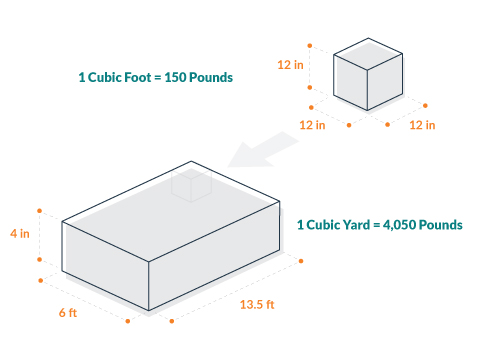
Image Source: www.dumpsters.com
Fathoming the Weight of Concrete
When you’re planning a concrete project, whether it’s a new patio, a foundation, or a decorative walkway, one of the most fundamental questions you’ll face is: how heavy is a yard of concrete? Knowing the weight of concrete per cubic yard is essential for several reasons. It impacts everything from how much material you need to order, the type of equipment required for transport and placement, and even the structural integrity of your project.
The weight of concrete per cubic yard isn’t a single, fixed number. It can fluctuate based on the mix of ingredients used. However, for general purposes, a standard estimate is vital. This article will guide you through deciphering the concrete density, explaining the factors that contribute to its weight, and providing practical ways to estimate the cubic yard concrete weight for your projects. We’ll also touch upon how to use a concrete weight calculator and what standard concrete weight you can typically expect.
The Basics: What Makes Concrete Heavy?
Concrete is a composite material. It’s made from cement, aggregate (like gravel and sand), and water. The cement acts as a binder, the aggregate provides bulk and strength, and the water is essential for the chemical reaction that hardens the cement. The specific proportions of these ingredients, along with any added admixtures, directly influence the final concrete density.
- Cement: Portland cement is the most common type. Its weight contributes significantly to the overall density.
- Aggregates: These make up the largest portion of concrete by volume. The type and size of aggregates (sand, gravel, crushed stone) play a major role in the final weight. Denser aggregates will result in heavier concrete.
- Water: While water is essential for the mix, its weight is also a factor. The water-to-cement ratio is critical for strength and workability, but it also influences the density.
- Air: Entrained air, either intentionally added or naturally present, can slightly reduce the overall weight of concrete by creating small pockets within the mix.
Standard Concrete Weight: A Baseline
When discussing how much does concrete weigh, it’s helpful to start with a general benchmark. The standard concrete weight is typically around 150 pounds per cubic foot. This figure is a useful starting point for many calculations.
Since concrete is usually ordered and discussed in cubic yards, we need to convert this. There are 27 cubic feet in one cubic yard (3 feet x 3 feet x 3 feet = 27 cubic feet).
So, if concrete weighs 150 pounds per cubic foot:
150 pounds/cubic foot * 27 cubic feet/cubic yard = 4,050 pounds per cubic yard.
This brings us back to our initial estimate: a yard of concrete weighs around 4,000 to 4,050 pounds. This is the standard concrete weight you’ll often hear quoted.
Concrete Density: The Key to Weight Variation
Concrete density is defined as its mass per unit volume. For concrete, this is usually expressed in pounds per cubic foot (lb/ft³) or kilograms per cubic meter (kg/m³). The density of concrete psi is not a standard measure. PSI (pounds per square inch) refers to compressive strength, not density. Density and strength are related but are distinct properties. A stronger concrete mix might be denser, but it’s not a direct one-to-one correlation without knowing the specific mix design.
The typical range for the density of concrete can vary:
- Normal-weight concrete: 140-150 lb/ft³ (This is what most residential and commercial projects use)
- Lightweight concrete: 90-115 lb/ft³ (Uses lighter aggregates like expanded shale or clay)
- Heavyweight concrete: 180-220 lb/ft³ (Uses dense aggregates like barite or steel shot, often for radiation shielding)
For the purpose of answering how heavy is a yard of concrete, we will focus on normal-weight concrete.
Calculating the Weight of a Cubic Yard of Concrete
To accurately determine how much does concrete weigh for your project, you need to consider the specific mix design. While the 4,000-4,050 lb/yd³ figure is a good average for normal-weight concrete, slight variations are common.
Here’s how to calculate concrete weight:
- Know your concrete density: This is the most crucial factor. Your concrete supplier can provide the density of the specific mix you are ordering.
- Determine the volume needed: You’ll need to calculate the volume of concrete required for your project. This is typically done by measuring the length, width, and depth of the area to be filled and multiplying them together. Ensure all measurements are in the same units (e.g., feet).
- Convert to cubic yards: If your measurements are in feet, divide the total cubic feet by 27 to get the volume in cubic yards.
Formula:
- Volume in Cubic Feet = Length (ft) × Width (ft) × Depth (ft)
- Volume in Cubic Yards = Volume in Cubic Feet / 27
Once you have the volume in cubic yards and the density in pounds per cubic foot, you can calculate the total weight:
- Total Weight (lbs) = Volume (yd³) × Density (lb/ft³) × 27 ft³/yd³
Alternatively, if you know the density per cubic yard:
- Total Weight (lbs) = Volume (yd³) × Density (lb/yd³)
Let’s illustrate with an example. Suppose your concrete supplier tells you the density of the mix you’re ordering is 150 lb/ft³. You need 5 cubic yards of concrete.
- Weight per cubic yard = 150 lb/ft³ × 27 ft³/yd³ = 4,050 lb/yd³
- Total weight for 5 cubic yards = 5 yd³ × 4,050 lb/yd³ = 20,250 lbs
Using a Concrete Weight Calculator
To simplify these calculations, many online resources and apps offer a concrete weight calculator. These tools allow you to input the dimensions of your project (length, width, depth) and the type of concrete, and they will automatically calculate the required volume in cubic yards and the estimated weight. These calculators are invaluable for ensuring you order the correct amount of material, preventing costly over-ordering or wasteful under-ordering.
When using a calculator, pay attention to the units it expects for input (feet, inches, meters) and the units for output (cubic yards, cubic meters, pounds, kilograms).
Factors Affecting Wet Concrete Weight
The term “wet concrete weight” refers to the weight of the concrete mix before it has fully cured and hardened. The weight we’ve been discussing (around 4,000 lbs per cubic yard) generally refers to this wet concrete weight or the weight of concrete shortly after placement.
During the curing process, some water evaporates, and the chemical reactions of hydration occur. This can lead to a slight decrease in the overall weight as the concrete hardens. However, for practical purposes related to ordering and transport, the wet concrete weight is the primary concern.
The consistency and slump of the concrete mix can also influence its perceived weight. A wetter mix (higher slump) might feel more fluid, but the fundamental density of the solid materials remains largely the same, with the added water contributing to the overall mass.
What Influences the Density of Concrete?
As mentioned earlier, the composition of the concrete mix is the primary driver of its density.
-
Aggregate Type and Size: This is perhaps the most significant factor.
- Dense Aggregates: Using heavier aggregates like crushed granite, basalt, or other dense stones will increase the concrete density.
- Lighter Aggregates: Using aggregates like expanded shale, clay, pumice, or even hollow glass spheres will significantly reduce the concrete density.
- Aggregate Size Distribution: A well-graded mix with a good distribution of aggregate sizes generally packs more tightly, potentially leading to higher density compared to a mix with predominantly fine or coarse aggregates.
-
Cement Content: While aggregates form the bulk, the cement paste that binds them also has its own density. Higher cement content, especially when combined with a low water-to-cement ratio, can sometimes lead to denser concrete, though the aggregate’s influence is typically more pronounced.
-
Water-to-Cement Ratio (w/c ratio): A lower w/c ratio generally leads to stronger concrete. While the water itself adds weight, a lower w/c ratio means less water is used relative to the cement. The paste that forms from a low w/c ratio is denser. However, the overall density is still dominated by the aggregates.
-
Admixtures: Certain admixtures, like silica fume or fly ash, can alter the paste structure and potentially influence density. However, their effect is generally less dramatic than that of aggregates. Air-entraining admixtures, by design, create air voids and thus reduce density.
Practical Implications of Concrete Weight
Knowing how heavy is a yard of concrete has several practical applications in construction:
- Ordering Materials: Accurately estimating the weight helps ensure you order the right quantity of concrete. This prevents delays and extra costs associated with insufficient or excessive orders.
- Transportation: Understanding the weight is crucial for selecting appropriate delivery vehicles. A standard concrete truck (cement mixer) can typically carry around 9 to 11 cubic yards of concrete. Knowing the weight per cubic yard helps determine if a single truck can handle the load or if multiple trips are needed, and it also informs weight restrictions on roads or bridges.
- Equipment Requirements: For larger projects, you might need to consider the weight the ground can support. For example, if you are pouring concrete on a structure that has weight limitations, knowing the density is vital. Also, moving large quantities of concrete, especially in bags for smaller DIY projects, requires understanding the physical effort involved. A bag of concrete mix (e.g., 80 lbs) typically yields about 0.6 cubic feet, meaning you’d need about 45 bags to make one cubic yard. That’s a substantial amount of weight to handle!
- Structural Design: Engineers use the density of concrete in their structural calculations. The dead load of the concrete itself is a critical factor in determining the required strength of supporting structures like beams, columns, and foundations. The concrete volume to weight conversion is fundamental to these calculations.
- Safety: Handling and moving materials, especially in large volumes, requires proper safety precautions. Knowing the weight helps in planning lifting and moving strategies to prevent injuries.
Deciphering the Concrete Volume to Weight Conversion
The process of converting concrete volume to weight is straightforward once you have the correct density.
Let’s recap the relationship:
Weight = Volume × Density
If you have the volume in cubic yards and the density in pounds per cubic foot, the conversion is:
Weight (lbs) = Volume (yd³) × Density (lb/ft³) × 27 (ft³/yd³)
Alternatively, if you know the density per cubic yard (which is simply density in lb/ft³ multiplied by 27), the calculation becomes even simpler:
Weight (lbs) = Volume (yd³) × Density (lb/yd³)
Example:
You need to pour a concrete slab that is 10 feet long, 10 feet wide, and 4 inches deep.
- Convert depth to feet: 4 inches / 12 inches/foot = 0.333 feet
- Calculate volume in cubic feet: 10 ft × 10 ft × 0.333 ft = 33.3 cubic feet
- Calculate volume in cubic yards: 33.3 cubic feet / 27 cubic feet/yd³ = 1.23 cubic yards
- Assume standard concrete density: 150 lb/ft³
- Calculate weight per cubic yard: 150 lb/ft³ × 27 ft³/yd³ = 4,050 lb/yd³
- Calculate total weight: 1.23 yd³ × 4,050 lb/yd³ = 4,981.5 lbs
So, for this slab, you’d need about 1.25 cubic yards of concrete, and it would weigh approximately 5,000 pounds.
Can I Get Different Weights of Concrete?
Yes, absolutely. As we’ve discussed, the concrete density can be varied by adjusting the mix design.
- For Lighter Concrete: If you need a lighter concrete mix, perhaps for a specific structural application or to reduce the load on a supporting structure, you can opt for lightweight aggregate concrete. This can reduce the weight of concrete per cubic yard by hundreds of pounds.
- For Heavier Concrete: In specialized applications, such as radiation shielding, heavyweight aggregates are used to significantly increase the concrete density and, consequently, the cubic yard concrete weight.
When ordering concrete, always discuss your project requirements with your supplier. They can help you select a mix that meets your strength, durability, and weight specifications.
How to Calculate Concrete Weight: A Practical Guide
For DIYers and contractors alike, knowing how to calculate concrete weight is a valuable skill.
Step 1: Measure Your Project Area
Accurately measure the length, width, and depth of the space you need to fill with concrete. Ensure all measurements are in the same unit, preferably feet.
Step 2: Calculate the Volume in Cubic Feet
Multiply your measurements:
* Volume (ft³) = Length (ft) × Width (ft) × Depth (ft)
Step 3: Convert to Cubic Yards
Divide the volume in cubic feet by 27:
* Volume (yd³) = Volume (ft³) / 27
Step 4: Determine the Concrete Density
The most reliable way to get this is to ask your concrete supplier for the density of the specific mix you are ordering. If you are using bagged concrete mix, the packaging usually provides information about the yield (how many cubic feet one bag will produce) and sometimes the approximate weight per cubic yard. For general estimations, use 150 lb/ft³ (or 4,050 lb/yd³) for standard concrete.
Step 5: Calculate the Total Weight
Use the formula:
* Total Weight (lbs) = Volume (yd³) × 4,050 lb/yd³ (for standard concrete)
Example for Bagged Concrete:
Let’s say you’re building a small sidewalk border that requires 0.5 cubic yards of concrete.
You check the bag of concrete mix, and it states that one 80 lb bag yields 0.6 cubic feet.
- Cubic feet needed: 0.5 yd³ × 27 ft³/yd³ = 13.5 ft³
- Number of bags needed: 13.5 ft³ / 0.6 ft³/bag = 22.5 bags. So, you’d need 23 bags.
- Total weight of concrete mix: 23 bags × 80 lb/bag = 1,840 lbs.
Remember, this is the weight of the dry mix. The wet concrete weight will be slightly higher due to the added water. The concrete weight calculator is often the easiest way to manage these calculations.
Frequently Asked Questions (FAQ)
Q1: How much does one bag of concrete weigh?
A bag of concrete mix can vary in weight. Common sizes are 40 lb, 60 lb, and 80 lb bags. The weight of the bag refers to the dry mix ingredients.
Q2: How many bags of concrete make a cubic yard?
This depends on the yield of the bag. For an 80 lb bag that yields 0.6 cubic feet, you would need approximately 45 bags (27 cubic feet / 0.6 cubic feet/bag) to make one cubic yard.
Q3: Does the weight of concrete change after it cures?
Yes, slightly. As concrete cures, some water evaporates, and the chemical hydration process occurs. This can lead to a minor reduction in weight, but for most practical purposes, the initial wet concrete weight is what’s considered for transport and handling.
Q4: What is the density of concrete per psi?
There is no direct conversion for density of concrete psi. PSI (pounds per square inch) measures compressive strength, while density is mass per unit volume. While a higher compressive strength might correlate with a denser mix in some cases, they are measured independently.
Q5: Is there a difference between the weight of concrete and the weight of the dry mix?
Yes. The weight of a bag of concrete mix is the weight of the dry ingredients (cement, sand, gravel). The wet concrete weight includes the weight of the added water, which is necessary for the concrete to set and harden.
Q6: How can I calculate the weight of a concrete slab if I know its dimensions?
First, calculate the volume of the slab in cubic feet (Length x Width x Depth). Then, convert this volume to cubic yards by dividing by 27. Finally, multiply the cubic yards by the approximate weight per cubic yard (around 4,050 lbs for standard concrete) to get the total estimated weight. Using a concrete weight calculator simplifies this process.
In conclusion, while a general answer to “How heavy is a yard of concrete?” is around 4,000 pounds, precise weight depends on the specific mix. By understanding concrete density, concrete volume to weight conversions, and utilizing resources like a concrete weight calculator, you can accurately estimate the weight for any project. This knowledge ensures efficient material ordering, proper equipment selection, and ultimately, a successful construction outcome.