
There are 27 cubic feet in 1 cubic yard because a yard is 3 feet long, and when you multiply these dimensions together for volume (length x width x height), you get 3 x 3 x 3, which equals 27. This fundamental concept in volume conversion stems from the basic definitions of these measurements.
When we talk about how much space something takes up, we often use terms like cubic feet and cubic yards. These are units used to measure volume, which is the amount of three-dimensional space an object occupies. Understanding the relationship between these units is crucial for many tasks, from planning a garden to ordering construction materials. Let’s dive deep into why this specific conversion factor exists and how it works.
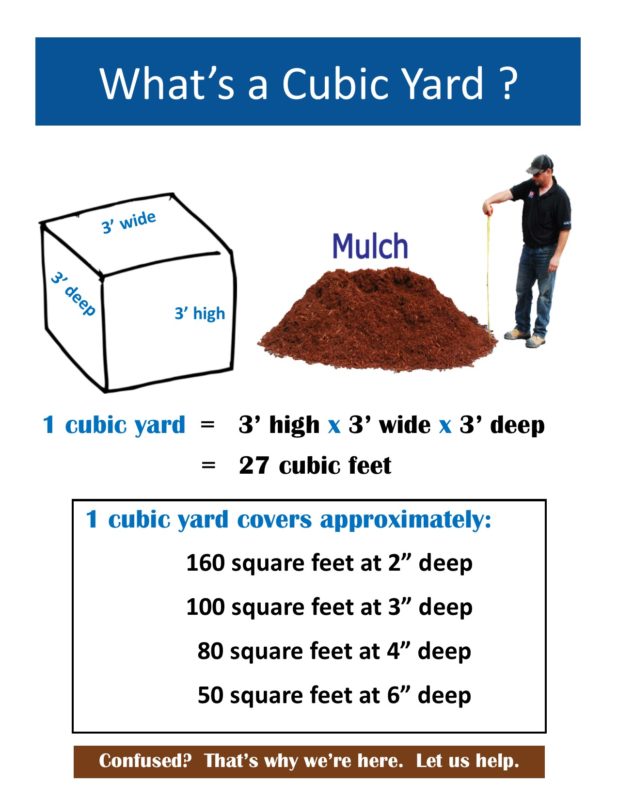
Image Source: stonegarden-nc.com
Deciphering the Cube: From Feet to Yards
At its core, this volume conversion is all about dimensions. Both cubic feet and cubic yards are derived from linear measurements.
- A Foot: A foot is a standard unit of length in the imperial and US customary systems. It’s approximately the length of a man’s foot, historically. Today, it’s precisely defined as 0.3048 meters.
- A Yard: A yard is also a unit of length. It’s equal to 3 feet. You might know it from a football field (100 yards long) or from fabric measurements.
Now, let’s talk about cubes. A cube is a three-dimensional shape where all sides – length, width, and height – are equal.
- A Cubic Foot: This is the volume of a cube where each side measures 1 foot. So, its dimensions are 1 foot x 1 foot x 1 foot.
- A Cubic Yard: This is the volume of a cube where each side measures 1 yard. So, its dimensions are 1 yard x 1 yard x 1 yard.
The Calculation: The Heart of the Conversion
To find the conversion factor between cubic feet and cubic yards, we need to consider the volume of both. We already know that 1 yard = 3 feet.
Let’s calculate the volume of a cubic yard in terms of feet:
1 cubic yard = 1 yard (length) x 1 yard (width) x 1 yard (height)
Since 1 yard is equal to 3 feet, we can substitute this into our calculation:
1 cubic yard = (3 feet) x (3 feet) x (3 feet)
Now, we multiply the numbers and the units:
1 cubic yard = (3 x 3 x 3) cubic feet
1 cubic yard = 27 cubic feet
This simple multiplication is the reason behind the conversion factor. Every linear dimension of the cubic yard (length, width, and height) is 3 feet. When you cube that linear conversion factor (3 feet per yard), you get the volumetric conversion factor.
Visualizing the Space: Cubes within Cubes
Imagine a large cube that is 1 yard on each side. This is our cubic yard. Now, picture dividing each of its sides into three equal sections, each 1 foot long.
If you were to build this large cubic yard using smaller, 1-foot cubes (which are cubic feet), how many of those smaller cubes would fit inside?
- Along the length, you can fit 3 cubes of 1 foot each.
- Along the width, you can fit 3 cubes of 1 foot each.
- Along the height, you can fit 3 cubes of 1 foot each.
So, you have 3 rows of cubes along the length, 3 columns of cubes along the width, and you stack these layers 3 times high. This creates a grid of 3 x 3 x 3 smaller cubes.
The total number of 1-foot cubes that fit inside the 1-yard cube is 3 x 3 x 3 = 27. This visual representation reinforces the cubic feet to cubic yards conversion.
Practical Applications of Yardage and Cubic Feet
This volume conversion is not just an abstract mathematical concept; it has real-world implications in various fields:
Construction and Landscaping
- Concrete and Gravel: When ordering concrete, gravel, sand, or mulch, you’ll often see prices quoted per cubic yard. Knowing how many cubic feet you need helps you accurately calculate how much material to order. For example, if you need to fill a hole that is 6 feet long, 6 feet wide, and 3 feet deep, its volume is 6 x 6 x 3 = 108 cubic feet. To convert this to cubic yards, you divide by 27: 108 / 27 = 4 cubic yards. This means you’d need to order 4 cubic yards of material.
- Excavation: When digging foundations or trenches, the amount of earth removed is measured in cubic yards. A contractor needs to know the capacity of their equipment and trucks to haul away the excavated soil.
Gardening and Agriculture
- Soil and Compost: Gardeners often buy soil or compost in bags measured in cubic feet, but larger quantities for significant projects are sold by the cubic yard. A raised garden bed that is 8 feet long, 4 feet wide, and 1 foot deep has a volume of 8 x 4 x 1 = 32 cubic feet. To convert this to cubic yards: 32 / 27 ≈ 1.18 cubic yards. You’d likely round up to 1.25 or 1.5 cubic yards to be safe.
- Fertilizers: Similar to soil, bulk fertilizers can be measured in cubic yards.
Moving and Storage
- Moving Trucks: The capacity of moving trucks or storage units can be described in cubic feet or cubic yards. This helps you estimate how much you can fit.
- Shipping: While not as common for smaller shipments, larger freight volumes might be discussed in cubic yards.
The Importance of Consistent Measurements
The reliability of any measurement system, including our imperial units, hinges on consistency. The definition of a foot and a yard is fixed, which in turn fixes the conversion factor between cubic feet and cubic yards. This consistency allows for accurate planning and execution in all the fields mentioned above. Without a stable conversion factor, calculating the required capacity for materials or the total space to be filled would be a guessing game.
Exploring Other Cubic Unit Conversions
It’s helpful to see how this principle applies to other common units, even though the numbers will be different. The core idea remains: cubing the linear conversion factor.
Feet to Inches
- Linear Conversion: 1 foot = 12 inches
- Cubic Conversion: 1 cubic foot = (12 inches) x (12 inches) x (12 inches) = 1728 cubic inches.
Yards to Inches
- Linear Conversion: 1 yard = 3 feet = 3 x 12 inches = 36 inches
- Cubic Conversion: 1 cubic yard = (36 inches) x (36 inches) x (36 inches) = 46,656 cubic inches.
Converting Between All Three
We can also verify our cubic feet to cubic yards conversion using inches:
1 cubic yard = 46,656 cubic inches
1 cubic foot = 1728 cubic inches
So, how many cubic feet are in a cubic yard?
Number of cubic feet = (Cubic inches in 1 cubic yard) / (Cubic inches in 1 cubic foot)
Number of cubic feet = 46,656 / 1728 = 27.
This confirms our primary conversion factor through an alternative path, demonstrating the interconnectedness of these measurements.
Tables for Quick Reference
Here’s a summary table that might be useful for quick unit conversion:
| Unit of Length | Conversion Factor | Unit of Volume | Conversion Factor |
|---|---|---|---|
| 1 Foot | 12 Inches | 1 Cubic Foot | 1728 Cubic Inches |
| 1 Yard | 3 Feet | 1 Cubic Yard | 27 Cubic Feet |
| 1 Yard | 36 Inches | 1 Cubic Yard | 46,656 Cubic Inches |
And for converting between cubic feet and cubic yards:
| To Convert From | To Convert To | Multiply By | Divide By |
|---|---|---|---|
| Cubic Feet | Cubic Yards | 1/27 (or 0.037037) | 27 |
| Cubic Yards | Cubic Feet | 27 | 1/27 (or 0.037037) |
Common Mistakes and How to Avoid Them
One of the most common mistakes when dealing with volume conversion is to confuse linear conversion with cubic conversion. People might think that since 1 yard is 3 feet, then 1 cubic yard is 3 cubic feet. This is incorrect because volume involves three dimensions.
Mistake: 1 yard = 3 feet, so 1 cubic yard = 3 cubic feet.
Correct Calculation: 1 cubic yard = 3 ft x 3 ft x 3 ft = 27 cubic feet.
Another common pitfall is using the wrong conversion factor when calculating the capacity of a space. Always remember to cube the linear conversion factor.
To avoid these errors:
- Always visualize: Picture the cubes. A cubic yard is a much larger space than a cubic foot.
- Double-check your math: Ensure you are multiplying by the linear factor three times (cubing it).
- Use a reliable calculator or chart: Especially when performing complex volume conversion for professional purposes.
- Context is key: Understand whether you need linear or cubic measurements for your task.
The Role of Cubic Feet to Cubic Yards in Estimating
Accurate volume conversion is vital for effective estimation in many projects. If you’re an estimator for a construction company, a landscaper, or even planning a DIY project, you need precise figures for materials.
- Underestimating: Leading to project delays and additional costs to procure more materials.
- Overestimating: Leading to wasted materials and increased budget expenditure.
Consider a scenario where you need to fill a rectangular area with soil. The dimensions are 10 feet by 15 feet, and you need a depth of 6 inches (which is 0.5 feet).
Volume in Cubic Feet:
Volume = Length x Width x Height
Volume = 10 ft x 15 ft x 0.5 ft
Volume = 75 cubic feet
Now, to convert this to cubic yards to order soil:
Volume in Cubic Yards = Volume in Cubic Feet / 27
Volume in Cubic Yards = 75 / 27
Volume in Cubic Yards ≈ 2.78 cubic yards
You would likely order 3 cubic yards of soil to ensure you have enough. This calculation directly impacts the project’s budget and material procurement.
Future of Measurements and Conversions
While the imperial system with feet and yards remains prevalent in some countries, the rest of the world largely uses the metric system, with meters and cubic meters. The principles of volume conversion remain the same, but the conversion factors differ significantly.
- 1 meter = 100 centimeters
- 1 cubic meter = 1 meter x 1 meter x 1 meter = 1,000,000 cubic centimeters.
The ability to perform unit conversion between different systems (e.g., metric to imperial) is a valuable skill in an increasingly globalized world. Understanding the fundamental mathematical relationships, like the one between cubic feet and cubic yards, makes it easier to grasp other, more complex conversions.
Frequently Asked Questions (FAQ)
Q1: Can I convert cubic yards to cubic feet by just multiplying by 3?
A1: No, you cannot. Since volume is three-dimensional, you need to multiply by 3 for each dimension. Therefore, to convert cubic yards to cubic feet, you multiply by 3 x 3 x 3, which equals 27.
Q2: Why are there different units for volume?
A2: Different units exist for historical reasons and for convenience in various applications. Feet and yards are part of the imperial system, used primarily in the United States, Liberia, and Myanmar. The metric system (meters, liters, kilograms) is used by most other countries and in scientific contexts worldwide.
Q3: Is there a simple way to remember the cubic feet to cubic yards conversion?
A3: Yes, remember that 1 yard is 3 feet. For volume, you cube this linear relationship: 3 x 3 x 3 = 27. So, 1 cubic yard equals 27 cubic feet.
Q4: What is yardage in construction?
A4: In construction and landscaping, “yardage” commonly refers to the quantity of materials (like concrete, gravel, mulch) measured in cubic yards.
Q5: How do I calculate the volume of an irregular shape in cubic feet or yards?
A5: For irregular shapes, you typically need to break them down into simpler geometric shapes whose volumes you can calculate (like rectangular prisms, cylinders, or cones) and then sum those volumes. Alternatively, advanced methods like 3D scanning and specialized software can be used for precise volumetric calculations.
In conclusion, the seemingly simple question of why there are 27 cubic feet in 1 cubic yard reveals a fundamental mathematical principle rooted in the dimensions of measurement. It’s a crucial piece of knowledge for anyone involved in projects that require accurate volume conversion and capacity calculations, ensuring that tasks are completed efficiently and within budget.