
Estimating the number of mulch bags needed for your yard is a common question for homeowners looking to beautify their garden beds, trees, and pathways. The general answer to how many bags of mulch are needed in a yard depends on the size of the area you want to cover and the desired depth of the mulch layer. Typically, most bagged mulch covers about 12 square feet at a 2-inch depth.
This guide will help you decipher the exact amount of mulch your yard requires. We’ll cover everything from calculating your needs to choosing the right mulch. Let’s get started on making your landscape look its best!
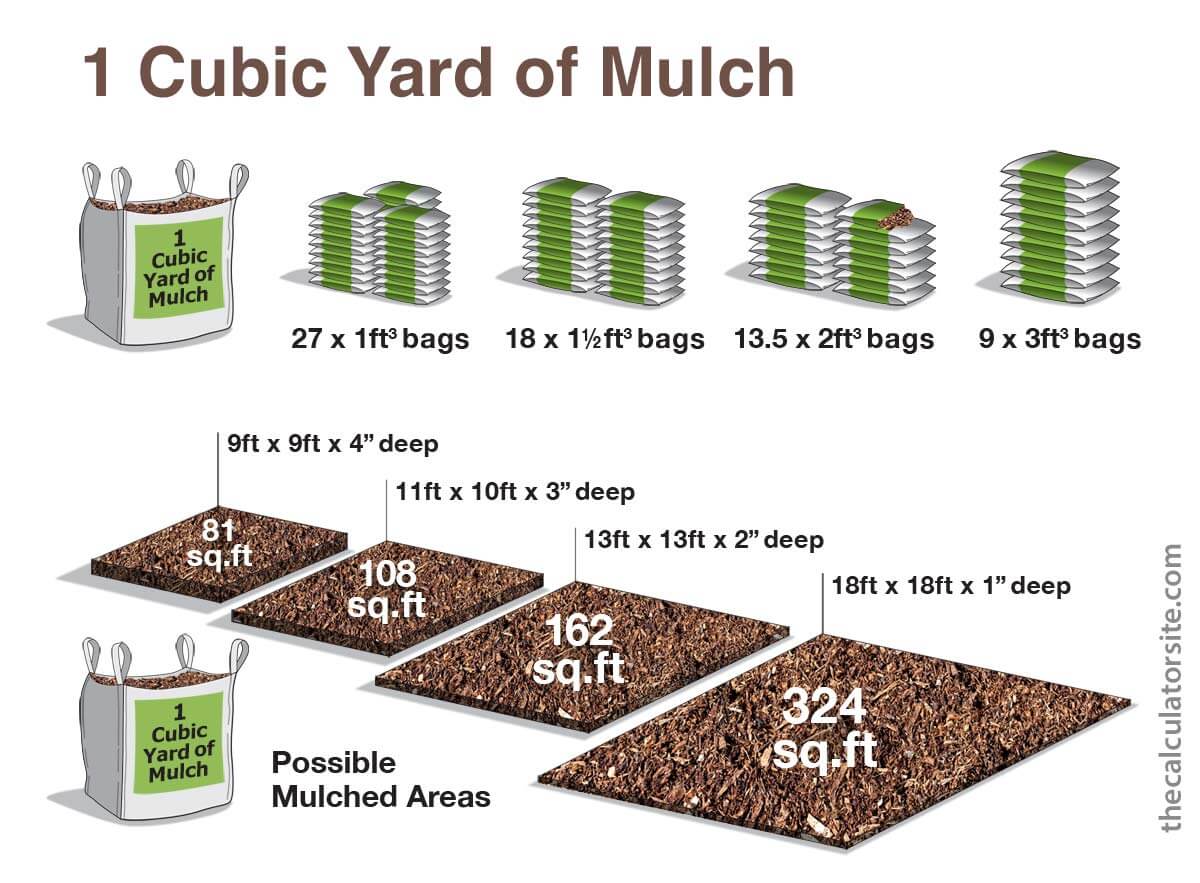
Image Source: www.thecalculatorsite.com
Figuring Out Your Mulch Needs
To accurately determine how many bags of mulch you need, you first need to know the size of the area you want to cover and how deep you want the mulch to be. This is the most crucial step in preventing under- or over-buying.
Measuring Your Garden Beds
The first step is to measure the length and width of each area you plan to mulch.
-
Rectangular or Square Areas: Measure the length and the width of the bed. Multiply these two numbers together to get the square footage.
- Example: A bed that is 10 feet long and 5 feet wide is 50 square feet (10 ft x 5 ft = 50 sq ft).
-
Circular Areas: Measure the diameter of the circle (the distance across the center). Divide the diameter by 2 to get the radius. Then, use the formula: π * radius² (where π is approximately 3.14).
- Example: A circular bed with a diameter of 6 feet has a radius of 3 feet. The area is approximately 28.26 square feet (3.14 * 3 ft * 3 ft = 28.26 sq ft).
-
Irregular Shapes: For oddly shaped areas, break them down into smaller, more manageable geometric shapes (rectangles, squares, triangles). Calculate the area of each shape and then add them all together for the total square footage.
Deciding on Mulch Depth
The ideal mulch depth is usually between 2 to 3 inches. This depth helps suppress weeds, retain soil moisture, and regulate soil temperature without suffocating plant roots.
- 2 inches: Good for areas with plants that don’t need a lot of moisture retention or for general ground cover.
- 3 inches: Better for areas where you want maximum weed suppression and moisture retention, such as around trees or in new plantings.
Converting Area to Yardage
Mulch is often sold by the cubic yard. A cubic yard is a unit of volume. Knowing your area in square feet and your desired depth in inches, you can calculate the cubic yards needed.
The formula is:
(Total Square Footage * Desired Depth in Inches) / 12 inches/foot = Cubic Yards
- Example: If you have 100 square feet to cover with 3 inches of mulch:
(100 sq ft * 3 inches) / 12 inches/foot = 300 / 12 = 25 cubic feet.
Since there are 27 cubic feet in a cubic yard (3 ft * 3 ft * 3 ft = 27 cu ft), you would need:
25 cubic feet / 27 cubic feet/cubic yard ≈ 0.93 cubic yards.
It’s always a good idea to round up to the nearest quarter or half yard, especially when ordering in bulk.
The Bagged Mulch Calculation
Most bagged mulch is sold in quantities that make conversion to yardage to bags straightforward. Standard bags of mulch usually cover a specific square footage at a standard depth.
Common Bag Sizes and Coverage
A typical bag of mulch you’ll find at garden centers contains about 2 to 3 cubic feet of material. This is where the mulch bag volume is important.
- 2 cubic foot bag: Usually covers about 12 square feet at a 2-inch depth.
- 3 cubic foot bag: Usually covers about 18 square feet at a 2-inch depth.
Calculating Bags Needed
Once you have your total square footage and desired depth, you can calculate the number of bags.
Number of Bags = Total Square Footage / Coverage per Bag (at your desired depth)
Let’s use our previous example: 100 square feet to cover with 3 inches of mulch.
- Most bags provide coverage at a 2-inch depth. To cover 3 inches, you’ll need 1.5 times the amount of mulch for 2 inches.
- If a 2 cubic foot bag covers 12 sq ft at 2 inches, it covers roughly 8 sq ft at 3 inches (12 sq ft / 1.5 = 8 sq ft).
- So, for 100 sq ft at 3 inches: 100 sq ft / 8 sq ft per bag = 12.5 bags.
You should always round up to the nearest whole bag to ensure you have enough. In this case, you’d buy 13 bags.
Sample Calculation Table
Here’s a table to help visualize the soil bag coverage for different bag sizes and depths.
| Bag Volume (cu ft) | Coverage at 2″ Depth (sq ft) | Coverage at 3″ Depth (sq ft) |
|---|---|---|
| 2 | 12 | 8 |
| 2.5 | 15 | 10 |
| 3 | 18 | 12 |
How to use this table:
1. Find your bag volume.
2. Choose the coverage column that matches your desired mulch depth.
3. Divide your total area’s square footage by the coverage number in that cell.
- Example: Your yard has 150 sq ft of planting beds, and you want 3 inches of mulch. You are using 2.5 cu ft bags.
- Look at the table for 2.5 cu ft bags and 3″ depth. Coverage is 10 sq ft.
- Calculation: 150 sq ft / 10 sq ft/bag = 15 bags.
When to Consider Bulk Mulch
For larger landscaping projects, buying mulch in bulk can be more cost-effective and environmentally friendly. Bulk mulch is typically delivered by a truck and dumped in a designated spot, and it’s measured in cubic yards.
Advantages of Bulk Mulch
- Cost Savings: Often cheaper per cubic yard than bagged mulch, especially for large quantities.
- Less Waste: No plastic bags to dispose of.
- Convenience: Delivered directly to your property.
- Variety: Sometimes a wider selection of mulch types is available in bulk.
Calculating Bulk Mulch Needs
The calculation process is the same as we discussed for determining cubic yards. You’ve already figured out your total square footage and desired depth.
Total Cubic Yards = (Total Square Footage * Desired Depth in Inches) / 12
Once you have this number, you can order it from your local landscape supplier. They often deliver in 1-cubic yard increments.
Choosing the Right Mulch
Beyond the quantity, the type of mulch you choose significantly impacts your garden’s appearance and health. Different mulches have varying properties and lifespans.
Popular Mulch Types
- Wood Bark Mulch (Shredded or Chipped):
- Pros: Long-lasting, good at retaining moisture, suppresses weeds effectively, comes in various colors and textures (cedar, pine, hardwood).
- Cons: Can sometimes float away in heavy rain if not well-established.
- Compost Mulch:
- Pros: Enriches the soil as it breaks down, improves soil structure and fertility.
- Cons: Can break down faster than wood mulches, may contain weed seeds if not properly composted.
- Rubber Mulch:
- Pros: Very durable, doesn’t decompose, good for playgrounds and areas where longevity is key.
- Cons: Can be expensive, might not be ideal for vegetable gardens or close to plant roots as it doesn’t offer soil benefits and can overheat.
- Leaf Mulch:
- Pros: Free if you collect your own leaves, breaks down nicely to improve soil.
- Cons: Can blow away easily if not shredded or weighed down, may contain diseases or pests if not from healthy sources.
- Pine Straw Mulch:
- Pros: Lightweight, needles interlock to stay in place, good for slopes, acidifies soil slightly (good for certain plants like azaleas).
- Cons: Breaks down faster than wood mulches, can be more expensive.
Aesthetics and Functionality
Consider the look you’re going for. Black dyed mulches offer a dramatic contrast, while natural brown or red mulches provide a classic garden look. Think about how the mulch will complement your plants and home.
Also, consider the lifespan. If you prefer to mulch once a year, opt for wood or rubber mulches. If you don’t mind replenishing more often and want to improve your soil, compost or leaf mulch might be better.
Frequently Asked Questions About Mulch
Here are some common questions homeowners have about mulch:
Q1: How much dirt is in a yard of mulch?
This question often arises when people are comparing bulk mulch to bagged products. A cubic yard is a measure of volume. While “dirt” is a general term for soil, when we talk about landscaping soil quantity and how much dirt in a yard, it refers to the volume. One cubic yard is equal to 27 cubic feet. So, if you order a cubic yard of mulch, you are getting 27 cubic feet of material.
Q2: What is the best depth for mulch?
The best mulch depth is generally between 2 to 3 inches. This depth is sufficient to suppress weeds, conserve moisture, and regulate soil temperature without restricting air circulation or hindering plant growth. Deeper mulch can sometimes lead to root rot or attract pests.
Q3: Can I use mulch on my lawn?
While mulch is fantastic for garden beds, trees, and shrubs, it’s generally not recommended for application directly on your lawn. Lawns typically require specific fertilizers and aeration. Mulching over grass can smother it and create an unhealthy environment.
Q4: How often should I reapply mulch?
The frequency of reapplying mulch depends on the type of mulch used and environmental factors.
* Wood Bark/Chips: May need topping up every 6-12 months.
* Compost/Leaf Mulch: Might require application every 3-6 months as they break down faster.
* Pine Straw: Needs replenishing every 3-6 months.
* Rubber Mulch: Generally does not need to be reapplied due to its non-degradable nature.
Q5: How do I calculate mulch for a specific area if I don’t know the bag coverage?
If you have a landscape material calculator or can find the mulch bag volume, you can perform the calculation yourself. As mentioned, most bags are 2 or 3 cubic feet. To find coverage at a 2-inch depth, divide the bag’s cubic feet by 0.1667 (2 inches / 12 inches per foot). For 3-inch depth, divide by 0.25 (3 inches / 12 inches per foot).
* For a 2 cu ft bag at 2″ depth: 2 cu ft / 0.1667 = 12 sq ft.
* For a 2 cu ft bag at 3″ depth: 2 cu ft / 0.25 = 8 sq ft.
Q6: What is the difference between garden soil and mulch?
Garden soil is typically a blend of topsoil, compost, and other organic matter designed to be planted in. It provides nutrients and structure for plant roots. Mulch, on the other hand, is a protective layer applied on top of the soil. Its primary functions are to conserve moisture, suppress weeds, and regulate soil temperature. You’ll use garden soil calculator when planning raised beds or amending existing soil, whereas a material coverage estimator is for mulch or decorative stone.
Q7: Can I mix different types of mulch?
Yes, you can mix different types of mulch, but it’s usually best to use the same type within a single planting bed for a uniform look and consistent breakdown rate. You might, for example, use wood mulch around trees and a finer compost mulch in a perennial border. Ensure they are applied in distinct areas.
Using a Material Coverage Estimator
Many online resources and garden centers offer material coverage estimator tools. These are invaluable for simplifying the calculation process. You input the dimensions of your area and the desired depth, and the tool will tell you how much material (mulch, gravel, etc.) you need, often in both bags and cubic yards.
When using these estimators, always double-check the coverage rates they provide, as they can vary slightly between manufacturers.
Handy Tools and Apps
- Online Calculators: Search for “mulch calculator” or “landscape material calculator.”
- Measuring Tapes: Essential for accurate measurements.
- Notebook and Pen: To jot down measurements and calculations.
- Smartphone Apps: Some gardening apps include measurement and calculation tools.
By carefully measuring your space and using these tools, you can confidently determine how many bags of mulch in a yard you will need. This prevents waste and ensures your landscape project is completed efficiently and effectively. Happy gardening!