
The width of a lawn mower refers to its cutting deck width, which is the most important factor determining how much grass it can cut in a single pass. The average lawn mower size varies significantly, but for homeowners, the walk-behind mower width typically ranges from 18 to 30 inches, while riding mower dimensions can span from 30 inches to over 60 inches. This guide will explore the different types of lawn mowers and their cutting widths to help you make the best choice for your lawn care needs.
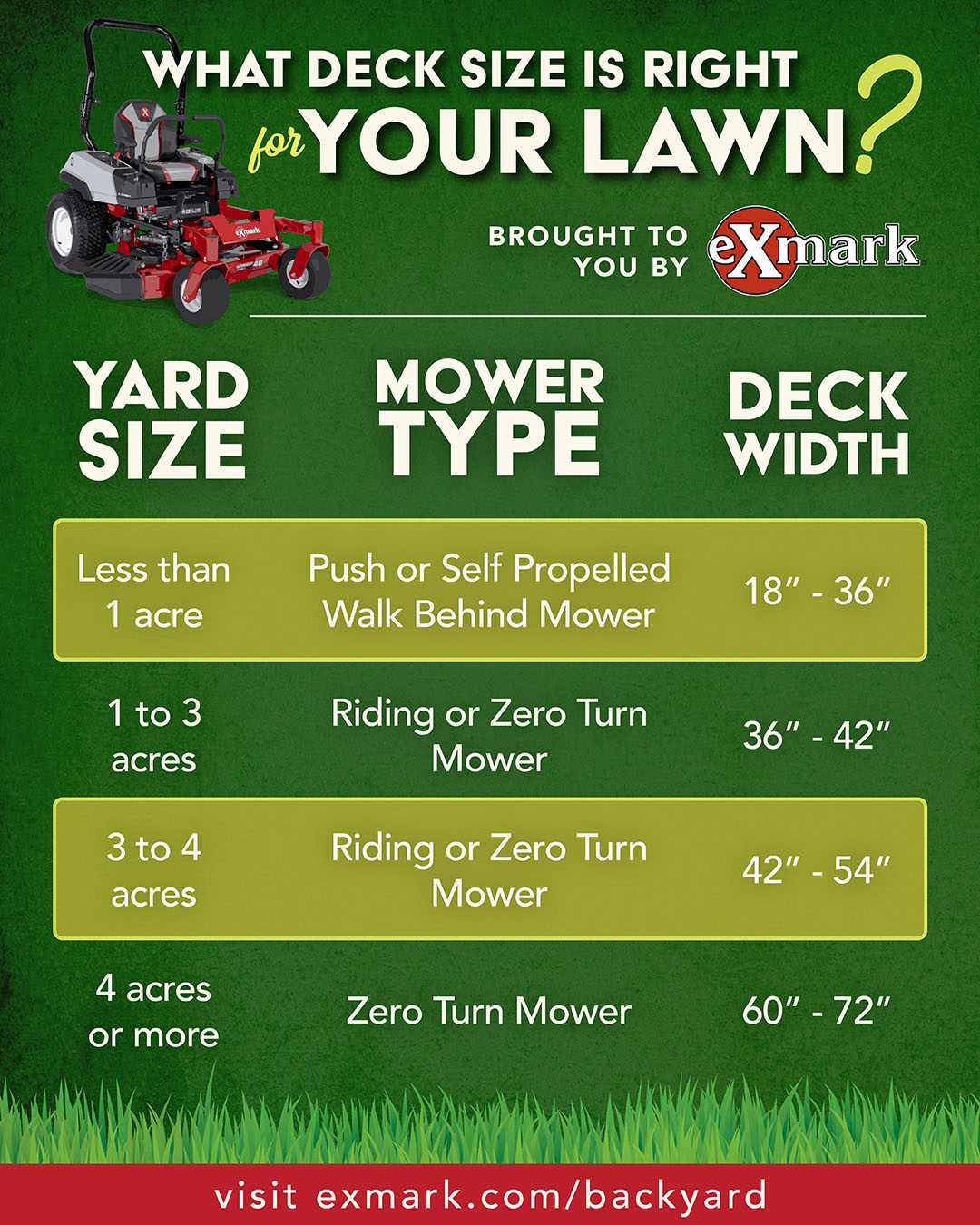
Image Source: backyard.exmark.com
Deciphering Lawn Mower Widths: A Crucial Choice
Choosing the right lawn mower involves many considerations, but one of the most impactful is its cutting width. This measurement directly affects how quickly you can mow your lawn and how efficiently you can navigate around obstacles.
What is a Lawn Mower’s Cutting Width?
The mower cutting width is the actual area of grass a mower can cut in one pass. It’s usually measured in inches. A wider cutting deck means fewer passes are needed to cover your entire lawn, saving you time and effort, especially for larger areas. However, a wider mower might be less maneuverable in tight spaces or around landscaping features.
Factors Influencing Mower Width
Several factors influence the typical width of a lawn mower:
- Type of Mower: Different mower types are designed for different lawn sizes and user needs, leading to variations in width.
- Intended Use: Homeowner mower width is generally smaller than commercial mower width because commercial mowers are built for speed and efficiency on large properties.
- Maneuverability Needs: Smaller widths offer better agility in complex yards with many trees, flower beds, or other landscaping elements.
- Storage Space: Wider mowers can take up more space in garages or sheds.
Types of Lawn Mowers and Their Typical Widths
Let’s explore the common types of lawn mowers and the lawn mower deck width you can expect from each.
Push Mower Width (and Reel Mower Width)
Push mower width is generally on the smaller side, as these mowers are typically used for smaller to medium-sized lawns and require manual propulsion.
Push Mower Characteristics:
- Propulsion: You push them yourself.
- Power Source: Can be electric (corded or battery) or gas-powered.
- Ideal For: Small to medium-sized lawns, yards with many obstacles, or areas where storage space is limited.
Push Mower Width Range:
- Standard Push Mowers (Rotary): These are the most common. Their cutting widths usually range from 18 to 22 inches.
- Self-Propelled Push Mowers: These offer a bit more power and ease of use, and their widths can extend slightly, sometimes reaching 21 to 23 inches.
Reel Mower Width:
Reel mower width is often quite similar to standard push mower widths, as they are also designed for smaller, well-maintained lawns where a precise cut is desired.
- How they work: Reel mowers use a cylindrical blade that spins against a stationary blade to “scissor” the grass. This provides a very clean cut.
- Reel Mower Width Range: Most reel mower width options are between 14 to 20 inches.
Walk-Behind Mower Width
The category of walk-behind mower width encompasses both standard push mowers and self-propelled models, and it’s designed for homeowners with small to medium-sized yards.
Walk-Behind Mower Variations:
- Basic Push Mowers: As mentioned, these are the most basic and often the narrowest.
- Self-Propelled Mowers: These take the effort out of pushing, often featuring front-wheel, rear-wheel, or all-wheel drive. They can sometimes have slightly wider decks to cover ground more efficiently.
- Electric (Corded/Battery) Walk-Behind Mowers: These often focus on lighter weight and quieter operation, and their widths are comparable to gas push mowers.
Walk-Behind Mower Width Summary:
| Mower Type | Typical Cutting Width (Inches) | Best For Lawn Size | Notes |
|---|---|---|---|
| Basic Push Mower | 18 – 21 | Small to Medium | Lightweight, good for tight spaces, manual effort |
| Self-Propelled Mower | 20 – 23 | Small to Medium | Easier to use on inclines, more power |
| Electric Walk-Behind | 18 – 21 | Small to Medium | Quieter, lighter, eco-friendly |
Riding Mower Dimensions (and Riding Mower Width)
Riding mower dimensions are significantly larger than walk-behind models, making them ideal for medium to large lawns. The riding mower width dictates how quickly you can cover large areas.
Types of Riding Mowers:
- Lawn Tractors: These are the most common type of riding mower. They are versatile and can often attach to various accessories like trailers, snow blowers, and aerators.
- Rear-Engine Riding Mowers: Typically smaller and more maneuverable than lawn tractors, often suitable for yards that are a bit too large for a walk-behind but not vast enough for a large tractor.
Riding Mower Width Range:
- Lawn Tractors: The lawn mower deck width for lawn tractors typically starts at 30 inches and can go up to 60 inches or more. Common sizes include 42, 46, 48, 50, and 54 inches.
- Rear-Engine Riding Mowers: These tend to have narrower decks, often ranging from 28 to 33 inches.
Zero Turn Mower Width
Zero turn mower width is a key characteristic, as these mowers are designed for speed and agility on larger properties. Their ability to turn on a dime makes them very efficient.
Zero Turn Mower Features:
- Zero-Turn Capability: Their steering system allows them to pivot 180 degrees on the spot, significantly reducing mowing time and improving maneuverability around obstacles.
- Commercial vs. Residential: Zero-turn mowers are popular with both commercial landscapers and homeowners with large yards.
Zero Turn Mower Width Range:
- Residential Zero-Turn Mowers: Homeowner models often have cutting widths ranging from 30 inches to 50 inches.
- Commercial Zero-Turn Mowers: For professional use, these can have much larger decks, commonly ranging from 48 inches to 72 inches or even wider.
Commercial Mower Width
Commercial mower width is all about maximizing efficiency and productivity for professionals who mow large areas regularly.
Commercial Mower Applications:
- Landscaping Businesses: Used for maintaining residential properties, commercial properties, parks, and sports fields.
- Municipalities: For groundskeeping in public spaces.
Commercial Mower Width Considerations:
- Speed and Coverage: Wider decks mean fewer passes, saving significant time and labor costs.
- Durability and Power: Commercial mowers are built to withstand heavier use and often have more powerful engines.
- Maneuverability: While they prioritize width, many commercial mowers, especially zero-turn models, are designed with maneuverability in mind for complex commercial properties.
Commercial Mower Width Range:
- Walk-Behind Commercial Mowers: These can be robust and wide, sometimes reaching 30 to 36 inches for professional landscapers working on medium-sized commercial properties or complex residential areas.
- Riding Commercial Mowers (Tractors and Zero-Turns): As noted earlier, these can range from 48 inches to over 72 inches, with 52, 60, and 72 inches being very common for rapid coverage.
Choosing the Right Lawn Mower Width for Your Needs
Selecting the appropriate lawn mower deck width depends on several critical factors related to your specific lawn and preferences.
Assessing Your Lawn Size
This is the most significant factor.
- Small Lawns (Under 1/4 Acre): A push mower width of 18-21 inches or a small walk-behind mower width of 21-23 inches is usually sufficient. Even a small zero turn mower width of 30 inches might be overkill unless you have many obstacles.
- Medium Lawns (1/4 to 1/2 Acre): A self-propelled walk-behind mower with a width of 21-23 inches is a good option. For easier mowing, a riding mower dimensions with a deck of 30-42 inches would be efficient.
- Large Lawns (1/2 Acre to 1 Acre): A riding mower with a deck width of 42-50 inches will significantly speed up mowing. A zero turn mower width of 42-48 inches would be even more efficient and maneuverable.
- Very Large Lawns (Over 1 Acre): You’ll likely need a larger riding mower dimensions with a deck of 50 inches or more, or a commercial-grade zero turn mower width of 50-72 inches.
Considering Lawn Complexity and Obstacles
- Open, Flat Lawns: Wider decks are excellent here, as they allow you to cover ground quickly.
- Lawns with Many Trees, Flower Beds, and Narrow Passages: Narrower decks offer superior maneuverability. A wider mower can be frustrating and time-consuming to navigate around intricate landscaping. For complex yards, consider a smaller walk-behind mower width or a residential zero turn mower width in the 30-42 inch range.
Your Physical Strength and Preferences
- Physical Fitness: If you have limited physical strength or are concerned about the effort involved, a self-propelled mower or a riding mower is a better choice. A narrow push mower width can be manageable for some, but a wider one can become quite strenuous.
- Time Commitment: If you want to spend less time mowing, a wider deck is your best friend, especially for larger areas.
Storage and Budget
- Storage Space: Wider mowers, especially riding models, require more storage space. Measure your garage or shed before purchasing.
- Budget: Generally, wider decks and more advanced mower types (like zero-turns) come with a higher price tag. Homeowner mower width options tend to be more budget-friendly than commercial mower width options, even at similar deck sizes.
Comparing Common Lawn Mower Widths: A Visual Aid
To help solidify your understanding, let’s visualize the typical cutting widths:
| Mower Type | Typical Cutting Width Range (Inches) | Primary Use Case |
|---|---|---|
| Reel Mower | 14 – 20 | Small, manicured lawns, precision cut |
| Standard Push Mower | 18 – 21 | Small to medium lawns, budget-friendly, maneuverable |
| Self-Propelled Mower | 20 – 23 | Small to medium lawns, less effort on slopes |
| Rear-Engine Rider | 28 – 33 | Medium lawns, more comfortable than walk-behinds |
| Residential Zero-Turn | 30 – 50 | Medium to large lawns, quick, agile |
| Lawn Tractor | 30 – 60+ | Medium to large lawns, versatile, towing |
| Commercial Walk-Behind | 30 – 36 | Medium to large lawns, professional, durable |
| Commercial Zero-Turn | 48 – 72+ | Large to very large properties, maximum efficiency |
Additional Considerations Beyond Width
While lawn mower deck width is paramount, other features contribute to a mower’s performance and your satisfaction.
Engine Power
A wider deck requires a more powerful engine to maintain consistent cutting speed and quality, especially in thicker or taller grass. Ensure the engine horsepower is adequate for the deck size.
Cutting Height Adjustment
The ability to easily adjust the cutting height is crucial for maintaining grass health. Look for mowers with simple, multi-position height adjustments.
Mulching, Bagging, and Side Discharge
Most mowers offer options for how they handle grass clippings:
- Mulching: Chops clippings into fine pieces and returns them to the lawn as fertilizer.
- Bagging: Collects clippings in a bag for disposal or composting.
- Side Discharge: Ejects clippings out the side of the deck.
Mower Type and Drive System
- Front-Wheel Drive (FWD): Good for maneuverability, especially on inclines.
- Rear-Wheel Drive (RWD): Offers better traction, especially on hills.
- All-Wheel Drive (AWD): Provides the best traction in all conditions.
- Zero-Turn Steering: Offers unparalleled agility.
Ease of Maintenance
Consider how easy it is to clean the deck, sharpen or replace blades, and perform routine maintenance tasks.
Frequently Asked Questions (FAQ)
What is the most common lawn mower width for homeowners?
For homeowner mower width, the most common range for walk-behind mowers is 20-22 inches. For riding mowers, 42-48 inches is very popular for medium to large yards.
Can I mow a large lawn with a narrow mower?
Yes, you can mow a large lawn with a narrow mower, but it will take significantly longer. A wider mower cutting width is much more efficient for larger areas.
How does zero turn mower width compare to a lawn tractor width?
While both are riding mowers, zero turn mower width and lawn tractor widths often overlap. However, zero-turn mowers are typically designed with wider decks for greater efficiency on large properties, with commercial models commonly exceeding 60 inches, whereas lawn tractors might top out around 54-60 inches for residential use.
What is a good width for a small yard?
For a small yard, a push mower width of 18-21 inches or a small walk-behind mower width of up to 23 inches is generally ideal. They are easier to maneuver and store.
Is a wider lawn mower always better?
Not necessarily. While a wider lawn mower deck width saves time on large, open lawns, it can be cumbersome and less efficient in yards with many obstacles or tight spaces. Maneuverability is key in such scenarios.
What is the average lawn mower size?
The average lawn mower size depends on the type. For walk-behind mowers, the cutting width is around 20-22 inches. For riding mowers, it’s more like 42-48 inches for the deck, but the overall machine is much larger and heavier.
By carefully considering your lawn’s characteristics and your personal preferences, you can confidently select a lawn mower with the ideal width for a beautifully maintained yard.