
So, how much does a yard of cured concrete weigh? A typical cubic yard of cured concrete weighs approximately 4,000 pounds (or about 2 tons). This figure can vary slightly depending on the specific mix design, but it provides a solid general estimate for most construction and DIY projects.
This article will delve into the factors influencing the weight of concrete, explore the concept of concrete density, and help you accurately estimate the weight of concrete for your needs. We’ll cover everything from understanding concrete mix weight to deciphering the typical concrete weight you can expect for various applications.
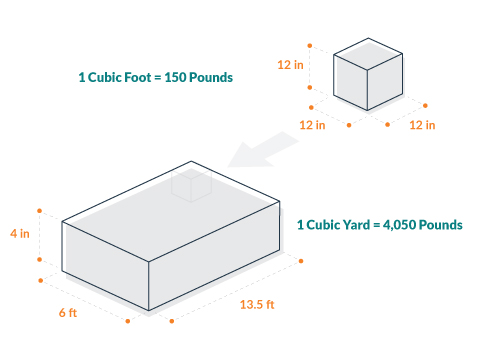
Image Source: www.dumpsters.com
Fathoming the Weight of Concrete
When you’re planning a project that involves concrete, knowing its weight is crucial for several reasons. It impacts transportation logistics, the structural capacity of foundations and supports, and even the amount of material you need to order. Let’s break down what goes into determining the weight of a cubic yard of concrete.
The Fundamentals of Concrete Volume to Weight
The relationship between concrete volume and weight is primarily governed by its density. Density is a measure of mass per unit of volume. In simpler terms, it tells you how much “stuff” is packed into a certain space. For concrete, this “stuff” includes cement, aggregates (sand and gravel), water, and admixtures.
A cubic yard of concrete is a standard unit of measurement in the construction industry. It represents a cube of concrete measuring 3 feet by 3 feet by 3 feet. When we talk about the weight of concrete, we’re usually referring to its weight in a cured state, meaning the chemical reaction between cement and water (hydration) has largely completed, and the concrete has hardened.
Concrete Density: The Key to Weight Estimation
Concrete density is not a fixed number; it varies based on the ingredients and their proportions in the concrete mix. Higher density means more weight per cubic foot or cubic yard. Conversely, lower density indicates less weight.
- Aggregates: The type and size of aggregates (sand, gravel, crushed stone) used in the concrete mix significantly influence its density. Denser aggregates will lead to denser concrete.
- Water-Cement Ratio: The amount of water used in the mix relative to the cement also plays a role. A lower water-cement ratio generally leads to stronger, denser concrete.
- Air Content: Entrained air, intentionally added to improve freeze-thaw resistance, reduces the overall density of the concrete.
The Weight of Concrete Per Cubic Yard: A Closer Look
As mentioned, the weight of concrete per cubic yard is a critical piece of information for any project. While 4,000 pounds is a good average, understanding the range is important for accurate planning.
Typical Concrete Weight Ranges:
| Concrete Type | Approximate Weight per Cubic Yard (lbs) | Notes |
|---|---|---|
| Normal Weight | 3,600 – 4,200 | Most common type, used in standard construction. |
| Lightweight | 2,000 – 3,500 | Uses lightweight aggregates like expanded shale or clay. |
| High-Density | 5,000+ | Used for specific applications like radiation shielding, uses heavy aggregates like barite. |
This table highlights that estimating concrete weight requires knowledge of the specific concrete mix being used.
Concrete Mix Weight: What’s Inside Matters
The concrete mix weight is directly determined by the ingredients that make up the concrete. A standard concrete mix, often referred to as “normal weight concrete,” typically consists of:
- Cement: The binder that reacts with water to harden.
- Fine Aggregate: Sand.
- Coarse Aggregate: Gravel or crushed stone.
- Water: Essential for the hydration process.
- Admixtures (Optional): Chemicals added to modify properties like workability, strength, or setting time.
Each of these components has its own density, and their combined proportions dictate the overall density and, therefore, the weight of the final cured concrete weight.
Deconstructing a Typical Concrete Mix
Let’s look at a common volumetric mix ratio, which is often simplified for understanding. A typical “1:2:3” mix (cement:sand:gravel by volume) will yield a certain weight per cubic yard.
- Cement: A bag of Portland cement typically weighs 94 lbs and has a volume of about 1 cubic foot.
- Sand: Dry sand weighs around 100-120 lbs per cubic foot.
- Gravel: Dry gravel weighs around 90-110 lbs per cubic foot.
When these materials are mixed with water, they occupy space differently due to the filling of voids. This is why simply adding the dry weights of the components doesn’t directly give you the wet or cured weight. Water adds mass, and the hydration process causes shrinkage, but the overall effect is that the cured concrete is denser than its individual dry components might suggest.
Standard Concrete Weight: What to Expect for Common Uses
The standard concrete weight is what most people encounter in everyday construction. This is your go-to figure for driveways, patios, sidewalks, and basic structural elements.
- Driveways and Patios: These typically use a standard mix designed for durability and moderate strength. The weight will fall within the normal weight range (3,600-4,200 lbs/yd³).
- Foundations: Foundations require strength and stability, often using mixes with a slightly higher cement content or denser aggregates, pushing the weight towards the upper end of the normal range.
- Structural Beams and Columns: These often require higher strength concrete, which can sometimes translate to slightly higher density and weight.
Factors Affecting Standard Concrete Weight
Even within the “standard” category, variations can occur:
- Aggregate Source: The specific type of gravel or crushed stone used can have slightly different densities. Limestone aggregate, for instance, is denser than granite.
- Moisture Content: While we discuss cured concrete, some residual moisture can slightly increase the weight compared to perfectly dry cured concrete.
- Air Entrainment: If air entrainment is added for freeze-thaw resistance, it will slightly reduce the overall weight.
How Much Does Concrete Weigh? Quantifying the Mass
To answer how much does concrete weigh more precisely, we need to consider its density in pounds per cubic foot. A common figure for the density of normal weight concrete is around 150 pounds per cubic foot (pcf).
To convert this to pounds per cubic yard, we use the conversion factor:
1 cubic yard = 27 cubic feet (3 ft x 3 ft x 3 ft)
So, if concrete weighs 150 lbs per cubic foot:
150 lbs/ft³ * 27 ft³/yd³ = 4,050 lbs/yd³
This calculation brings us back to our initial estimate of around 4,000 pounds per cubic yard for standard concrete.
Estimating Concrete Weight for Your Project
When you’re planning a project, you’ll likely need to calculate the volume of concrete required first. This is usually done by measuring the dimensions of the space to be filled and multiplying them together (length x width x height). Ensure all measurements are in the same units, preferably feet, to get the volume in cubic feet. Then, divide by 27 to get the volume in cubic yards.
Example:
You need to pour a concrete slab that is 10 feet long, 12 feet wide, and 4 inches thick.
- Convert thickness to feet: 4 inches / 12 inches/foot = 0.333 feet
- Calculate volume in cubic feet: 10 ft * 12 ft * 0.333 ft = 39.96 cubic feet
- Convert volume to cubic yards: 39.96 cubic feet / 27 cubic feet/yd³ ≈ 1.48 cubic yards
Now, using our typical concrete weight of 4,000 lbs/yd³:
1.48 yd³ * 4,000 lbs/yd³ = 5,920 lbs
So, you would need approximately 5,920 pounds of concrete for this slab. It’s always a good idea to round up to the nearest quarter or half cubic yard when ordering to account for spillage or slight inaccuracies in measurement.
The Nuances of Cured Concrete Weight
The term cured concrete weight refers to the weight after the concrete has hardened and reached its designed strength. The curing process involves a chemical reaction, and while it’s the stage where concrete achieves its final properties, it’s also important to note that:
- Initial Set vs. Final Set: Concrete starts to harden (initial set) within a few hours and continues to gain strength and density over weeks and months (final set and beyond). The weight doesn’t change significantly after the initial set, but density and strength do.
- Shrinkage: During curing, concrete does experience some shrinkage as excess water evaporates. This can slightly reduce the overall volume and concentrate the mass, but the weight itself is primarily determined by the initial mix ingredients.
Lightweight and Heavyweight Concrete Considerations
Beyond the standard, there are specialized concrete types that deviate significantly in weight:
Lightweight Concrete
Lightweight concrete is designed to reduce the dead load on structures. It’s achieved by using lightweight aggregates such as:
- Expanded shale
- Expanded clay
- Expanded slate
- Pumice
- Scoria
This type of concrete is often used in situations where reducing the overall weight of a structure is paramount, such as in high-rise buildings or for precast components. Its lower density means a lower weight of concrete per cubic yard.
Applications for Lightweight Concrete:
- Precast floor and roof slabs
- Concrete masonry units (cinder blocks)
- Insulating concrete decks
- Non-structural fill
Heavyweight Concrete
Conversely, heavyweight concrete is used when increased mass is required, most commonly for radiation shielding in nuclear facilities and medical imaging rooms. This is achieved by using dense aggregates like:
- Barite
- Magnetite
- Hematite
- Ilmenite
The high density of these aggregates results in a significantly higher concrete density and, consequently, a much greater cured concrete weight.
Applications for Heavyweight Concrete:
- Radiation shielding (hospitals, power plants)
- Counterweights
- Ballast
Practical Implications for Your Project
Knowing how much does concrete weigh directly impacts several aspects of your project planning:
-
Transportation: The weight of concrete is a major consideration for delivery. Trucks have weight limits, and knowing the weight of a cubic yard helps determine how many yards can be legally and safely transported. A concrete truck typically carries between 8 and 11 cubic yards of concrete.
- 8 cubic yards * 4,000 lbs/yd³ = 32,000 lbs (16 tons)
- 11 cubic yards * 4,000 lbs/yd³ = 44,000 lbs (22 tons)
These figures, plus the weight of the truck itself, must be within legal road limits.
-
Structural Support: When pouring concrete for floors, balconies, or foundations, the underlying structure must be able to support the immense weight of the cured concrete. Engineers use the concrete density to calculate the load accurately.
-
Ordering Material: While you order concrete by volume (cubic yards), knowing the approximate weight helps if you’re calculating load limits for smaller deliveries or if you need to inform a supplier about unusual weight requirements.
-
DIY Lifting and Moving: If you’re working with smaller batches of concrete or precast elements, the weight is crucial for planning how to lift, move, and place them safely.
Deciphering the Calculations for Concrete Volume to Weight
Let’s reinforce the process of converting volume to weight. The core of this is the density, typically expressed in pounds per cubic foot (pcf) or kilograms per cubic meter (kg/m³).
- Step 1: Determine Volume: Measure the dimensions of your project in feet (length, width, height/thickness).
- Volume (cubic feet) = Length (ft) × Width (ft) × Height (ft)
- Step 2: Convert to Cubic Yards: Divide the volume in cubic feet by 27.
- Volume (cubic yards) = Volume (cubic feet) / 27
- Step 3: Apply Weight per Cubic Yard: Multiply the volume in cubic yards by the estimated weight per cubic yard.
- Total Weight (lbs) = Volume (cubic yards) × Weight per Cubic Yard (lbs/yd³)
Example with different dimensions:
A concrete footing is 20 ft long, 2 ft wide, and 1 ft deep.
- Volume (cubic feet): 20 ft × 2 ft × 1 ft = 40 cubic feet
- Volume (cubic yards): 40 ft³ / 27 ft³/yd³ ≈ 1.48 cubic yards
- Total Weight (lbs): 1.48 yd³ × 4,000 lbs/yd³ = 5,920 lbs
Frequently Asked Questions (FAQ)
Q1: Does the slump of concrete affect its weight?
A: The slump of concrete refers to its workability or how much it slumps when placed in a cone test. While a wetter mix (higher slump) might have a slightly higher initial weight due to more water, the final cured weight is more dependent on the solid components and the overall water-cement ratio rather than just the slump value itself. Significantly changing the water content to alter slump will impact density and thus weight.
Q2: What is the weight of a bag of concrete?
A: A standard bag of concrete mix (often called “concrete mix” or “concrete patching material,” not pure cement) typically weighs 40 lbs or 80 lbs. These bags are designed to yield a specific volume when mixed with water. For instance, an 80 lb bag of a typical concrete mix might yield about 0.6 cubic feet of concrete, which is much less than a cubic yard. To get a cubic yard, you’d need roughly 1.5 of the 80 lb bags (since 27 cubic feet / 0.6 cubic feet/bag ≈ 45 bags, but this is a simplified calculation and varies by product). Always check the product packaging for yield information.
Q3: Is the weight of concrete the same when it’s wet versus cured?
A: No, wet concrete is heavier than cured concrete. When concrete is mixed, it contains a significant amount of water. As it cures, some of this water is used in the hydration process, and some evaporates. While the hydration process itself adds mass to the hardened cement paste, the net effect over time, especially considering water evaporation, is that the fully cured concrete is slightly less dense and thus lighter than its freshly mixed, wet state. However, for practical purposes and when discussing structural loads, we usually refer to the weight of the cured concrete.
Q4: How do I calculate the weight of concrete needed for a specific job?
A: First, calculate the volume of concrete required in cubic yards. Then, multiply that volume by the estimated weight per cubic yard for the type of concrete you are using (typically around 4,000 lbs/yd³ for standard concrete). Always round up your order quantity.
Q5: Can I use the weight of concrete to determine its strength?
A: While denser concrete is often stronger, you cannot reliably determine concrete strength solely by its weight. Strength is primarily a function of the water-cement ratio, aggregate quality, and proper curing. Specialized mixes with lightweight aggregates can be strong despite being lighter, and mixes with lightweight air entrainment can also have varied strength-to-weight ratios. Always refer to the mix design or specifications for strength information.
By now, you should have a thorough grasp of how much does a yard of cured concrete weigh, the factors influencing its density, and how to apply this knowledge to your projects. Whether you’re a seasoned contractor or a DIY enthusiast, this information is fundamental for successful and safe construction.