
How much area does a cubic yard of mulch cover? Generally, a cubic yard of mulch covers about 100 square feet at a depth of 3 inches. However, this can vary based on the desired depth and the type of mulch used.
Whether you’re planning a small garden bed refresh or a complete landscape overhaul, knowing your landscaping mulch quantity is crucial for efficient purchasing and effective application. Mulch not only beautifies your yard but also conserves moisture, suppresses weeds, and improves soil health. But the real question for any DIY landscaper is: how much mulch do I actually need? This guide will break down how much a yard of mulch covers, helping you avoid overspending or under-delivering on your mulching project. We’ll delve into mulch calculation formula, mulch depth calculator use, and how to determine how many bags of mulch per yard.
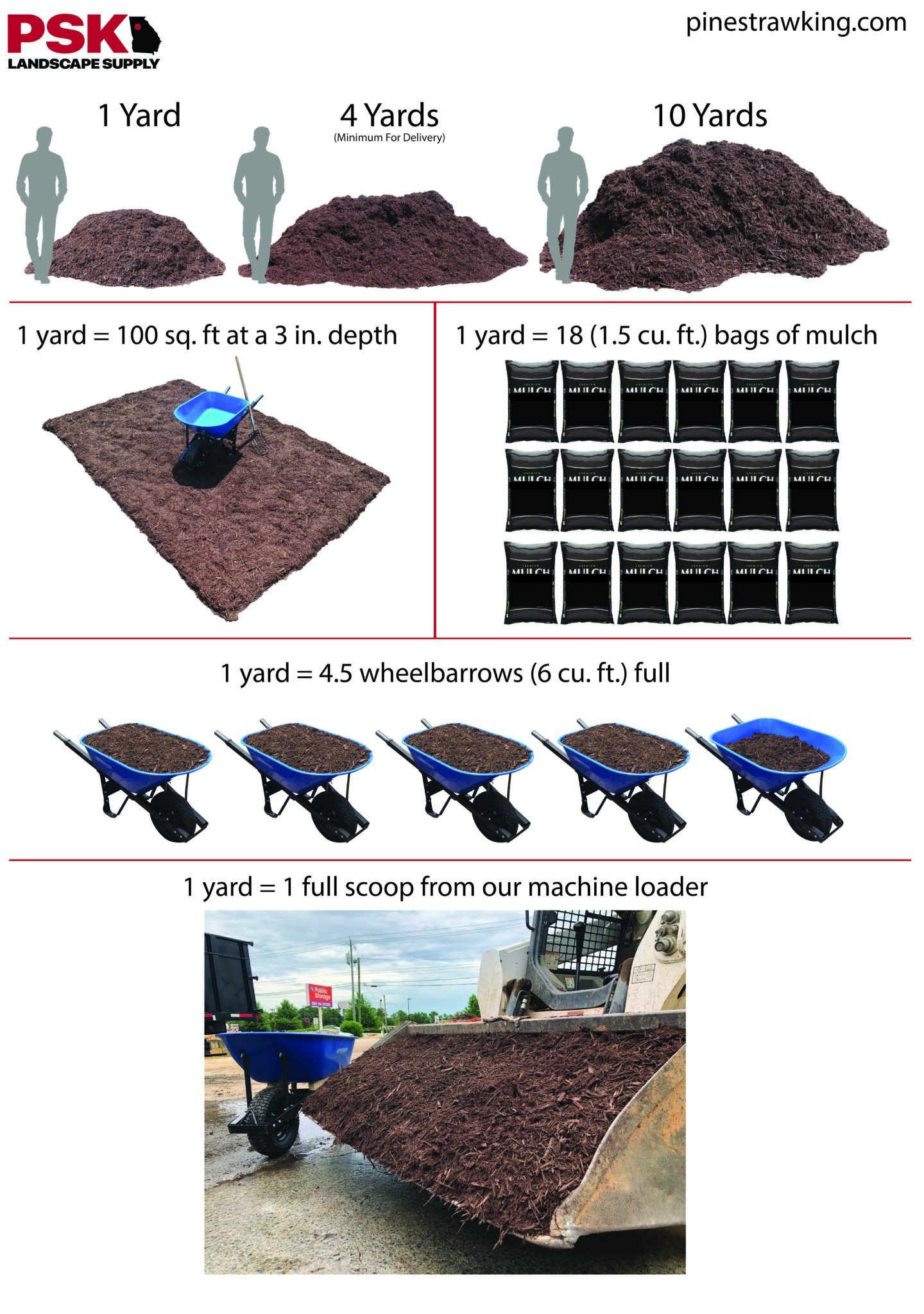
Image Source: pinestrawking.com
Gauging Your Mulch Needs: The Fundamentals
Before you can calculate coverage, it’s important to understand the basic unit of measurement for bulk mulch. Mulch is typically sold by the cubic yard. A cubic yard is a measure of volume, representing a cube that is three feet long, three feet wide, and three feet high (3′ x 3′ x 3′).
The Magic of Depth: How Thickness Affects Coverage
The most significant factor influencing how much area a cubic yard of mulch covers is the mulch depth. Most landscaping professionals recommend a mulch depth of 2 to 3 inches for optimal benefits.
- Too thin: Applying mulch too thinly won’t effectively suppress weeds or retain moisture. It also looks less appealing.
- Too thick: Applying mulch too thickly can suffocate plant roots, prevent water from reaching the soil, and even encourage fungal growth.
For this reason, using a mulch depth calculator or a mulch coverage chart is highly recommended to ensure you achieve the ideal layer.
Recommended Mulch Depths:
- General Garden Beds: 2-3 inches
- Around Trees (Root Flare): 2-3 inches, keeping mulch away from the trunk itself.
- New Plantings: 2-3 inches
- Steep Slopes: 3-4 inches (to prevent erosion)
The Role of Mulch Type
While the depth is paramount, the type of mulch can also play a minor role in coverage.
- Shredded Bark/Wood Mulch: These are common and generally consistent in how they pack down.
- Pine Needles/Straw: These can be lighter and might settle more, potentially requiring a slightly deeper application for the same level of coverage.
- Composted Mulch: This can be denser and may settle more than wood mulches.
However, for practical purposes, the depth remains the primary driver of square foot mulch coverage.
Calculating Your Mulch Requirements: Step-by-Step
The process of calculating mulch needs involves a few simple steps. The core is to determine the total area you want to cover and then divide that by the coverage rate of a cubic yard at your desired depth.
Step 1: Measure Your Area
You need to know the total square footage of the areas you plan to mulch.
- Sketch Your Landscape: Draw a simple diagram of your garden beds, around trees, or any other areas that require mulch.
- Measure Dimensions: Use a tape measure to find the length and width of each section.
- Calculate Square Footage: For rectangular or square areas, multiply the length by the width (Length x Width = Square Footage).
- Example: A garden bed that is 10 feet long and 4 feet wide has an area of 40 square feet (10′ x 4′ = 40 sq ft).
- Calculate for Irregular Shapes: For circular areas, measure the diameter and use the formula: π * (radius)² = Square Footage. (Radius = Diameter / 2).
- Example: A circular bed with a 6-foot diameter (3-foot radius) has an area of approximately 28.3 square feet (3.14 * (3 ft)² ≈ 28.3 sq ft).
- Sum Total Square Footage: Add up the square footage of all your sections to get your total area needing mulch.
Step 2: Determine Your Desired Mulch Depth
As discussed, 2-3 inches is the standard recommendation. Let’s use 3 inches as our example for calculating cubic yard mulch coverage.
Step 3: Using the Mulch Calculation Formula
The core mulch calculation formula is:
Total Square Feet to Cover / Coverage Rate per Cubic Yard = Cubic Yards Needed
However, the “Coverage Rate per Cubic Yard” is not a fixed number; it depends on the depth. We need to convert the desired depth into feet to work with the cubic yard measurement.
- Convert inches to feet: Divide the desired depth in inches by 12 (since there are 12 inches in a foot).
- Example: 3 inches / 12 inches/foot = 0.25 feet
Now, we can derive a more specific formula for square foot mulch coverage:
Coverage per Cubic Yard (sq ft) = 1 / Desired Depth (in feet)
- Example: At a 3-inch depth (0.25 feet), one cubic yard covers: 1 / 0.25 = 400 square feet.
So, a general rule of thumb is:
- 1 cubic yard covers approximately 100 sq ft at 3 inches deep.
- 1 cubic yard covers approximately 133 sq ft at 2 inches deep.
- 1 cubic yard covers approximately 66 sq ft at 4 inches deep.
Let’s refine the calculation using your total area:
Cubic Yards Needed = Total Square Footage to Cover / Coverage per Cubic Yard (at desired depth)
- Example Calculation:
- You have a garden bed measuring 50 sq ft.
- You want to apply mulch at a 3-inch depth.
- From our derived coverage rate, 1 cubic yard covers 400 sq ft at 3 inches.
- Cubic Yards Needed = 50 sq ft / 400 sq ft/cubic yard = 0.125 cubic yards.
Step 4: Convert to Bags if Necessary
Bulk mulch is often more economical for larger projects. However, for smaller areas, bagged mulch might be more convenient. You’ll need to know how many bags of mulch per yard are equivalent.
Bagged mulch typically comes in 2 cubic foot bags.
- Cubic Feet in a Cubic Yard: A cubic yard is 27 cubic feet (3′ x 3′ x 3′ = 27 cu ft).
- Bags per Cubic Yard: 27 cubic feet / 2 cubic feet/bag = 13.5 bags.
So, if your calculation indicates you need 1 cubic yard of mulch, you would need approximately 14 bags of 2 cubic foot mulch.
- Example Calculation (using bags):
- You need 0.125 cubic yards of mulch.
- Number of Bags Needed = 0.125 cubic yards * 13.5 bags/cubic yard ≈ 1.69 bags.
- Since you can’t buy parts of bags, you would round up and buy 2 bags.
Practical Application: Using a Mulch Coverage Calculator
Manually calculating can sometimes lead to errors, especially with irregular shapes or when converting units. This is where a mulch coverage calculator becomes invaluable. These online tools allow you to input your area dimensions and desired depth, and they automatically provide the landscaping mulch quantity you need.
Many landscaping supply companies offer these tools on their websites, making the process quick and straightforward. They often provide results in both cubic yards and the equivalent number of bags.
How to Use a Mulch Coverage Calculator:
- Enter Project Area: Input the length and width of your garden beds or other areas. If you have multiple sections, you might need to calculate each separately and add them up, or some calculators allow for multiple inputs.
- Specify Mulch Depth: Select your desired mulch depth (e.g., 2 inches, 3 inches).
- View Results: The calculator will then display the total cubic yards of mulch required and, often, the number of bags needed based on standard bag sizes.
Using a mulch calculator simplifies the calculating mulch needs process significantly.
Factors Affecting Your Mulch Quantity
While the formulas provide a good starting point, a few real-world factors can influence how much mulch you actually use.
Compaction and Settling
Fresh mulch, especially wood-based varieties, can be fluffy and contain air pockets. As it settles, it will compact. It’s always a good idea to buy a little extra (5-10%) to account for this settling, especially if you want to maintain a consistent depth over time. This is where a mulch depth calculator might not account for long-term settling.
Uneven Terrain
If your landscape has significant slopes or dips, you might end up using slightly more mulch in some areas to achieve a consistent depth across the entire surface.
Type of Mulch (Again)
While depth is the main factor, some mulches naturally pack down more than others. Fine-textured mulches might settle more rapidly than larger, chunkier wood chips.
Application Method
How you spread the mulch can also affect the final depth. If you’re not careful, you might accidentally apply it too thinly in some spots and too thickly in others. Using tools like a rake with depth markers or simply being mindful of your application can help.
Sample Mulch Coverage Scenarios
Let’s illustrate with some common scenarios.
Scenario 1: Small Flower Bed
- Dimensions: 6 feet long x 3 feet wide
- Total Area: 18 sq ft (6′ x 3′)
- Desired Depth: 3 inches
Using our formula:
* Coverage at 3 inches: 400 sq ft per cubic yard.
* Cubic Yards Needed: 18 sq ft / 400 sq ft/cubic yard = 0.045 cubic yards.
This is a very small amount, likely less than one bag of bagged mulch. If you use 2 cubic foot bags:
* Number of Bags Needed: 0.045 cubic yards * 13.5 bags/cubic yard ≈ 0.6 bags.
* You would need to buy 1 bag of mulch.
Scenario 2: Large Garden Area
- Dimensions: 20 feet long x 10 feet wide
- Total Area: 200 sq ft (20′ x 10′)
- Desired Depth: 3 inches
Using our formula:
* Coverage at 3 inches: 400 sq ft per cubic yard.
* Cubic Yards Needed: 200 sq ft / 400 sq ft/cubic yard = 0.5 cubic yards.
This is a significant amount, and you’d likely buy it in bulk. If you were to buy bagged mulch:
* Number of Bags Needed: 0.5 cubic yards * 13.5 bags/cubic yard = 6.75 bags.
* You would need to buy 7 bags of mulch.
Scenario 3: Around a Large Tree
- Area: A circular area with a 10-foot diameter around a tree.
- Radius: 5 feet (10′ / 2)
- Desired Depth: 2 inches
First, calculate the area:
* Area = π * (radius)² = 3.14 * (5 ft)² = 3.14 * 25 sq ft = 78.5 sq ft.
Now, let’s determine coverage at 2 inches deep:
* Coverage at 2 inches: 133 sq ft per cubic yard.
* Cubic Yards Needed: 78.5 sq ft / 133 sq ft/cubic yard ≈ 0.59 cubic yards.
If purchasing in bulk, you’d likely round up to 1 cubic yard to be safe and account for settling. If buying bags:
* Number of Bags Needed: 0.59 cubic yards * 13.5 bags/cubic yard ≈ 7.97 bags.
* You would need to buy 8 bags of mulch.
Tools to Aid Your Calculations
Here’s a breakdown of helpful tools and resources for calculating mulch needs:
Mulch Depth Calculator
While not a separate tool in the sense of a website, the concept of a mulch depth calculator is embedded within mulch coverage chart and mulch calculator tools. It essentially helps you determine how many square feet a cubic yard will cover based on the depth you select.
Mulch Coverage Chart
A mulch coverage chart provides a quick reference for how much area a cubic yard will cover at various depths.
Table: Mulch Coverage Chart (Approximate Square Feet per Cubic Yard)
| Mulch Depth (Inches) | Coverage (Square Feet per Cubic Yard) |
|---|---|
| 1 | 800 |
| 2 | 400 |
| 3 | 267 |
| 4 | 200 |
Note: These are approximate values for calculation purposes. Actual coverage can vary slightly.
Mulch Calculation Formula Explained
As we’ve seen, the fundamental mulch calculation formula boils down to:
Total Area to Cover (sq ft) / Coverage Rate (sq ft per cubic yard) = Cubic Yards Needed
Where the Coverage Rate is derived from the desired depth:
Coverage Rate (sq ft/cu yd) = 27 cu ft/cu yd / (Desired Depth in ft)
(Remember to convert desired depth from inches to feet by dividing by 12).
How Many Bags of Mulch Per Yard
This is a common question for those opting for bagged mulch. As established, if using standard 2 cubic foot bags, you’ll need approximately 13.5 bags of mulch per cubic yard. Always check the volume listed on the mulch bag, as it can sometimes vary.
Tips for Purchasing and Applying Mulch
- Buy in Bulk When Possible: For larger areas, purchasing mulch by the cubic yard from a landscape supplier is often more cost-effective than buying numerous bags. Many suppliers offer delivery services.
- Check Bag Size: Ensure you know the volume of the bags you are buying. Most standard bags are 2 cubic feet, but some may be larger or smaller.
- Order Extra: It’s wise to add 5-10% extra mulch to your order to account for settling, uneven application, or unforeseen needs.
- Consider Mulch Type for Your Needs:
- Wood Chips/Bark: Durable, long-lasting, good for weed suppression.
- Shredded Bark: Finer texture, breaks down faster, good for smaller beds.
- Pine Needles: Lightweight, good for acidic-loving plants, can blow away in high winds.
- Compost: Improves soil structure as it breaks down, provides nutrients.
- Apply Evenly: Use a rake to spread the mulch consistently across the area. Avoid piling mulch against the trunks of trees and shrubs, as this can lead to rot and disease. Aim for the recommended mulch depth.
- Refresh Annually (or as needed): Mulch decomposes over time. You’ll likely need to top it up or replace it every year or two to maintain its benefits and appearance.
Frequently Asked Questions (FAQ)
How thick should I apply mulch?
The ideal mulch depth is generally 2 to 3 inches. This depth effectively suppresses weeds, retains soil moisture, and regulates soil temperature without harming plants. For areas prone to erosion, like slopes, you might go up to 4 inches.
Can I use a different depth than the standard 3 inches?
Yes, you can adjust the mulch depth. If you choose a different depth, remember that it will alter your square foot mulch coverage. For example, a 2-inch depth will allow a cubic yard to cover more square footage than a 3-inch depth. Always refer to your mulch coverage chart or use a mulch coverage calculator to adjust for your chosen depth.
What if my garden beds are not rectangular?
For irregular shapes, you can break them down into smaller, measurable sections (rectangles, squares, circles) and calculate the area of each. Then, add all the individual areas together to get your total square footage. Alternatively, many online mulch coverage calculator tools allow you to input complex shapes or multiple dimensions.
How much mulch do I need for a 4×8 foot garden bed?
For a 4×8 foot garden bed (32 sq ft) at a 3-inch depth, you would need approximately 0.08 cubic yards (32 sq ft / 400 sq ft/cubic yard). This is less than one bag of 2 cubic foot mulch, so you’d buy one bag.
Is it better to buy mulch in bags or in bulk?
For small areas or specific color needs, bagged mulch is convenient. For larger projects, buying mulch in bulk by the cubic yard is almost always more economical and reduces packaging waste. Many garden centers and landscape suppliers offer bulk delivery.
By carefully measuring your space and using these guidelines and tools for calculating mulch needs, you can ensure you purchase the right landscaping mulch quantity for a beautiful and healthy garden.