
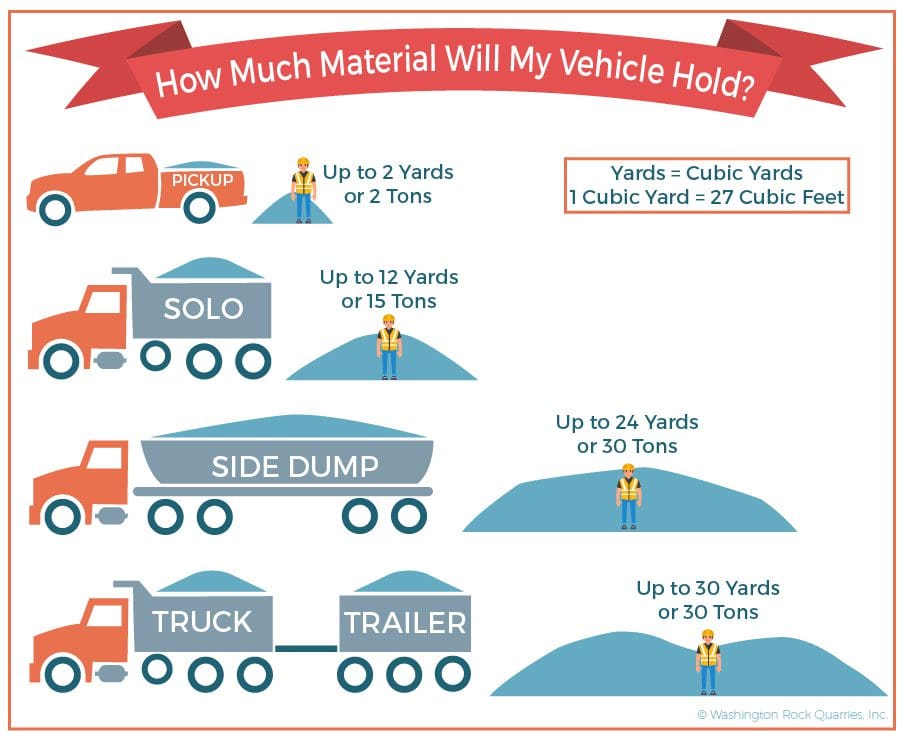
Image Source: www.wa-rock.com
How Many Tons In A Square Yard? Your Guide
To determine how many tons are in a square yard, you first need to know the material’s density and the depth or thickness of the material. There isn’t a fixed conversion; it’s a calculation based on these two factors.
When working with construction, landscaping, or even crafting, you’ll often encounter measurements in both square yards and tons. The question of “how many tons in a square yard?” is a common one, but it’s not as straightforward as converting inches to feet. Unlike volume measurements where a direct conversion might exist, weight in tons relates to a specific material’s density and its spread over an area. This guide will walk you through the process, making it simple to figure out the weight of any material you’re working with, from gravel to soil.
Deciphering the Weight of Materials
The core of this question lies in something called density, or the unit weight of materials. Density tells us how much a material weighs for a given volume. Think of it like this: a pound of feathers takes up a lot more space than a pound of lead. They have different densities. When we talk about tons per square yard, we’re essentially asking about the weight of a layer of material spread across one square yard.
To make this calculation, we need two key pieces of information:
- The density of the material: This is typically expressed in pounds per cubic foot (lb/ft³) or kilograms per cubic meter (kg/m³).
- The thickness or depth of the material: This is how deep the material is spread over the square yard.
Once you have these, you can use a material weight calculator or follow these steps to calculate weight.
Material Density: The Foundation of Your Calculation
Every material has a different density of materials. This property is crucial because it dictates how heavy a certain volume of that material will be. For example, compacted gravel is much denser than loose topsoil.
Here’s a look at the approximate unit weight of materials for some common construction and landscaping items. Remember that these are averages, and the actual weight can vary based on moisture content, compaction, and the specific composition of the material.
| Material | Density (lb/ft³) | Density (kg/m³) |
|---|---|---|
| Asphalt | 140-150 | 2243-2403 |
| Concrete (standard) | 145-150 | 2323-2403 |
| Crushed Stone (gravel) | 100-110 | 1602-1762 |
| Sand (dry) | 95-105 | 1522-1682 |
| Soil (topsoil, loose) | 70-90 | 1121-1442 |
| Soil (compacted) | 100-120 | 1602-1923 |
| Mulch (wood chips) | 20-30 | 320-481 |
| Gypsum Wallboard | 40-50 | 641-801 |
| Steel | 490 | 7850 |
Note: These are typical ranges. Always check the specific product data if available.
The Importance of Thickness: How Much Material?
The weight per square yard is directly influenced by how thick the material is laid. A thin layer of gravel will weigh much less than a thick layer of the same gravel, even though both cover the same area.
When you’re looking at quantities for projects, you’ll often see them specified in inches or feet of depth. For example, a landscape might call for 4 inches of gravel.
Converting Square Yards to Tons: The Step-by-Step Process
Now that we have the essential components—density and thickness—let’s break down how to calculate weight and convert square yards to tons.
The fundamental idea is to first find the volume of the material you’re covering in square yards, then convert that volume to weight using the material’s density.
Here’s the breakdown:
Step 1: Convert Square Yards to Square Feet
Since density is usually given in pounds per cubic foot, it’s easiest to work in square feet.
- There are 9 square feet in 1 square yard.
- To convert square yards to square feet, multiply the square yard measurement by 9.
Formula: Square Feet = Square Yards × 9
Step 2: Convert Thickness to Feet
Your material’s thickness is likely in inches. We need to convert this to feet to match our density units.
- There are 12 inches in 1 foot.
- To convert inches to feet, divide the number of inches by 12.
Formula: Thickness (in feet) = Thickness (in inches) / 12
Step 3: Calculate the Volume in Cubic Feet
Now we can find the volume of the material. Volume is calculated by multiplying the area by the thickness.
- Area in square feet (from Step 1)
- Thickness in feet (from Step 2)
Formula: Volume (in cubic feet) = Area (in square feet) × Thickness (in feet)
Step 4: Calculate the Weight in Pounds
Using the material’s density (in lb/ft³), we can now calculate the total weight of the material in pounds.
- Volume in cubic feet (from Step 3)
- Density of the material (in lb/ft³)
Formula: Weight (in pounds) = Volume (in cubic feet) × Density (lb/ft³)
Step 5: Convert Pounds to Tons
The final step is to convert the weight from pounds to tons.
- There are 2000 pounds in 1 ton.
- To convert pounds to tons, divide the weight in pounds by 2000.
Formula: Weight (in tons) = Weight (in pounds) / 2000
Putting It All Together: A Practical Example
Let’s say you need to lay 4 inches of crushed gravel over an area of 50 square yards. We’ll use an average density for crushed gravel of 105 lb/ft³.
Step 1: Convert Square Yards to Square Feet
Area = 50 sq yd × 9 sq ft/sq yd = 450 sq ft
Step 2: Convert Thickness to Feet
Thickness = 4 inches / 12 inches/ft = 0.333 ft
Step 3: Calculate the Volume in Cubic Feet
Volume = 450 sq ft × 0.333 ft = 149.85 cubic feet (approx.)
Step 4: Calculate the Weight in Pounds
Weight = 149.85 cubic feet × 105 lb/cubic foot = 15,734.25 pounds (approx.)
Step 5: Convert Pounds to Tons
Weight = 15,734.25 pounds / 2000 pounds/ton = 7.87 tons (approx.)
So, you would need approximately 7.87 tons of crushed gravel for this project.
Calculating Tons Per Square Yard Directly
You can also streamline the calculation by combining these steps into a single formula. This is essentially what a material weight calculator does.
Formula for Tons per Square Yard (for a given thickness):
Tons/sq yd = (Area in sq yd × Thickness in inches × Density in lb/cubic foot) / (2000 × 12 × 9)
Let’s re-run the gravel example using this combined formula:
Tons/sq yd = (50 sq yd × 4 inches × 105 lb/cubic foot) / (2000 × 12 × 9)
Tons/sq yd = (21,000) / (216,000)
Tons/sq yd = 0.0972 tons per square yard for every 1 inch of gravel.
To find the total tons for 4 inches:
Total Tons = 0.0972 tons/sq yd/inch × 4 inches = 0.3888 tons per square yard.
Then, for the total area:
Total Tons = 0.3888 tons/sq yd × 50 sq yd = 19.44 tons.
Wait, why is this different? Ah, the formula I provided initially was for the total tons for the entire area.
Let’s refine this to directly answer “how many tons in a square yard” for a specific thickness. We need to calculate the weight per square yard for a 1-inch thickness and then multiply by the desired thickness in inches.
Weight per Square Yard for 1 Inch Thickness:
- Area: 1 sq yd = 9 sq ft
- Thickness: 1 inch = 1/12 ft
- Volume: 9 sq ft × (1/12) ft = 0.75 cubic feet
- Weight (lbs): 0.75 cubic feet × Density (lb/ft³)
- Weight (tons): (0.75 × Density) / 2000
Let’s calculate for gravel (105 lb/ft³):
Weight per sq yd for 1 inch = (0.75 × 10⁵) / 2000 = 78.75 / 2000 = 0.039375 tons per square yard per inch of thickness.
Now, for our original example (50 sq yd, 4 inches of gravel):
Total Tons = 0.039375 tons/sq yd/inch × 4 inches × 50 sq yd
Total Tons = 0.1575 tons/sq yd × 50 sq yd = 7.875 tons.
This matches our earlier, more detailed calculation. This derived factor (0.039375 tons/sq yd/inch for gravel) is what a material weight calculator would likely use internally.
Tables for Quick Conversions
To make things even easier, here are some handy tables that show the approximate tons per square yard calculation for common materials at a 4-inch thickness. This is a very common depth for driveways and pathways.
Approximate Tons per Square Yard for 4 Inches Thickness
| Material | Density (lb/ft³) | Tons per sq yd (4 inches) |
|---|---|---|
| Asphalt | 145 | 8.40 |
| Concrete (standard) | 148 | 8.59 |
| Crushed Stone (gravel) | 105 | 6.09 |
| Sand (dry) | 100 | 5.81 |
| Soil (compacted) | 110 | 6.38 |
| Mulch (wood chips) | 25 | 1.45 |
Remember these are estimates. Always use the specific density if you have it.
To use these tables for a different thickness, you can simply adjust the value:
- For 2 inches thickness, use half the value in the table.
- For 6 inches thickness, use 1.5 times the value in the table.
For example, if you need 6 inches of crushed gravel (which is 1.5 times 4 inches), the calculation would be:
6.09 tons/sq yd (for 4 inches) × 1.5 = 9.14 tons per square yard for 6 inches.
For 50 square yards of gravel at 6 inches: 9.14 tons/sq yd × 50 sq yd = 457 tons.
Common Applications and Considerations
Knowing how to convert square yards to tons is vital for several industries:
- Construction: Estimating the amount of aggregate for road bases, driveways, concrete mixes, and asphalt paving.
- Landscaping: Ordering soil, gravel, mulch, and decorative stones for gardens and yards.
- Mining and Quarrying: Calculating bulk material shipments.
- DIY Projects: Ensuring you order the correct amount of material for patios, pathways, or garden beds.
Moisture Content: A Hidden Factor
It’s important to note that moisture can significantly impact the weight of materials. Wet sand or soil will be heavier than dry sand or soil because water adds mass. When purchasing materials, especially aggregates like sand and gravel, they might be sold by weight. If the material is delivered wet, you’ll be paying for the extra weight of the water. If you’re calculating from density figures, try to use figures for the material in a typical, slightly damp condition if possible, or be aware that dry densities will be lower.
Compaction: Density Changes
As mentioned earlier, compaction also changes the density of materials. Compacted soil is denser than loose soil. When calculating for a project where compaction is expected (like a road base), use a density figure that reflects the compacted state. If you’re just ordering loose material to be spread and then compacted, you might need to account for a potential reduction in volume and increase in density after compaction.
Frequently Asked Questions (FAQ)
Q1: What is the general rule of thumb for tons per square yard?
A1: There isn’t a single “rule of thumb” that applies to all materials. However, a common reference point is that 4 inches of gravel or crushed stone typically weighs around 5-6 tons per 100 square yards, or roughly 0.05 to 0.06 tons per square yard per inch of thickness. This varies greatly by material density.
Q2: Can I estimate the weight of any material using this method?
A2: Yes, as long as you can find the material’s density (usually in pounds per cubic foot or kilograms per cubic meter) and the desired thickness.
Q3: Who needs to know how to calculate tons per square yard?
A3: Contractors, landscapers, project managers, engineers, builders, and even DIY enthusiasts undertaking projects involving bulk materials need this knowledge for accurate material ordering and cost estimation.
Q4: Does the type of stone affect the weight per square yard?
A4: Absolutely. Different types of stones, even when crushed to similar sizes, have different mineral compositions, which leads to different densities. For instance, granite is denser than limestone.
Q5: How can I find the exact density of a specific material?
A5: The best way is to check the supplier’s product data sheet, technical specifications, or ask them directly. Sometimes, aggregate suppliers will provide yield charts or conversion factors.
Q6: Are there online tools to help with these calculations?
A6: Yes, many websites offer free material weight calculators or tons per cubic yard calculators. These tools can greatly simplify the process, especially if you need to calculate for a large or complex area. You simply input the material type, area in square yards, and thickness in inches, and it provides the estimated tonnage.
Q7: How do “tons in cubic yards” relate to “tons in square yards”?
A7: “Tons in cubic yards” refers to the total weight of a cubic yard of a material. To get to “tons per square yard,” you first need to know the cubic yardage of material spread over your area. You’d convert your area (in square yards) and thickness (in feet) to cubic yards, then multiply by the material’s density per cubic yard to get the weight in tons. The square yard calculation is essentially a projection of that cubic yard density onto a specific thickness over an area.
By following these steps and utilizing the provided information, you can confidently tackle any project requiring the conversion of area and thickness into weight, ensuring you order the right amount of material and stay within budget. Remember, accurate measurements and knowing your material’s density are the keys to success.