
A yard of mulch typically covers 100 square feet at a depth of 3 inches, or 162 square feet at a depth of 2 inches. This guide will delve into the specifics of mulch coverage, helping you accurately estimate your garden mulch quantity and avoid unnecessary trips to the garden center.
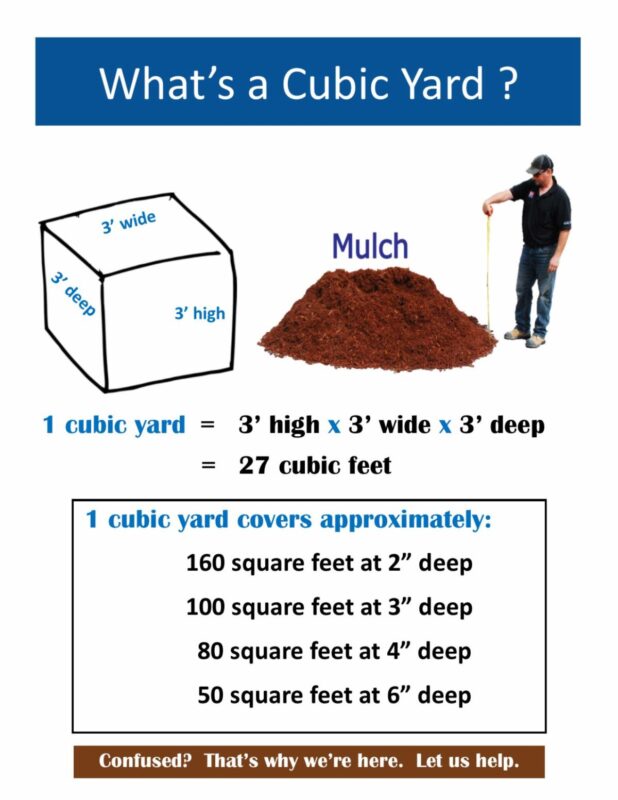
Image Source: stonegarden-nc.com
Figuring Out Your Mulch Needs
When you’re planning your garden or landscape project, one of the most common questions is: how many square feet will a yard of mulch cover? It’s a crucial question because getting it wrong can lead to either too little mulch, leaving your soil exposed, or too much, resulting in wasted money and effort. Thankfully, with a little bit of math, you can precisely determine your landscape mulch coverage requirements.
The Science Behind Mulch Coverage: Cubic Feet and Depth
The key to understanding mulch coverage lies in comprehending volume. Mulch is sold by the cubic yard, but when we talk about covering an area, we’re interested in the surface area it will spread across and the depth we want to apply it.
A cubic yard is a unit of volume. One cubic yard is equal to 27 cubic feet. When you purchase a yard of mulch, you are buying a specific volume of material. The amount of square footage this volume will cover depends entirely on how thick you spread it. This is where the concept of mulch depth for coverage becomes essential.
Standard Mulch Depths for Optimal Results
Gardeners and landscapers generally recommend specific mulch depths for different purposes:
- General Garden Beds and Flower Beds: A depth of 2 to 3 inches is usually ideal. This provides good weed suppression and moisture retention without suffocating plant roots.
- Around Trees and Shrubs: Apply mulch in a ring around the base of trees and shrubs, keeping it a few inches away from the trunk or stem to prevent rot. A depth of 3 to 4 inches is often recommended here.
- Vegetable Gardens: Similar to flower beds, 2 to 3 inches is typically sufficient for vegetable gardens, helping to keep soil moist and suppress weeds.
- Steep Slopes: For areas prone to erosion, a slightly deeper application, perhaps 3 to 4 inches, can offer better stability.
It’s important to note that applying mulch too deeply can have detrimental effects. It can restrict air circulation to the soil, promote fungal diseases, and even encourage roots to grow into the mulch layer, making them vulnerable.
Calculating Your Square Footage
Before you can determine how much mulch per square foot you need, you must first calculate the total square footage of the area you plan to mulch. This is a straightforward process:
Measuring Your Mulch Areas
- Identify the Shape: Most garden beds and landscaped areas are rectangular or square. Some might be irregularly shaped, like around a tree or a curved flower bed.
- Measure Length and Width: For rectangular or square areas, measure the length and the width of the area in feet.
-
Calculate the Area: Multiply the length by the width.
- Formula: Area = Length × Width
Example: If you have a rectangular flower bed that is 10 feet long and 4 feet wide, its area is 10 ft × 4 ft = 40 square feet.
-
Irregular Shapes: For irregularly shaped areas, you can break them down into smaller, more manageable geometric shapes (rectangles, squares, triangles) and calculate the area of each. Then, add all the individual areas together. Alternatively, you can use online tools or graph paper to estimate the area.
Square Footage Mulching Calculation: Putting It Together
Let’s say you have multiple areas to mulch:
- A rectangular flower bed measuring 10 feet by 6 feet.
- A circular area around a tree with a radius of 3 feet.
- A long, narrow border that is 20 feet long and 2 feet wide.
Calculations:
- Flower Bed: 10 ft × 6 ft = 60 sq ft
- Tree Area: The area of a circle is calculated using the formula A = πr², where π (pi) is approximately 3.14 and r is the radius. So, A = 3.14 × (3 ft)² = 3.14 × 9 sq ft = 28.26 sq ft.
- Border: 20 ft × 2 ft = 40 sq ft
Total Area to Mulch: 60 sq ft + 28.26 sq ft + 40 sq ft = 128.26 sq ft
This is your total square footage mulching calculation.
The Math: From Cubic Yards to Square Feet
Now that you know your total square footage, you can work backward to figure out how much mulch you need.
Understanding Cubic Feet of Mulch Coverage
Remember that a cubic yard contains 27 cubic feet. The formula to determine how many square feet a cubic yard of mulch will cover is:
Coverage (sq ft) = (Volume of mulch in cubic feet) / (Desired mulch depth in feet)
Since mulch depth is usually given in inches, you’ll need to convert it to feet:
Depth in feet = Depth in inches / 12
Let’s use the standard desired depths:
-
For a 2-inch depth:
- Depth in feet = 2 inches / 12 = 0.167 feet
- Coverage per cubic yard = 27 cubic feet / 0.167 feet = approximately 162 square feet.
-
For a 3-inch depth:
- Depth in feet = 3 inches / 12 = 0.25 feet
- Coverage per cubic yard = 27 cubic feet / 0.25 feet = 108 square feet.
-
For a 4-inch depth:
- Depth in feet = 4 inches / 12 = 0.333 feet
- Coverage per cubic yard = 27 cubic feet / 0.333 feet = approximately 81 square feet.
The Universal Mulch Coverage Rule of Thumb
A common and easy-to-remember guideline is that one cubic yard of mulch will cover approximately 100 square feet at a 3-inch depth, or 162 square feet at a 2-inch depth. This is a good starting point, but precise calculations are always better.
Determining Mulch Needed: Using Your Calculations
Once you have your total square footage and the coverage rate per cubic yard for your desired depth, you can calculate the number of yards needed.
Number of Cubic Yards = Total Square Footage / Coverage Rate per Cubic Yard
Example: Using our previous example of 128.26 square feet that needs to be mulched to a depth of 3 inches:
- Coverage rate for 3 inches = 108 sq ft per cubic yard.
- Number of Cubic Yards = 128.26 sq ft / 108 sq ft/cubic yard = 1.19 cubic yards.
Since you can’t typically buy fractions of a cubic yard from bulk suppliers, you would round up to 2 cubic yards to ensure you have enough.
Why Mulch Depth Matters: The Impact on Coverage
The mulch spread rate is directly tied to the depth you choose. Applying mulch too thin means it won’t be effective at suppressing weeds or retaining moisture, and you’ll need to replenish it more often. Applying it too thick can harm your plants.
The Nuances of Mulch Bag Coverage
Many garden centers sell mulch in bags. These bags typically contain 2 or 3 cubic feet of mulch. To figure out how many bags you need, you’ll need to do a similar calculation:
-
Calculate Total Cubic Feet Needed:
- Total Square Footage × Desired Depth (in feet) = Total Cubic Feet Needed
Example: For our 128.26 sq ft area at a 3-inch (0.25 ft) depth:
* 128.26 sq ft × 0.25 ft = 32.07 cubic feet. -
Calculate Number of Bags:
- Total Cubic Feet Needed / Cubic Feet per Bag = Number of Bags
Example: If bags contain 2 cubic feet of mulch:
* 32.07 cubic feet / 2 cubic feet/bag = 16.04 bags.Again, you’ll round up to 17 bags.
This calculation is essential for understanding mulch bag coverage accurately. Always check the bag for its stated volume.
Factors Affecting Mulch Coverage
While the formulas are straightforward, several real-world factors can influence your actual landscape mulch coverage:
Soil Compaction and Settling
Freshly delivered mulch can be fluffy and voluminous. However, over time, especially after rain or walking on it, mulch can compact and settle. This means your initial application might appear thicker than it will be after a few weeks. It’s often wise to account for this by slightly overestimating your needs.
Type of Mulch
Different types of mulch have different densities and particle sizes.
- Shredded Bark or Wood Chips: These tend to interlock and settle less than finer materials.
- Shredded Hardwood: Can be quite dense.
- Pine Bark: Can be lighter and fluffier.
- Composted Organic Matter: Can be very dense and compact significantly.
These variations mean that a cubic yard of one type of mulch might spread slightly further or less far than another. Always check if the supplier provides any specific coverage estimates for their products.
Surface Irregularities
Uneven terrain or heavily planted areas where mulch needs to be applied carefully around stems and foliage might require more mulch to achieve the desired depth consistently.
Weed Pressure
If you have particularly stubborn weeds, you might opt for a slightly deeper application (e.g., 3-4 inches) to ensure good weed suppression. This will, of course, reduce the square footage a single yard can cover.
Utilizing a Mulch Coverage Calculator
To simplify the process, many online resources offer a mulch coverage calculator. These tools are incredibly helpful. You typically input:
- The square footage of your area (or the length and width, which the calculator can compute).
- Your desired mulch depth.
The calculator then instantly tells you how many cubic yards or bags of mulch you need. This takes the guesswork out of determining mulch needed.
How to Use a Mulch Coverage Calculator:
- Measure your area(s).
- Decide on your desired mulch depth.
- Find a reputable online mulch calculator. Search for “mulch calculator” or “mulch coverage calculator.”
- Enter your measurements and desired depth.
- Review the results and make sure to round up for any partial yards or bags.
These calculators are based on the same mathematical principles outlined in this guide, ensuring accuracy.
Practical Tips for Mulching
Before You Start
- Clear the Area: Remove all weeds and debris from the area you plan to mulch.
- Water the Soil: It’s a good idea to water the soil before applying mulch, especially during dry periods, as mulch can sometimes repel water if applied to very dry soil.
- Loosen Compacted Soil: If the soil is heavily compacted, lightly loosening it before mulching can improve drainage and aeration.
Applying the Mulch
- Use a Spade or Rake: Spread the mulch evenly using a spade or rake.
- Maintain Consistent Depth: Aim for an even layer across the entire area.
- Avoid Mulching Too Close to Stems/Trunks: Leave a small gap (1-2 inches) around the base of plants, trees, and shrubs. This prevents moisture buildup against the bark, which can lead to rot and disease.
Replenishment
- Top Up as Needed: Check your mulch levels periodically. You may need to top up your mulch in the spring or fall, especially if it has decomposed or washed away.
- Annual Application: Many gardeners find it beneficial to add a fresh layer of mulch annually to maintain its effectiveness.
Frequently Asked Questions (FAQ)
Q1: What is the best mulch depth for general garden beds?
A1: For most general garden beds, a mulch depth of 2 to 3 inches is recommended. This depth effectively suppresses weeds and conserves soil moisture without suffocating plant roots.
Q2: Can I use mulch that is too thick?
A2: Yes, you can use mulch that is too thick. Applying mulch excessively deep (more than 4-5 inches) can restrict air and water circulation to the soil, promote fungal diseases, and even encourage shallow root growth that can be detrimental to your plants.
Q3: How do I calculate how much mulch I need for a circular garden bed?
A3: To calculate mulch for a circular bed, first find the radius (the distance from the center to the edge). Then, use the formula for the area of a circle: Area = π * radius². The radius should be in feet. For example, if your circular bed has a 4-foot radius, the area is approximately 3.14 * (4 ft)² = 50.24 square feet.
Q4: Who should I ask if I’m unsure about my mulch calculations?
A4: If you are unsure about your mulch calculations, you can ask a knowledgeable employee at your local garden center or nursery. They often have experience with these types of calculations and can offer advice based on the specific products they sell.
Q5: What is the typical mulch spread rate for a cubic yard?
A5: The typical mulch spread rate for a cubic yard is about 100 square feet when applied at a 3-inch depth, or 162 square feet at a 2-inch depth. This can vary slightly depending on the type of mulch.
By following these guidelines and using the provided calculations, you can confidently estimate your mulch needs and ensure your garden and landscape beds are beautifully and effectively mulched.