
A cubic yard can cover approximately 100 square feet at a depth of 3 inches, but this number changes depending on the depth. Converting cubic yards to square feet requires knowing the desired depth of coverage.
When you’re planning a landscaping project, a garden bed, or a new patio, you’ll often hear about materials measured in cubic yards. But how far does a cubic yard of gravel, soil, or mulch actually go? This guide will break down the cubic yard to square feet conversion and help you with estimating material needs accurately. We’ll explore how to perform a volume to area calculation so you can be confident when buying landscaping materials coverage.
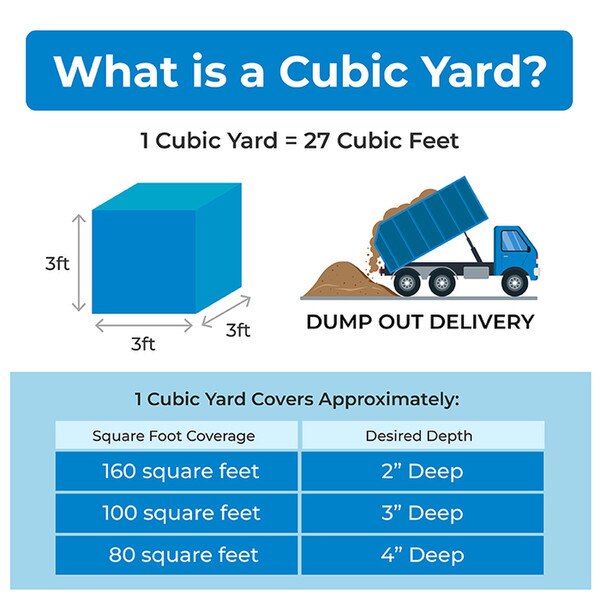
Image Source: www.cumminlandscapesupply.com
What is a Cubic Yard?
Let’s start with the basics. A cubic yard is a unit of volume. Think of it as a cube that is 3 feet long, 3 feet wide, and 3 feet high.
- Length: 3 feet
- Width: 3 feet
- Height: 3 feet
To find the total volume in cubic feet, we multiply these dimensions: 3 feet * 3 feet * 3 feet = 27 cubic feet. So, one cubic yard is equal to 27 cubic feet. This is a crucial piece of information for our calculations.
Converting Cubic Yards to Square Feet: The Core Concept
You can’t directly convert a unit of volume (cubic yards) into a unit of area (square feet). They measure different things. However, we can determine how much area a certain volume will cover if we know the depth.
Imagine spreading a pile of gravel. The amount of gravel is measured in cubic yards (volume). The area it covers on the ground is measured in square feet (area). The thickness of the gravel layer is the missing link that connects volume to area.
The basic formula we’ll use is:
Area (in square feet) = Volume (in cubic feet) / Depth (in feet)
Since we usually measure depth in inches for landscaping projects, we’ll need to convert inches to feet. There are 12 inches in 1 foot. So, to convert inches to feet, you divide the number of inches by 12.
Depth (in feet) = Depth (in inches) / 12
Now, let’s put it all together:
Area (sq ft) = (Volume in cubic yards * 27 cubic feet/cubic yard) / (Depth in inches / 12 inches/foot)
This formula allows us to answer the main question: “How many square feet does a cubic yard cover?”
Common Depths and Their Coverage
The depth of your material is the biggest factor in how much area a cubic yard will cover. Here are some common depths and the approximate square footage a single cubic yard will cover:
1-Inch Depth
If you need to cover an area with just a 1-inch layer of material:
- Depth in feet: 1 inch / 12 inches/foot = 0.0833 feet
- Area covered by 1 cubic yard: 27 cubic feet / 0.0833 feet = 324 square feet
So, 1 cubic yard of material will cover about 324 square feet if spread 1 inch deep.
2-Inch Depth
For a 2-inch layer:
- Depth in feet: 2 inches / 12 inches/foot = 0.1667 feet
- Area covered by 1 cubic yard: 27 cubic feet / 0.1667 feet = 162 square feet
One cubic yard covers about 162 square feet when spread 2 inches deep.
3-Inch Depth
This is a very common depth for landscaping projects:
- Depth in feet: 3 inches / 12 inches/foot = 0.25 feet
- Area covered by 1 cubic yard: 27 cubic feet / 0.25 feet = 108 square feet
As mentioned earlier, 1 cubic yard typically covers about 108 square feet at a 3-inch depth. (Note: Some sources round this to 100 sq ft for simplicity, which is a close estimate).
4-Inch Depth
For a deeper layer, like for a base for a patio:
- Depth in feet: 4 inches / 12 inches/foot = 0.3333 feet
- Area covered by 1 cubic yard: 27 cubic feet / 0.3333 feet = 81 square feet
One cubic yard covers approximately 81 square feet when spread 4 inches deep.
6-Inch Depth
This is a significant depth, often used for structural purposes:
- Depth in feet: 6 inches / 12 inches/foot = 0.5 feet
- Area covered by 1 cubic yard: 27 cubic feet / 0.5 feet = 54 square feet
So, 1 cubic yard covers about 54 square feet if spread 6 inches deep.
Table: Cubic Yard Coverage by Depth
Here’s a quick reference table for landscaping materials coverage:
| Depth (inches) | Depth (feet) | Area Covered by 1 Cubic Yard (sq ft) |
|---|---|---|
| 1 | 0.0833 | 324 |
| 2 | 0.1667 | 162 |
| 3 | 0.25 | 108 |
| 4 | 0.3333 | 81 |
| 6 | 0.5 | 54 |
These numbers are essential for cubic yardage estimation.
Factors Affecting Coverage
While the calculations provide a solid baseline, several real-world factors can influence how much area your cubic yard of material actually covers:
- Material Compaction: Some materials, like soil or certain types of mulch, will compact over time. This means a cubic yard might initially cover a certain area, but as it settles, the depth might decrease, effectively reducing the covered area or requiring more material to maintain the original depth.
- Uneven Subgrade: If the ground you’re covering isn’t perfectly flat, you’ll have thicker and thinner spots. This can lead to using more material than calculated to achieve an even depth.
- Type of Material: The particle size and shape can play a role. Fine sand might settle differently than coarse gravel.
- Wastage: Some material is inevitably lost due to spillage during transport or spreading.
- Desired Finish: Sometimes, you might want a slightly thicker layer for aesthetic reasons or better performance, especially with mulch.
Always consider buying a little extra to account for these variations.
Calculating Your Needs: A Step-by-Step Approach
To accurately estimate how much material you need, you’ll follow these steps:
Step 1: Measure Your Area
First, determine the length and width of the area you want to cover. Measure in feet.
- Length (ft): ______
- Width (ft): ______
Step 2: Calculate the Area in Square Feet
Multiply the length by the width to get the total area in square feet.
- Total Area (sq ft) = Length (ft) * Width (ft)
Step 3: Determine Your Desired Depth
Decide how deep you want the material to be. This is often based on the type of material and its purpose. Common depths are 3 inches for mulch or topsoil and 4-6 inches for gravel bases.
- Desired Depth (inches): ______
Step 4: Convert Depth to Feet
Use the formula: Depth (ft) = Depth (inches) / 12
Step 5: Calculate the Volume Needed in Cubic Feet
Now, use the area and depth in feet to find the total volume needed in cubic feet.
- Volume (cubic feet) = Total Area (sq ft) * Depth (ft)
Step 6: Convert Cubic Feet to Cubic Yards
Finally, convert the volume from cubic feet to cubic yards. Remember, 1 cubic yard = 27 cubic feet.
- Volume (cubic yards) = Volume (cubic feet) / 27
Example Calculation: Mulching a Garden Bed
Let’s say you have a garden bed that is 20 feet long and 10 feet wide, and you want to add mulch to a depth of 3 inches.
- Step 1: Length = 20 ft, Width = 10 ft
- Step 2: Area = 20 ft * 10 ft = 200 sq ft
- Step 3: Desired Depth = 3 inches
- Step 4: Depth in feet = 3 inches / 12 inches/ft = 0.25 ft
- Step 5: Volume (cubic feet) = 200 sq ft * 0.25 ft = 50 cubic feet
- Step 6: Volume (cubic yards) = 50 cubic feet / 27 cubic feet/cubic yard = 1.85 cubic yards
So, you would need approximately 1.85 cubic yards of mulch. It’s wise to round this up to 2 cubic yards to account for compaction and any minor losses.
Specific Material Coverage Examples
Let’s look at how different landscaping materials are typically used and their coverage:
Mulch Coverage Area
Mulch is primarily used for aesthetics, weed suppression, and moisture retention. A common depth for mulch is 2-4 inches.
- For 2 inches of mulch: 1 cubic yard covers about 162 sq ft.
- For 3 inches of mulch: 1 cubic yard covers about 108 sq ft.
- For 4 inches of mulch: 1 cubic yard covers about 81 sq ft.
When spreading mulch, remember it’s bulky but can compact. It’s always better to have a little extra to top up areas that might settle more.
Gravel Per Cubic Yard
Gravel is used for pathways, driveways, drainage, and as a base for patios or retaining walls. The depth required depends heavily on its purpose.
- Decorative gravel pathways (2-3 inches): 1 cubic yard covers 108-162 sq ft.
- Gravel base for patios or walkways (4 inches): 1 cubic yard covers about 81 sq ft.
- Gravel base for driveways or heavy-duty areas (6 inches): 1 cubic yard covers about 54 sq ft.
Gravel tends to be denser than mulch and may compact less, but the angular edges can interlock, making a firm base.
Soil Coverage Square Footage
Topsoil or compost is used for creating new garden beds, amending existing soil, or filling raised beds. A common depth is 3-6 inches.
- For 3 inches of topsoil: 1 cubic yard covers about 108 sq ft.
- For 4 inches of topsoil: 1 cubic yard covers about 81 sq ft.
- For 6 inches of topsoil: 1 cubic yard covers about 54 sq ft.
Soil can compact, especially if it contains organic matter. If you are creating a new lawn, the seedbed might need a consistent depth for optimal germination.
Concrete Cubic Yard Coverage
While not typically thought of as a “coverage” material in the same way as mulch or gravel, understanding concrete cubic yard coverage is important for projects like patios, sidewalks, or foundations.
A cubic yard of concrete (27 cubic feet) can be used to create:
- A slab that is 4 inches thick and covers 81 square feet (200 sq ft * 0.25 ft / 27 cu ft/cu yd).
- A slab that is 3 inches thick and covers 108 square feet (200 sq ft * 0.25 ft / 27 cu ft/cu yd).
The thickness is critical. A standard driveway might require a 4-inch base, while a patio might be 4-6 inches thick. It’s essential to consult local building codes for required depths for structural elements.
Using a Landscaping Coverage Calculator
Many online resources offer a landscaping coverage calculator. These tools can simplify the cubic yardage estimation process. You typically input:
- The length and width of your area (in feet).
- The desired depth (in inches).
The calculator then performs the volume to area calculation for you and tells you how many cubic yards you need. These calculators are incredibly helpful for quick estimates and can save you time and potential errors.
Example: Using a Calculator
Let’s use our garden bed example (20 ft x 10 ft, 3-inch depth) with a hypothetical online calculator:
- Input Length: 20 feet
- Input Width: 10 feet
- Input Depth: 3 inches
The calculator would likely output: “You need approximately 1.85 cubic yards.” You would then round up to 2 cubic yards.
Frequently Asked Questions (FAQ)
Q1: What is the difference between a cubic yard and a square yard?
A1: A cubic yard measures volume (length x width x height), while a square yard measures area (length x width). You need to know the depth to convert volume to area coverage.
Q2: How much does a cubic yard of gravel weigh?
A2: The weight of a cubic yard of gravel can vary significantly depending on the type of stone and its density. On average, a cubic yard of gravel weighs between 1.5 to 1.7 tons (3,000 to 3,400 pounds).
Q3: How much does a cubic yard of mulch weigh?
A3: Mulch weight also varies. Dry, shredded bark mulch might weigh around 500-800 pounds per cubic yard, while wet or heavier wood chip mulch can weigh 1,000-1,200 pounds per cubic yard.
Q4: Can I use the same coverage calculation for all landscaping materials?
A4: Yes, the fundamental volume to area calculation is the same. However, remember that different materials compact differently, so you might need to adjust your purchase quantity slightly based on the specific material’s properties.
Q5: If I buy a bag of soil, how many cubic yards is that?
A5: Soil and mulch are often sold in bags. A common bag size is 2 cubic feet. To convert this to cubic yards, divide by 27: 2 cubic feet / 27 cubic feet/cubic yard ≈ 0.074 cubic yards per bag. So, one bag is a very small fraction of a cubic yard. You would need about 13-14 bags to equal 1 cubic yard (1 / 0.074 ≈ 13.5).
Q6: What if my area isn’t a perfect rectangle?
A6: For irregular shapes, break them down into simpler geometric shapes (rectangles, triangles, circles) and calculate the area of each part. Then, sum up the areas to get the total area in square feet before proceeding with the depth calculation.
Q7: How do I convert square feet to cubic feet?
A7: To convert square feet to cubic feet, you need to multiply the area (in square feet) by the depth in feet. For example, 100 square feet * 0.5 feet (6 inches) = 50 cubic feet.
Final Thoughts on Estimating Material Needs
Accurate cubic yardage estimation is key to a successful project. By following these steps and using the provided conversion factors, you can confidently determine how much material you need. Remember to:
- Measure your area accurately.
- Choose the correct depth for your material.
- Convert all measurements to the same units (feet are generally easiest for calculations).
- Round up your final quantity to account for variations and waste.
Whether you’re spreading mulch coverage area, laying down gravel per cubic yard, or filling beds with soil coverage square footage, this guide will help you get the job done right the first time. Happy landscaping!