
A typical garden hose can deliver anywhere from 5 to 12 gallons per minute (GPM), but this number can vary significantly based on several factors. Knowing your garden hose’s flow rate is crucial for effective watering, whether you’re using a simple spray nozzle or a sophisticated sprinkler system. This guide will help you decipher the GPM your hose provides and how to optimize your water usage.
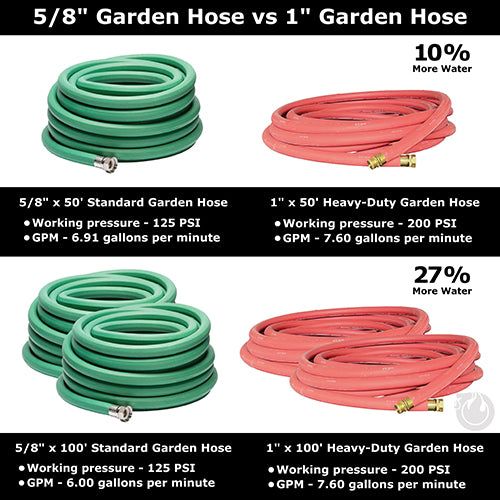
Image Source: firehosedirect.com
Fathoming Your Outdoor Faucet Flow
The journey of water from your home’s plumbing to your garden begins at the outdoor faucet flow. This is the source of your hose’s power, and its output dictates the maximum potential flow rate.
The Water Pressure Factor
Water pressure is perhaps the most significant determinant of how much water your hose can deliver. Measured in pounds per square inch (PSI), water pressure is the force pushing the water through your pipes and out of the faucet.
- Typical Residential Water Pressure: Most homes have water pressure between 40 and 60 PSI.
- Impact on Flow Rate: Higher water pressure generally leads to a higher flow rate from your hose. If your home’s pressure is on the lower end, you’ll likely see a lower GPM from your hose, even with a wide-open faucet.
- Measuring Your Water Pressure: You can purchase a simple water pressure gauge that screws onto an outdoor faucet. This will give you a precise reading.
What Affects Household Water Pressure?
Several things can influence the water pressure in your home:
- Municipal Water Supply: The pressure provided by your local water utility.
- Well Systems: The pressure generated by your well pump.
- Plumbing System Age and Condition: Older pipes, especially those made of galvanized steel, can become corroded internally, reducing water flow and pressure.
- Distance from the Water Source: The further your faucet is from the main water line, the more pressure can be lost due to friction.
- Simultaneous Water Usage: If multiple faucets or appliances are using water in your home at the same time, the pressure at your outdoor faucet can drop.
The Crucial Role of Hose Diameter
The size of your garden hose plays a vital role in how much water can pass through it. Think of it like a highway: a wider highway can handle more traffic.
- Common Hose Diameters: Garden hoses are typically available in 1/2 inch, 5/8 inch, and 3/4 inch diameters.
- Impact on Flow Rate: A larger diameter hose allows more water to flow through it at the same pressure, resulting in a higher GPM.
Comparing Hose Diameters and Flow Rates
| Hose Diameter | Typical Flow Rate (GPM) | Notes |
|---|---|---|
| 1/2 inch | 5 – 9 | Suitable for light watering, car washing, but less efficient for large areas. |
| 5/8 inch | 8 – 12 | The most common size, offering a good balance of flow and manageability. |
| 3/4 inch | 10 – 15+ | Ideal for large gardens, powering sprinklers, and when high flow rate is needed. |
Note: These are approximate values and can vary based on water pressure and hose length.
Hose Length Matters Too
While diameter is critical, the length of your hose also affects the flow rate. Longer hoses create more friction, which can reduce pressure and, consequently, the GPM.
- Friction Loss: As water travels through a hose, it loses some of its energy due to friction against the hose’s inner walls.
- Mitigation: If you need to water a large area with a long hose, consider using a wider diameter hose to compensate for friction loss.
The Influence of Nozzle Type
The nozzle type you attach to your garden hose significantly impacts the flow rate and how water is dispersed. Different nozzles are designed for different tasks.
Common Nozzle Types and Their Effect on Flow
- Adjustable Spray Nozzles: These are versatile and allow you to change the spray pattern from a gentle shower to a powerful jet.
- Impact: When set to a wider spray, they can reduce the apparent flow rate as the water is dispersed over a larger area. A concentrated jet, however, can feel like a higher GPM due to the velocity.
- Trigger Nozzles: Similar to adjustable nozzles, they offer control over the spray and often a shut-off feature.
- Soaker Hoses/Drip Irrigation: These are designed for slow, targeted watering directly at the root zone.
- Impact: They have a very low flow rate by design, promoting water conservation.
- Sprinkler Heads: When attached to the hose, the design of the sprinkler head dictates the sprinkler performance and the effective GPM delivered to your lawn or garden.
- Impact: Different sprinkler designs have varying GPM requirements to operate efficiently.
Optimizing Nozzle Choice for Water Usage
Choosing the right nozzle can dramatically improve your irrigation efficiency and contribute to water conservation.
- For delicate plants, a fine mist or shower setting is best, using a lower effective flow rate.
- For washing a car or cleaning patios, a more powerful jet is needed, which will deliver a higher effective GPM.
- For watering established gardens, a soaker hose or a carefully chosen sprinkler can ensure water reaches the roots with minimal waste.
Measuring Your Garden Hose’s Flow Rate
Knowing your outdoor faucet flow and the characteristics of your hose is one thing, but actually measuring your hose’s GPM is straightforward and highly recommended for accurate water usage management.
The Bucket Test: A Simple GPM Measurement
This is the most common and easiest way to determine your hose’s flow rate.
Steps for the Bucket Test:
- Gather Your Supplies: You’ll need a bucket with a known volume (e.g., a 5-gallon bucket) and a stopwatch or your phone’s timer.
- Turn On the Water: Go to your outdoor faucet and turn it on fully.
- Start the Timer and Fill: Place the hose into the bucket and start the timer simultaneously.
- Measure the Time: As soon as the bucket is full, stop the timer.
- Calculate GPM:
- Let’s say your bucket holds 5 gallons.
- If it took 30 seconds to fill the bucket, that’s 0.5 minutes (30 seconds / 60 seconds per minute).
- Your flow rate is: Gallons / Minutes = 5 gallons / 0.5 minutes = 10 GPM.
Example Calculation:
- Bucket size: 5 gallons
- Time to fill: 45 seconds (0.75 minutes)
- Flow Rate (GPM) = 5 gallons / 0.75 minutes = 6.67 GPM
This simple test gives you a reliable GPM figure for your specific setup.
When to Perform the Bucket Test
- Before Buying Sprinklers: If you’re planning to purchase a sprinkler, knowing your hose’s GPM is essential to ensure the sprinkler will operate effectively according to its specifications. Many sprinklers have optimal GPM ranges for best sprinkler performance.
- For Water Conservation Efforts: If you’re looking to reduce your water usage, understanding your flow rate helps you identify where water is being used most.
- When Experiencing Watering Issues: If your lawn is unevenly watered or your plants aren’t getting enough water, your GPM might be too low.
Factors Affecting Sprinkler Performance
When you connect a sprinkler to your garden hose, the sprinkler performance is directly tied to the flow rate your hose can deliver and the sprinkler’s design.
Matching Sprinkler GPM to Hose GPM
Sprinklers are designed to operate within a specific range of water pressure and GPM to achieve their intended spray pattern and coverage area.
- Low GPM: If your hose’s GPM is too low for a sprinkler, the sprinkler might not rotate properly, or the water spray might be weak and fall too close to the sprinkler head, leading to inefficient watering.
- High GPM: Conversely, if your hose’s GPM is significantly higher than what the sprinkler is designed for, the water stream can become distorted, leading to uneven coverage and potentially “blasting” away soil or damaging delicate plants.
Sprinkler Flow Rate Requirements
Most in-ground and oscillating sprinklers will list their recommended operating GPM and water pressure on the packaging or in their manual. It’s crucial to match these requirements with your hose’s capabilities.
- Impact Sprinklers: These often require higher GPM and water pressure to rotate and deliver water in a circular pattern.
- Oscillating Sprinklers: While they have a more controlled back-and-forth motion, they still need adequate flow rate to achieve good coverage.
- Impact of Multiple Sprinklers: If you plan to run multiple sprinklers from a single hose or splitter, you must consider the combined GPM requirements of all sprinklers. The total GPM drawn cannot exceed your hose’s capacity without a significant drop in performance.
How Hose Diameter and Length Affect Sprinkler Performance
The limitations of your hose, as discussed earlier, directly impact how well a sprinkler performs.
- Narrower/Longer Hoses: These will reduce the effective GPM reaching the sprinkler, potentially causing it to underperform.
- Wider/Shorter Hoses: These will deliver a higher GPM and more consistent pressure, leading to better sprinkler performance.
Water Conservation and Efficient Irrigation
Understanding your garden hose’s flow rate is not just about getting water to your plants; it’s also a critical step towards water conservation and improving irrigation efficiency.
The Link Between GPM and Water Usage
The higher your hose’s GPM, the faster you can deliver a specific amount of water. However, this speed can be a double-edged sword.
- Faster Watering: A higher GPM can mean you water for shorter periods, but if the flow is uncontrolled, you can easily overwater.
- Slower, Targeted Watering: Using a nozzle with a lower flow rate or a soaker hose allows for more controlled watering, letting water penetrate the soil gradually and reach the root zone effectively. This reduces runoff and evaporation.
Strategies for Water Conservation:
- Watering Schedule: Water early in the morning or late in the evening to minimize evaporation.
- Targeted Watering: Use soaker hoses or drip irrigation systems to deliver water directly to plant roots. This is highly efficient and uses a significantly lower GPM than overhead sprinklers.
- Mulching: Apply mulch around plants to retain soil moisture and reduce the need for frequent watering.
- Rain Barrels: Collect rainwater to supplement your watering needs, reducing reliance on your outdoor faucet flow.
- Smart Controllers: If you use an irrigation system, a smart controller can adjust watering based on weather data, preventing unnecessary watering.
Calculating Water Usage for Irrigation
Knowing your GPM allows you to calculate how much water you’re using for specific tasks.
Formula for Water Usage:
Water Usage (Gallons) = Flow Rate (GPM) × Time (Minutes)
Example:
If your hose delivers 8 GPM and you water for 20 minutes, you’ve used:
8 GPM × 20 minutes = 160 gallons
This calculation can be eye-opening and help you identify areas where you can reduce water usage.
Deciphering Your System’s Limitations
When you’re trying to achieve optimal irrigation efficiency, it’s vital to look at your entire watering system, not just the hose.
The Faucet as a Bottleneck
Even if you have a wide-diameter hose, your outdoor faucet flow can be the ultimate limiting factor. If your faucet is undersized or has internal restrictions, it can restrict the GPM your hose can deliver.
Identifying Faucet Flow Issues:
- Low Pressure at the Faucet: As mentioned, low water pressure directly translates to lower GPM.
- Valve Type: Older gate valves can restrict flow more than modern ball valves.
- Aerators: Some faucet spouts have aerators. While good for water saving at a sink, they can significantly reduce the flow rate from an outdoor faucet if they are not designed for high volume.
The Impact of Hose Connectors and Couplings
Small details can make a difference. The connectors and couplings on your hose can also restrict flow rate.
- Standard Couplings: Most standard hose couplings are designed to be compatible with common hose sizes.
- High-Flow Couplings: Specialty high-flow couplings are available that have a wider internal diameter, potentially increasing your GPM slightly by reducing restriction at the connection points. This is more relevant for those seeking to maximize irrigation efficiency.
Maximizing Your Hose’s Potential
Once you know your hose’s GPM, you can make informed decisions to improve your watering.
Upgrading Your Equipment
- Hose Diameter: If you consistently find your flow rate too low for your needs, consider investing in a larger diameter hose (e.g., moving from 1/2 inch to 5/8 inch or 3/4 inch).
- Nozzles and Sprinklers: Choose nozzles and sprinklers that are designed to operate efficiently within your hose’s GPM capabilities. Look for products that specify their GPM requirements.
- Hose Length: If you use very long hoses, try to use the largest diameter hose you can manage to mitigate friction loss.
Adjusting Your Watering Practices
- Watering Duration: Use your calculated GPM to adjust how long you water. If you need to deliver a specific amount of water, you can now calculate the precise time needed.
- Targeted Watering: Focus water where it’s needed most. Hand-watering with a shut-off nozzle can be very efficient for specific plants or areas, allowing you to control the flow rate precisely.
Common Scenarios and Expected GPM
Let’s look at some typical scenarios and what GPM you might expect.
Scenario 1: Standard Home with Good Pressure
- Water Pressure: 50 PSI
- Hose Diameter: 5/8 inch
- Hose Length: 50 feet
- Nozzle: Open hose end or basic spray nozzle (wide open)
- Expected GPM: 8 – 10 GPM
Scenario 2: Home with Lower Pressure or Smaller Hose
- Water Pressure: 35 PSI
- Hose Diameter: 1/2 inch
- Hose Length: 75 feet
- Nozzle: Open hose end
- Expected GPM: 5 – 7 GPM
Scenario 3: High-Demand Irrigation Setup
- Water Pressure: 60 PSI
- Hose Diameter: 3/4 inch
- Hose Length: 50 feet
- Nozzle: Sprinkler head requiring 5 GPM at 40 PSI
- Expected GPM: If the hose and pressure can supply the sprinkler’s needs, the effective flow rate to the sprinkler will be around 5 GPM. If the hose/pressure can supply more, the sprinkler’s design will still limit the actual delivery.
These examples highlight how interconnected the factors are. Your goal should be to match your equipment and practices to achieve the best irrigation efficiency and desired outcomes, whether it’s a lush lawn or thriving vegetables, all while practicing water conservation.
Frequently Asked Questions (FAQ)
Q1: How can I increase the GPM from my garden hose?
You can increase your hose’s GPM by increasing water pressure (if possible through your system), using a wider diameter hose, using a shorter hose, and ensuring your faucet valve is fully open and not restricted. Also, check that your nozzle is not overly restrictive for your needs.
Q2: What is a good GPM for watering a lawn?
A good flow rate for watering a lawn depends on the type of sprinkler you use. Most oscillating and rotary sprinklers are designed to operate effectively between 4 and 8 GPM. Using the bucket test to determine your hose’s GPM will help you choose sprinklers that will provide good sprinkler performance. Overwatering, even at a low GPM, can still be detrimental, so mindful watering times are crucial.
Q3: Does hose color affect water flow?
No, the color of your garden hose does not affect its flow rate or GPM. The color is purely aesthetic.
Q4: Can I run two garden hoses from one outdoor faucet?
Yes, you can use a splitter to run two garden hoses from one faucet. However, the total flow rate available will be divided between the two hoses. If your faucet’s outdoor faucet flow is 10 GPM, and you split it into two hoses, each hose will receive approximately 5 GPM, assuming they are of similar diameter and length and have minimal restriction. This can impact sprinkler performance if the combined demand exceeds the supply.
Q5: How does water pressure affect GPM?
Water pressure is a primary driver of GPM. Higher water pressure means more force pushing the water through the hose, resulting in a higher flow rate. Conversely, lower pressure will reduce the GPM. This is a key factor in irrigation efficiency.
Q6: How can I reduce my water usage when watering my garden?
To reduce water usage, focus on water conservation techniques. Use a hose nozzle with a shut-off feature, water only when necessary (check soil moisture), water during cooler parts of the day to minimize evaporation, use soaker hoses or drip irrigation for targeted watering, and consider mulching your garden beds. Optimizing your irrigation efficiency by matching your GPM to your needs is also important.