
So, you’re wondering, “How big is a yard of mulch?” A yard of mulch is a unit of volume, specifically a cubic yard, which is equal to 3 feet by 3 feet by 3 feet. This guide will help you figure out exactly how much mulch do I need for your landscaping projects.
Choosing the right amount of mulch is crucial for both the health of your plants and the aesthetics of your garden. Too little mulch, and your soil dries out quickly, weeds take over, and plants suffer. Too much, and you can smother delicate roots or create an environment for pests. This comprehensive guide will break down the concept of a cubic yard mulch, explain how to measure your needs, and provide tools to ensure you get it just right. Whether you’re buying in bags or in bulk, we’ll cover everything you need to know to tackle your next mulching project with confidence.
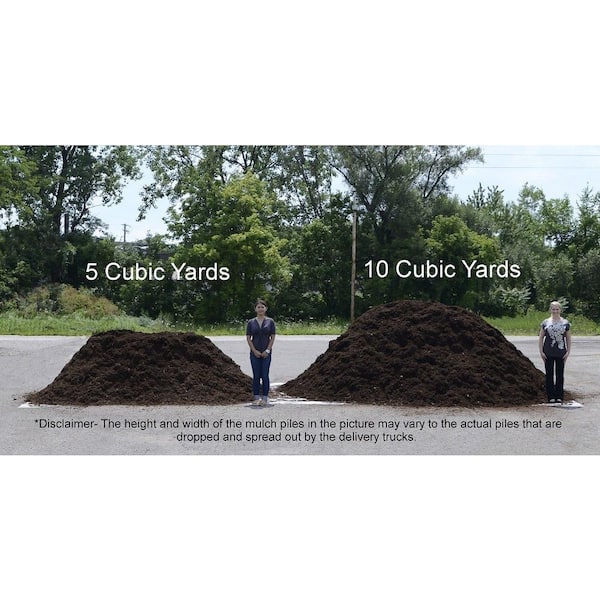
Image Source: images.thdstatic.com
Deciphering the Cubic Yard: The Standard Measure
When you hear about buying mulch, it’s almost always measured in cubic yards. But what exactly does that mean for your garden beds? A cubic yard is a measure of volume. Imagine a cube that is 3 feet long, 3 feet wide, and 3 feet tall. That’s one cubic yard. This might seem like a lot, but mulch compacts and settles, so understanding this unit is the first step in calculating mulch.
From Bags to Bulk: What You Need to Know
You’ll often see mulch sold in two ways: in bags at garden centers or in bulk quantities delivered by truck.
- Bagged Mulch: Typically, bags of mulch are sold in quantities like 2 cubic feet or 3 cubic feet. This is convenient for small projects but can become very expensive and generate a lot of waste for larger areas. We’ll help you convert mulch bags to cubic yard so you can compare prices effectively.
- Bulk Mulch: Buying mulch in bulk means you’re purchasing it by the cubic yard, usually from a landscape supply yard. This is generally more cost-effective for larger areas and reduces plastic waste.
The Magic of Mulch Coverage: Why It Matters
The primary reason for calculating mulch correctly is to achieve the ideal mulch depth for your specific needs. Most experts recommend a mulch depth of 2 to 4 inches. This depth provides the best benefits:
- Weed Suppression: A good layer of mulch acts as a barrier, preventing sunlight from reaching weed seeds, thus inhibiting their germination.
- Moisture Retention: Mulch helps keep the soil moist by reducing evaporation, meaning you’ll water your plants less frequently.
- Temperature Regulation: It insulates the soil, keeping it cooler in the summer and warmer in the winter, protecting plant roots from extreme temperature fluctuations.
- Soil Improvement: As organic mulches decompose, they add valuable nutrients and improve soil structure over time.
Calculating Your Mulch Needs: A Step-by-Step Approach
To determine how much mulch do I need, you first need to measure the area you intend to mulch. This involves calculating the square footage of your garden beds, tree rings, or any other areas.
Step 1: Measure Your Area
- Rectangular or Square Beds: Measure the length and width of the bed in feet. Multiply the length by the width to get the square footage.
- Example: A bed that is 10 feet long and 4 feet wide has an area of 10 ft * 4 ft = 40 square feet.
- Circular Beds: Measure the diameter of the circle in feet. Divide the diameter by 2 to get the radius. Use the formula: Area = π * radius² (where π is approximately 3.14).
- Example: A circular bed with a 6-foot diameter has a radius of 3 feet. The area is 3.14 * (3 ft)² = 3.14 * 9 sq ft = 28.26 square feet.
- Irregularly Shaped Beds: Break down the irregular shape into smaller, more manageable geometric shapes (rectangles, squares, triangles, circles). Calculate the area of each shape and then add them together.
Step 2: Determine Your Desired Mulch Depth
As mentioned, a common recommendation is 2 to 4 inches of mulch. For most general purposes, 3 inches is a good starting point.
Step 3: Convert Depth to Feet
Since your area is measured in square feet, you need to convert your desired mulch depth from inches to feet. There are 12 inches in a foot.
- For 2 inches: 2 inches / 12 inches/foot = 0.167 feet
- For 3 inches: 3 inches / 12 inches/foot = 0.25 feet
- For 4 inches: 4 inches / 12 inches/foot = 0.333 feet
Step 4: Calculate the Volume of Mulch Needed (in Cubic Feet)
Now, multiply your total square footage by your desired mulch depth in feet. This will give you the total cubic feet of mulch you need.
-
Formula: Volume (cubic feet) = Area (square feet) * Depth (feet)
- Example (using a 40 sq ft bed and 3-inch depth):
Volume = 40 sq ft * 0.25 ft = 10 cubic feet of mulch.
- Example (using a 40 sq ft bed and 3-inch depth):
Step 5: Convert Cubic Feet to Cubic Yards
Since mulch is typically sold by the cubic yard, you need to convert your cubic feet measurement. There are 27 cubic feet in 1 cubic yard (3 ft x 3 ft x 3 ft = 27 cu ft).
-
Formula: Volume (cubic yards) = Volume (cubic feet) / 27
- Example (continuing from above):
Volume = 10 cubic feet / 27 cu ft/cubic yard = 0.37 cubic yards.
- Example (continuing from above):
Using a Mulch Coverage Calculator
Many landscape supply companies and gardening websites offer a mulch coverage calculator or bulk mulch calculator. These tools simplify the process. You simply input your area dimensions (length, width, shape) and your desired depth, and the calculator will tell you how many cubic yards you need. This is a quick and efficient way to get your numbers, acting as a handy mulch estimator.
Estimating Mulch per Square Foot
It’s also helpful to think about mulch per square foot. For a standard depth of 3 inches, here’s a general guideline:
- 1 cubic yard of mulch covers approximately 100-150 square feet at a depth of 2-3 inches.
This rough estimate can be useful for quick mental calculations. For precise needs, however, using the formulas above or a mulch volume calculator is best.
Converting Mulch Bags to Cubic Yards
Let’s say you’re at the garden center and the mulch is only sold in bags. You need to know how many bags to buy to equal a cubic yard.
- Common Bag Sizes:
- 2 cubic foot bag
- 3 cubic foot bag
Here’s how to convert:
- For 2 cubic foot bags:
- To get 1 cubic yard (27 cubic feet): 27 cu ft / 2 cu ft/bag = 13.5 bags.
- Recommendation: Buy 14 bags of 2 cu ft mulch.
- For 3 cubic foot bags:
- To get 1 cubic yard (27 cubic feet): 27 cu ft / 3 cu ft/bag = 9 bags.
- Recommendation: Buy 9 bags of 3 cu ft mulch.
Remember to add a little extra to account for settling and any potential underestimation.
Factors Affecting Your Mulch Purchase
Beyond just the volume, several other factors can influence how much mulch do I need and the best way to buy it.
The Type of Mulch
Different types of mulch have slightly different densities and how they settle.
- Wood Chips/Bark Mulch: These are common and generally consistent in volume.
- Shredded Bark: This type can be fluffier initially but compacts well.
- Compost: This can be denser and may settle more significantly.
- Gravel/Stone: While not organic mulch, stone is also sold by the cubic yard. It doesn’t break down and compacts less, so you need to be more precise with your depth.
Existing Mulch Layers
If you have an existing layer of mulch, you might not need to apply a full 2-3 inches. You can top up thinner areas or remove old, degraded mulch first. If topping up, you’ll need less material.
Terrain and Slopes
For sloped areas, a thicker mulch layer (around 4 inches) can help prevent erosion and keep the mulch in place. This means you’ll need a bit more cubic yard mulch than for flat areas.
Compaction and Settling
Mulch, especially organic types, will compact and settle over time. It’s always a good idea to buy slightly more than your exact calculation to account for this. A 10% buffer is often recommended. So, if your calculation comes to 0.4 cubic yards, you might want to round up to 0.5 cubic yards, or even 1 cubic yard if purchasing in bulk and the minimum delivery is 1 yard.
Practical Application: Visualizing a Cubic Yard
So, how big is a yard of mulch in practical terms?
- Imagine a small car’s trunk. A cubic yard of mulch would fill it significantly, possibly overflowing if not packed.
- Think of a standard pallet. A cubic yard of mulch is roughly equivalent to 27 standard 2-cubic-foot bags.
When ordering bulk mulch, it typically arrives in a large pile on your driveway or curb. This pile can look enormous, but remember that it will settle and compact once spread.
Spreading Mulch: Achieving the Right Depth
Once your mulch arrives, the goal is to spread it evenly to your desired depth. A garden rake or a flat shovel is ideal for this.
Mulch Depth Calculation in Practice
Let’s revisit the mulch depth calculation:
- Target Depth: 3 inches (0.25 feet)
- Area to Cover: 100 square feet
Calculating Mulch:
1. Area = 100 sq ft
2. Depth = 0.25 ft
3. Volume = 100 sq ft * 0.25 ft = 25 cubic feet
4. Volume in Cubic Yards = 25 cu ft / 27 cu ft/cubic yard ≈ 0.93 cubic yards
So, for 100 square feet at a 3-inch depth, you’ll need just under 1 cubic yard of mulch. It’s wise to round up to a full cubic yard, especially when ordering in bulk, to ensure you have enough and account for settling.
Using Your Mulch Estimator Wisely
Your mulch estimator or mulch coverage calculator is your best friend. When using one, double-check the units. Ensure you’re entering measurements in feet and inches as requested and that the output is in cubic yards.
Table: Mulch Coverage Guide (Approximate)
This table provides a quick reference for how much area a cubic yard of mulch can cover at different depths.
| Mulch Depth (Inches) | Mulch Depth (Feet) | Square Feet Covered per Cubic Yard |
|---|---|---|
| 2 | 0.167 | 162 sq ft |
| 3 | 0.25 | 108 sq ft |
| 4 | 0.333 | 81 sq ft |
Note: These are approximations. Actual coverage may vary based on mulch type and compaction.
Optimizing Your Mulch Purchase
- Measure Twice, Order Once: Accuracy in your measurements is key.
- Consider Delivery Fees: If ordering bulk mulch, delivery fees can be a significant cost. Factor this in when comparing bulk vs. bagged mulch. Sometimes, ordering a bit more to avoid a second delivery charge is cost-effective.
- Shop Around: Prices for both bagged and bulk mulch can vary significantly between suppliers.
- When in Doubt, Buy Extra: It’s better to have a little extra mulch than to run short and have an unfinished or unevenly mulched area.
FAQ Section
Here are answers to some common questions about mulch quantities:
Q: How much mulch do I need for a 10×10 garden bed?
A: For a 10×10 garden bed (100 sq ft) at a 3-inch depth, you need approximately 0.93 cubic yards of mulch. It’s best to round up to 1 cubic yard.
Q: Can I put mulch directly on top of old mulch?
A: Yes, you can top-dress with new mulch. However, if the old mulch is very thin or degraded, you might want to rake it out or remove it before adding the new layer to ensure a consistent and effective depth.
Q: How many mulch bags make a cubic yard?
A: Generally, 9 bags of 3 cubic foot mulch or 14 bags of 2 cubic foot mulch will equal 1 cubic yard.
Q: What is the best depth for mulch?
A: For most garden beds, a depth of 2-4 inches is recommended. 3 inches is a common and effective depth for weed suppression, moisture retention, and soil insulation.
Q: How do I calculate mulch for a circular area?
A: Measure the diameter, find the radius (diameter/2), and use the formula Area = π * radius². Then, convert your desired depth to feet and multiply by the area to get cubic feet, then divide by 27 for cubic yards.
Q: Is it better to buy mulch in bags or in bulk?
A: For larger areas, bulk mulch is typically more cost-effective and environmentally friendly. For very small projects, bags can be more convenient. Always compare the price per cubic yard.
Q: What is a cubic yard mulch?
A: A cubic yard mulch is a unit of volume representing a cube that is 3 feet by 3 feet by 3 feet. It is the standard measure for purchasing mulch in bulk.
Q: Where can I find a bulk mulch calculator?
A: Many landscape supply companies, garden centers, and home improvement store websites offer a bulk mulch calculator or mulch estimator to help you determine your needs.
By following these steps and utilizing the provided tools, you can confidently determine exactly how big is a yard of mulch in relation to your specific landscaping needs, ensuring your garden beds are well-mulched for health and beauty.