
Can you use Epsom salt on your lawn? Yes, you can! Epsom salt, also known as magnesium sulfate, can be a beneficial addition to your lawn care routine, helping to promote greener, healthier grass. This guide will walk you through everything you need to know about Epsom salt lawn application, the benefits of Epsom salt for grass, and the best ways to incorporate it into your lawn care.
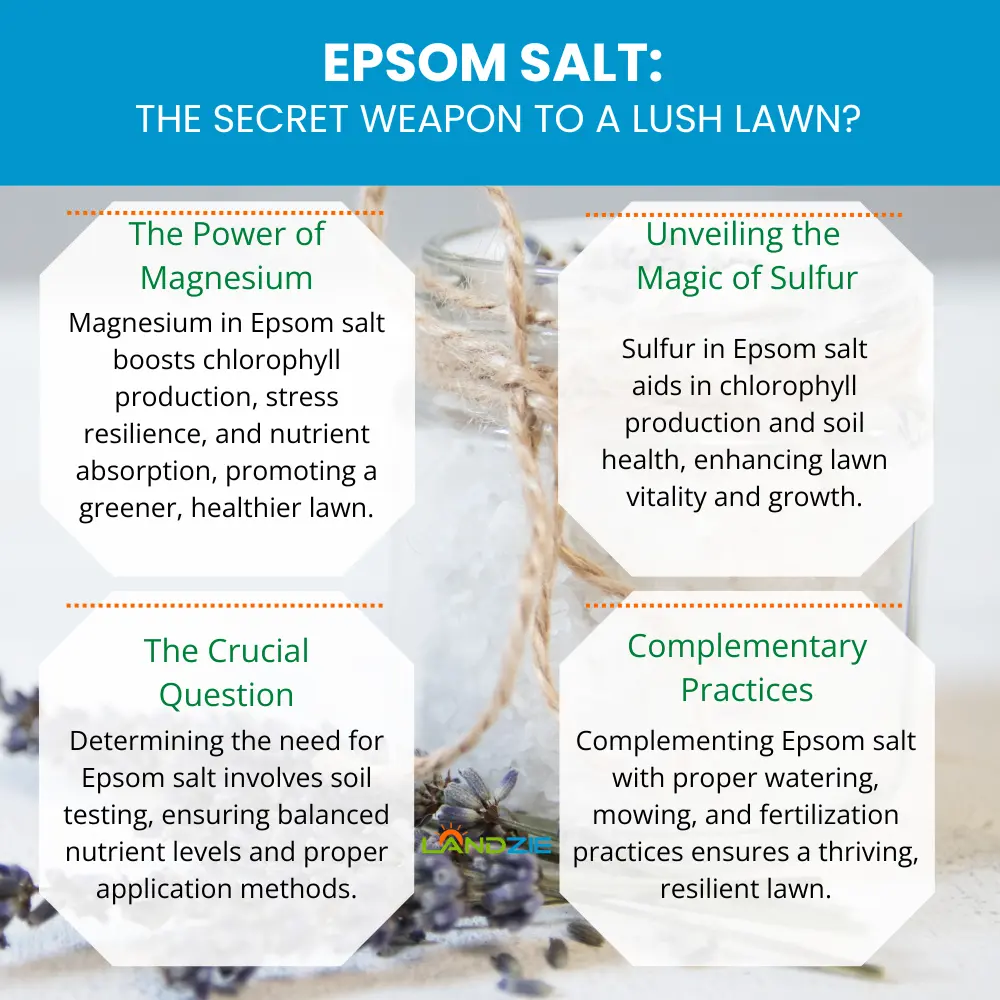
Image Source: landzie.com
Why Use Epsom Salt on Your Lawn?
Many homeowners wonder if Epsom salt is truly effective for their lawns. The answer is a resounding yes, when used correctly. Epsom salt provides essential nutrients that grass needs to thrive.
The Core Nutrients: Magnesium and Sulfur
Epsom salt is primarily composed of magnesium (Mg) and sulfur (S). These two elements are crucial for plant health and play vital roles in your grass’s ability to grow strong and green.
- Magnesium: This is the central atom in chlorophyll, the pigment that gives plants their green color and is essential for photosynthesis. Without enough magnesium, grass can become pale or yellow, a condition known as chlorosis. Magnesium also helps activate enzymes needed for plant growth and nutrient uptake.
- Sulfur: Sulfur is a component of amino acids, which are the building blocks of proteins. It also plays a role in enzyme activity and vitamin production within the plant. Sulfur contributes to overall plant vigor and can help improve the flavor and aroma of certain plants, though this is less relevant for a lawn. For grass, sulfur aids in the production of chlorophyll and helps with nutrient absorption.
Addressing Soil Deficiencies
Many soils, especially those that are sandy or have been heavily fertilized with potassium, can become deficient in magnesium. Epsom salt soil amendment can help replenish these depleted levels. When magnesium is lacking, grass can struggle to utilize other essential nutrients, even if they are present in the soil. By providing magnesium, Epsom salt improves nutrient uptake and overall plant health.
The Benefits of Epsom Salt for Grass
Applying Epsom salt to your lawn offers several advantages that contribute to its overall health and appearance.
Deeper Green Color
The most noticeable benefit of Epsom salt for grass is its ability to promote a deeper, richer green color. This is directly linked to magnesium’s role in chlorophyll production. More chlorophyll means more photosynthesis, leading to lusher, more vibrant green blades.
Enhanced Growth and Vigor
With adequate magnesium and sulfur, your grass can grow more robustly. This translates to thicker turf that is better able to withstand stress from drought, heat, and foot traffic. Epsom salt for lawn growth is a simple way to support healthier, more resilient turf.
Improved Nutrient Uptake
As mentioned, magnesium is key to how grass absorbs other nutrients from the soil. By ensuring sufficient magnesium levels, Epsom salt helps your lawn make the most of the fertilizers and nutrients already present, leading to more efficient growth and a healthier root system.
Soil Health Improvement
While primarily a nutrient source for the grass, Epsom salt can also have a subtle positive effect on soil structure over time, particularly in clay soils. Magnesium helps to flocculate (clump together) soil particles, improving aeration and drainage. This makes it easier for roots to penetrate the soil and access water and nutrients.
Natural and Safe Option
Compared to many synthetic fertilizers, Epsom salt is a natural mineral. When applied correctly, it is generally safe for lawns, pets, and children, making it an attractive option for eco-conscious homeowners.
How to Apply Epsom Salt to Your Lawn: A Step-by-Step Guide
Applying Epsom salt to your lawn is a straightforward process. Here’s how to do it effectively.
When to Apply Epsom Salt to Lawn
The best times to apply Epsom salt are during the active growing seasons for your grass type.
- Spring: As the grass begins to green up after winter, a spring application can give it a good start.
- Late Summer/Early Fall: This period is crucial for strengthening the grass before winter dormancy. An application can help it recover from summer stress and prepare for cooler weather.
Avoid applying Epsom salt during periods of extreme heat or drought, as this can stress the grass. It’s also best to avoid applying it when the grass is dormant.
Dosage and Ratio: How Much Epsom Salt to Use
Getting the dosage right is crucial. Too much can be detrimental, while too little won’t provide the desired benefits. A common and safe recommendation is to use 1 to 2 pounds of Epsom salt per 1,000 square feet of lawn.
- For a general boost: Start with 1 pound per 1,000 sq ft.
- For lawns showing signs of magnesium deficiency (pale color): You might use up to 2 pounds per 1,000 sq ft.
It’s always better to start with a lower dose and observe the results. You can gradually increase it in subsequent applications if needed.
Methods of Application
There are two main ways to apply Epsom salt to your lawn:
Method 1: Dissolving in Water (Recommended)
This is the most common and effective method, as it ensures even distribution and immediate absorption by the grass.
- Gather Supplies: You’ll need Epsom salt, a watering can or a hose-end sprayer, water, and your lawn.
- Dissolve the Salt: For every 1 pound of Epsom salt, dissolve it in approximately 2-3 gallons of water. Mix thoroughly until the salt is completely dissolved.
- Tip: It’s easier to dissolve if you use warm water.
- Apply with Watering Can: Pour the dissolved solution into a watering can and distribute it evenly over the 1,000 square feet you are treating. Walk at a steady pace to ensure uniform coverage.
- Apply with Hose-End Sprayer: If using a hose-end sprayer designed for liquid fertilizers, follow the manufacturer’s instructions for mixing. Typically, you would fill the sprayer’s reservoir with the dissolved Epsom salt solution and spray it over the lawn.
- Water Thoroughly: After applying the dissolved Epsom salt, it’s important to water your lawn immediately. This helps wash any residual salt off the grass blades and allows the nutrients to penetrate the soil and reach the roots. This step is critical for successful Epsom salt lawn application.
Method 2: Dry Application (Use with Caution)
While less recommended, you can apply Epsom salt in its dry granular form. This method requires extreme care to avoid burning the grass.
- Mix with Granular Fertilizer (Optional): You can mix Epsom salt with a granular lawn fertilizer. Ensure the fertilizer is also designed for dry application. The ratio of Epsom salt to fertilizer should be kept moderate.
- Use a Spreader: Apply the mixture evenly using a broadcast spreader or a drop spreader. Calibrate your spreader carefully to ensure you are applying the correct amount.
- Water Thoroughly and Immediately: This is the most critical step for dry application. You must water the lawn immediately and thoroughly after applying dry Epsom salt. This helps dissolve the salt and prevent it from sitting on the grass blades, which can cause damage or “burn.” The how to water Epsom salt into lawn step is paramount here.
Table: Application Methods Compared
| Feature | Dissolving in Water (Liquid) | Dry Application (Granular) |
|---|---|---|
| Distribution | Even and controlled | Can be uneven if not careful |
| Risk of Burn | Low | Moderate to High |
| Absorption | Faster | Slower, requires watering |
| Ease of Use | Moderate | Moderate (requires spreader) |
| Recommendation | Highly Recommended | Use with Caution |
Epsom Salt as a Fertilizer for Lawn
When used correctly, Epsom salt acts as a valuable Epsom salt fertilizer for lawn, providing essential magnesium and sulfur that many commercial fertilizers may lack or provide in unbalanced ratios.
Balancing Soil Nutrients
Many fertilizers focus on the macronutrients: nitrogen (N), phosphorus (P), and potassium (K). While these are vital, a lack of secondary nutrients like magnesium can hinder the grass’s ability to utilize them effectively. Epsom salt helps correct this imbalance.
Correcting Magnesium Deficiencies
If your soil test indicates low magnesium levels, or if your grass exhibits symptoms like yellowing between the veins (interveinal chlorosis), Epsom salt is an excellent way to address this specific deficiency.
Complementing Other Fertilizers
You can use Epsom salt in conjunction with your regular lawn fertilizer program. Apply Epsom salt between fertilizer applications, or mix it with a nitrogen-based fertilizer if you are confident in your spreader calibration and watering routine. Always follow the recommended application rates for both products.
Tips for Successful Epsom Salt Lawn Health
To maximize the benefits and avoid any potential drawbacks, keep these tips in mind for your Epsom salt lawn health journey.
Know Your Grass Type
Different grass types have varying nutrient needs and tolerances. Cool-season grasses (like fescues and ryegrass) and warm-season grasses (like Bermuda and Zoysia) will respond slightly differently. However, the general application rates provided are suitable for most common lawn grasses.
Soil Testing is Your Friend
For the most precise approach, consider getting a soil test done. A soil test will reveal your soil’s pH and nutrient levels, including magnesium. This information will help you determine if Epsom salt is truly needed and in what quantities.
Observe Your Lawn
After applying Epsom salt, pay attention to how your lawn responds. Look for signs of improved color and vigor. If you don’t see any positive changes after a couple of applications, re-evaluate your lawn care practices or consult with a local gardening expert.
Avoid Over-Application
As with any soil amendment or fertilizer, more is not always better. Over-applying Epsom salt can lead to an imbalance of nutrients in the soil, potentially harming your grass. Stick to the recommended rates.
Patch Test First
If you are concerned about how your lawn might react, try applying Epsom salt to a small, inconspicuous patch of your lawn first. Monitor it for a week or two before treating the entire lawn.
Epsom Salt Soil Amendment: Deeper Dive
Beyond just feeding the grass, Epsom salt soil amendment can contribute to the long-term health of your soil.
Improving Soil Structure
In clay-heavy soils, magnesium ions can help aggregate soil particles. This process, known as flocculation, creates more pore space, which improves drainage and aeration. Healthy soil structure is fundamental for strong root development and overall plant vitality.
Enhancing Water Retention
While improved drainage is a benefit, well-aggregated soil also tends to retain moisture more effectively, reducing the frequency with which you need to water your lawn. This is particularly beneficial during dry spells.
Increasing Availability of Other Nutrients
Magnesium plays a role in making other essential soil nutrients, such as phosphorus and potassium, more available to plant roots. This means that even if your soil has these nutrients, your grass might not be able to access them efficiently without adequate magnesium.
Applying Magnesium Sulfate to Grass: What You Need to Know
Applying magnesium sulfate to grass (which is the chemical name for Epsom salt) is essentially adding a readily available source of magnesium and sulfur.
Magnesium’s Role in Photosynthesis
Chlorophyll, the green pigment in plants, has a magnesium atom at its core. This atom is central to capturing light energy. Without enough magnesium, chlorophyll production is reduced, leading to less efficient photosynthesis and the characteristic yellowing of the leaves.
Sulfur’s Contribution to Plant Health
Sulfur is a constituent of several amino acids and vitamins. It is also involved in enzyme activity and energy production within the plant. A deficiency in sulfur can manifest as stunted growth and a general lack of vigor.
Understanding Soil pH
Epsom salt has a neutral pH (around 7.0). This means it is unlikely to significantly alter the pH of your soil. If your soil is very acidic or alkaline, you may need to address those issues separately with lime or sulfur, respectively. However, for most lawns, the pH impact of Epsom salt is negligible.
Common Questions About Using Epsom Salt on Lawns
Here are answers to some common questions homeowners have about this topic.
FAQ
Q1: How often can I apply Epsom salt to my lawn?
A: You can typically apply Epsom salt 2-3 times per growing season. Allow at least 4-6 weeks between applications to avoid over-fertilization.
Q2: Can Epsom salt harm my lawn?
A: When applied at the recommended rates and properly watered in, Epsom salt is generally safe. Over-application or applying it without adequate water can potentially scorch the grass blades.
Q3: Will Epsom salt kill weeds?
A: No, Epsom salt is not a herbicide and will not kill weeds. Its purpose is to provide nutrients to the grass.
Q4: Is Epsom salt safe for pets and children?
A: Yes, when used as directed, Epsom salt is considered safe for pets and children. However, it’s always a good practice to keep them off the lawn immediately after application until it has been watered in and dried to prevent them from ingesting large amounts.
Q5: What if my soil already has enough magnesium?
A: If a soil test indicates sufficient magnesium, adding more Epsom salt is unnecessary and could potentially cause an imbalance. It’s best to rely on soil test results for tailored nutrient management.
Q6: Can I use Epsom salt on my flower beds or vegetable garden?
A: Yes, Epsom salt can be beneficial for many plants in gardens, particularly those that are heavy magnesium feeders like tomatoes, peppers, and roses. The application rates may vary, so it’s good to research specific plant needs.
Q7: Does Epsom salt help with lawn diseases?
A: While healthy turf is more resistant to diseases, Epsom salt itself does not directly treat or prevent lawn diseases. It supports overall health, which can indirectly improve disease resistance.
Final Thoughts on Epsom Salt Lawn Care
Incorporating Epsom salt into your lawn care with Epsom salt routine is a simple, effective, and natural way to boost your grass’s health and appearance. By providing essential magnesium and sulfur, you can encourage deeper green color, promote stronger growth, and improve nutrient uptake. Remember to follow the recommended application rates and methods, especially watering thoroughly after application, to ensure the best results for your lawn. With a little effort, you can achieve that lush, green lawn you’ve always wanted.