
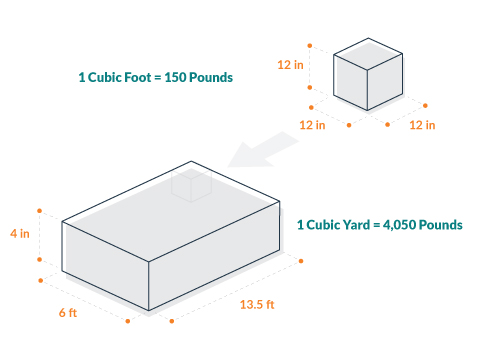
Image Source: www.dumpsters.com
How Much Does a Yard of Concrete Weigh Wet?
A cubic yard of wet concrete typically weighs between 3,700 and 4,050 pounds. This weight can vary depending on the mix design, specifically the proportions of aggregate, cement, water, and any additives.
Fathoming the Weight of Wet Concrete
When embarking on any construction project, knowing the weight of materials is crucial. This is especially true for concrete, a fundamental building block in modern infrastructure. Many people wonder, “How much does concrete weigh?” This is a broad question, and the answer is nuanced. However, when we get more specific and ask, “How much does a yard of concrete weigh wet?”, we’re looking for a more defined answer that impacts everything from transportation logistics to structural calculations.
The wet concrete weight per cubic yard is a vital piece of information for engineers, contractors, and even DIY enthusiasts planning to pour a foundation, sidewalk, or patio. This knowledge helps determine the load-bearing capacity of a structure, the strength of its support, and the best methods for handling and transporting the material. Let’s dive deep into what influences this weight and how to calculate it.
Deconstructing Concrete: The Building Blocks of Weight
Concrete is not a monolithic substance. It’s a composite material made from several key ingredients:
- Portland Cement: This is the binder that reacts with water to harden and bind the other components together.
- Aggregates: These are typically sand (fine aggregate) and gravel or crushed stone (coarse aggregate). Aggregates make up the largest volume of the concrete mix and significantly influence its density.
- Water: Water is essential for the chemical reaction (hydration) that hardens the cement. The amount of water affects the workability and strength of the concrete, and consequently, its weight.
- Admixtures (Optional): These are added to modify the properties of fresh or hardened concrete, such as improving workability, accelerating or retarding setting, or enhancing durability.
The exact proportions of these ingredients define the concrete density. A denser mix will naturally weigh more.
The Core Question: Cubic Yard of Concrete Weight
To answer “how much does a cubic yard of concrete weigh wet?” accurately, we need to consider the typical mix. Standard concrete mixes, designed for general-purpose use like sidewalks, driveways, and residential foundations, generally fall within a specific weight range.
- Typical Weight Range: As stated earlier, a cubic yard of wet concrete typically weighs between 3,700 to 4,050 pounds.
This range is a good starting point, but it’s essential to understand what causes the variation.
Factors Influencing Wet Concrete Weight
Several factors contribute to the precise weight of a cubic yard of wet concrete:
- Aggregate Type and Density: The type of rock used for coarse aggregate (e.g., granite, limestone, basalt) and the density of the sand used will have a significant impact. Denser aggregates lead to denser, heavier concrete.
- Aggregate Size and Gradation: The distribution of aggregate sizes also plays a role. A well-graded mix (a good mix of different aggregate sizes) can lead to a denser, more compact concrete.
- Water-Cement Ratio: While water is necessary for hydration, excess water increases the volume without significantly adding to the solid mass, thus slightly reducing the overall density and weight per cubic yard. However, very low water-cement ratios can lead to less dense, more porous concrete if not mixed properly.
- Cement Content: Higher cement content generally increases the weight, as cement is denser than water.
- Air Entrainment: Air-entrained concrete, used for improved freeze-thaw resistance, contains tiny air bubbles, which reduce the overall weight.
- Admixtures: Some admixtures can alter the density of the mix.
Deciphering Wet Concrete Density Per Yard
The concept of wet concrete density per yard is essentially what we’ve been discussing – the weight of a specific volume of freshly mixed, unhardened concrete. This density is crucial for structural design calculations.
- Density of Wet Concrete: The density of wet concrete is generally around 150 pounds per cubic foot (pcf) for typical mixes. To convert this to a cubic yard, we multiply by 27 (since there are 27 cubic feet in a cubic yard).
- 150 pcf * 27 cubic feet/cubic yard = 4,050 pounds per cubic yard.
This calculation highlights why the upper end of our typical range is 4,050 pounds. Variations from this value are due to the factors mentioned above.
How Much Does Concrete Weigh Wet? A Closer Look at the Numbers
Let’s break down the weight of a cubic yard of concrete into its components to better grasp how much does concrete weigh. A typical concrete mix, often referred to as a “standard mix” or “5-sack mix,” might have the following approximate composition by weight for a cubic yard:
- Cement: ~500-600 pounds
- Sand (Fine Aggregate): ~1,100-1,300 pounds
- Gravel (Coarse Aggregate): ~1,600-1,800 pounds
- Water: ~250-300 pounds (This is the amount of water added to the dry ingredients for mixing. The total weight will be the sum of all these.)
Adding these components together gives us a rough estimate:
500 (cement) + 1100 (sand) + 1600 (gravel) + 250 (water) = 3450 pounds.
However, this is a simplified view. The actual wet concrete weight per cubic yard is influenced by the actual specific gravities of the materials and the amount of void space filled by cement paste and water.
The Role of Specific Gravity
Specific gravity is the ratio of the density of a substance to the density of a reference substance, usually water. Aggregates have specific gravities typically ranging from 2.5 to 2.8. Cement has a specific gravity of around 3.15.
A more precise calculation involves considering these specific gravities and the proportions of each material in the mix. For example, a mix with heavier aggregates will naturally yield a higher cubic yard of concrete weight.
Calculating the Weight: Using a Concrete Weight Calculator
For precision, especially in large-scale projects, a concrete weight calculator is invaluable. These calculators typically ask for the proportions of cement, sand, gravel, and water, along with their specific gravities, to provide an accurate wet concrete weight calculation.
While you can manually calculate the weight if you have the mix design, using an online calculator or referring to engineering tables is often more practical. These tools often use established formulas to account for the complex interactions of the materials.
Sample Calculation (Simplified)
Let’s consider a hypothetical scenario to illustrate the wet concrete weight calculation:
Suppose a mix design for a cubic yard of concrete has the following:
- Cement: 550 lbs
- Sand: 1200 lbs
- Gravel: 1700 lbs
- Water: 280 lbs
Total dry ingredients weight = 550 + 1200 + 1700 = 3450 lbs.
Adding the water: 3450 + 280 = 3730 lbs.
This simplified calculation closely matches the lower end of our typical range. The difference between this and the higher end (4050 lbs) would be due to variations in the specific gravity of aggregates and potentially a denser mix design.
Comparing Units: Weight of Concrete Per Cubic Meter
It’s also common in many parts of the world to measure concrete volume in cubic meters. To answer “weight of concrete per cubic meter,” we need to convert our findings.
- 1 cubic yard ≈ 0.7646 cubic meters
- 1 cubic meter ≈ 1.308 cubic yards
Using the lower end of our range (3,700 lbs/yd³):
3,700 lbs/yd³ * 0.7646 yd³/m³ ≈ 2,830 lbs/m³
Using the higher end of our range (4,050 lbs/yd³):
4,050 lbs/yd³ * 0.7646 yd³/m³ ≈ 3,090 lbs/m³
So, the weight of concrete per cubic meter is typically between 2,830 and 3,090 pounds. This is roughly 1,285 to 1,400 kilograms per cubic meter, depending on the specific mix.
How Much Does a Cubic Yard of Concrete Weigh? The Nuances
The question “how much does a cubic yard of concrete weigh” can be further elaborated by considering the state of the concrete. We’ve focused on wet concrete. However, hardened concrete is slightly lighter because some of the water has reacted and become part of the solid structure, and any excess water that was not chemically bound or evaporated might be gone.
- Hardened Concrete: The weight of hardened concrete is slightly less than wet concrete. The reduction is generally minor, perhaps 1-3%, but it can be significant for large structural calculations.
For most practical purposes, when ordering concrete, the weight specified by the supplier will refer to the wet, freshly mixed state.
Practical Implications of Concrete Weight
Knowing the wet concrete weight per cubic yard has several critical applications:
- Transportation: Understanding the weight helps in calculating the load capacity of trucks and trailers used to transport concrete. A standard concrete mixer truck typically carries 9-11 cubic yards, meaning it can transport upwards of 33,000 to 44,550 pounds of concrete!
- Structural Engineering: Engineers use concrete weight to calculate dead loads on foundations, beams, columns, and slabs. This is fundamental to ensuring the structural integrity of buildings and other constructions.
- Cost Estimation: While concrete is usually sold by volume (cubic yard or meter), knowing its weight can sometimes be relevant for specific pricing models or for comparing different material suppliers.
- Handling and Safety: Knowing the weight helps in planning for the safe lifting and movement of precast concrete elements or when using concrete pumps.
Variations in Concrete Mixes and Their Weights
It’s worth noting that not all concrete is created equal. Different applications require different mix designs, which will affect the weight:
- Lightweight Concrete: Used for insulation or reducing structural loads, lightweight concrete can use aggregates like expanded shale, clay, or pumice. Its density can be significantly lower, sometimes less than half that of normal-weight concrete.
- High-Density Concrete: Used for radiation shielding, high-density concrete incorporates heavy aggregates like barite or magnetite. This significantly increases its weight, with densities sometimes exceeding 300 pcf.
- Self-Consolidating Concrete (SCC): SCC is designed to flow easily and fill formwork without vibration. Its mix design, often with more fines and superplasticizers, can influence its density.
For standard construction, however, the 3,700-4,050 lbs/yd³ range remains the most relevant for understanding how much does a yard of concrete weigh wet.
Summary of Key Weights
To recap and provide a quick reference:
| Material | Typical Weight per Cubic Yard (Wet) | Typical Weight per Cubic Meter (Wet) |
|---|---|---|
| Standard Concrete Mix | 3,700 – 4,050 pounds | 2,830 – 3,090 pounds |
| (~150 lbs/cubic foot) | (~1.68 – 1.84 tons) | (~1.28 – 1.40 tons) |
Note: 1 ton = 2000 pounds.
Frequently Asked Questions About Concrete Weight
Q1: Does the water content significantly change the weight of concrete per cubic yard?
A1: Yes, the water content influences the wet concrete weight calculation. While water is essential for hydration, adding more water than necessary (increasing the water-cement ratio) increases the volume of the mix without a proportional increase in solid material, thus slightly reducing the density and overall weight per cubic yard. However, the primary drivers of weight are the aggregates.
Q2: Is the weight of concrete the same everywhere?
A2: No, the concrete density can vary. As discussed, the type and density of aggregates used, along with the proportions in the mix design, will affect the final weight. Therefore, “how much does concrete weigh” is not a single fixed number.
Q3: How can I find the exact weight of the concrete I am using?
A3: The most accurate way is to consult the concrete supplier or the mix design specifications provided by the engineer or contractor. They will have the precise details of the materials used. You can also use an online concrete weight calculator if you have the mix proportions.
Q4: Does dried or hardened concrete weigh less than wet concrete?
A4: Yes, hardened concrete typically weighs slightly less than wet concrete. This is because the hydration process consumes some of the water, and any excess water that was not chemically bound or evaporated is no longer part of the mass.
Q5: What is the average weight of a concrete slab?
A5: The weight of a concrete slab depends on its thickness and the wet concrete density per yard. For instance, a 4-inch thick (1/3 foot) slab poured with concrete weighing 4,000 lbs/yd³ would weigh approximately 4,000 lbs/yd³ * (1/3) yd³/ft³ * 27 ft³/yd³ = 100 lbs per cubic foot for the slab itself. So, a 10ft x 10ft slab (100 sq ft) would weigh 100 lbs/ft² * 100 ft² = 10,000 pounds. This is a simplified example, and actual calculations would consider the precise density and any reinforcement.
By now, you should have a solid grasp of how much does a yard of concrete weigh wet, along with the factors influencing it and how to find more specific information for your projects. This knowledge is a cornerstone for safe and effective construction.