
Can you describe a garden? Yes, you can describe a garden by focusing on its sights, sounds, smells, textures, and the feelings it evokes. This guide will equip you with the tools to do just that, transforming your writing from a simple overview into a vibrant, immersive experience for your readers.
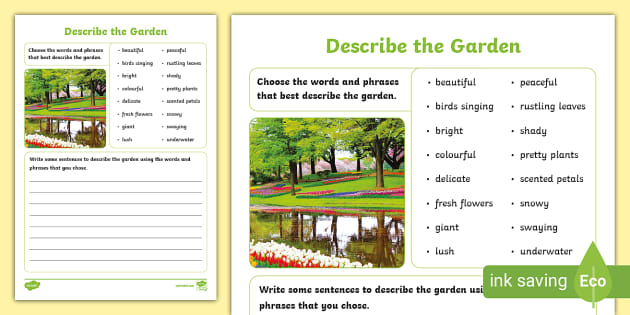
Image Source: images.twinkl.co.uk
Painting with Words: The Art of Garden Description
Writing about gardens is a joy that goes beyond listing flowers. It’s about capturing an atmosphere, a feeling, a living, breathing entity. A good garden description invites the reader to step into your created space, to feel the sun on their skin, to smell the damp earth, and to marvel at the delicate dance of a butterfly. It’s about using evocative language gardening techniques to create vivid garden imagery.
Unlocking Your Gardening Vocabulary
To truly bring a garden to life, you need a rich gardening vocabulary. Think beyond “pretty flowers.” Consider the specific types of plants, their forms, and their life cycles.
Descriptive Words for Plants
Every plant has a story to tell through its appearance. Let’s explore some ways to describe them.
-
Leaf Shapes:
- Lanceolate: Long and narrow, tapering to a point.
- Ovate: Egg-shaped, wider at the base.
- Spatulate: Spoon-shaped.
- Palmate: Divided into several lobes like fingers of a hand.
- Pinnate: Compound leaves with leaflets arranged along a central stem.
- Cordate: Heart-shaped.
- Linear: Very long and narrow, with parallel sides.
- Deltoid: Triangular.
-
Flower Forms:
- Bell-shaped: Like a classic bell.
- Star-shaped: With pointed petals radiating outwards.
- Trumpet-shaped: Long and tubular with a flared opening.
- Disc-shaped: Flat with many tiny florets in the center.
- Fringed: Having a serrated or cut edge.
- Umbel: A cluster of flowers with stems of equal length arising from a common center.
- Spike: Flowers arranged along an upright stem.
-
Plant Textures and Surfaces:
- Velvety: Soft and downy.
- Silky: Smooth and lustrous.
- Waxy: Having a smooth, shiny coating.
- Fuzzy: Covered in soft hairs.
- Prickly: Covered in sharp points.
- Leathery: Thick and firm.
- Papery: Thin and delicate.
-
Growth Habits:
- Sprawling: Growing outwards and downwards.
- Climbing: Growing upwards with tendrils or twining stems.
- Weeping: Having branches that hang downwards.
- Upright: Growing straight and tall.
- Bushy: Dense and rounded.
- Groundcover: Spreading low to the ground.
Engaging the Senses: Sensory Details Garden
A truly compelling garden description appeals to all the senses. Think about what you see, hear, smell, and even touch. This is where you build your garden imagery.
What You See: Visual Feast
The visual aspect of a garden is often the most immediate. It’s about color, light, and form.
-
Colors:
- Beyond basic colors, consider their intensity and hue. Is it a vibrant scarlet or a muted crimson? A pale lavender or a deep violet?
- Think about color combinations: harmonious blues and greens, contrasting yellows and purples, earthy browns and deep reds.
- Consider how light affects color: sun-drenched petals, shadow-kissed leaves, iridescent sheens.
-
Light and Shadow:
- Dappled sunlight: Light filtering through leaves.
- Golden hour glow: Soft, warm light late in the day.
- Deep shade: Areas of cool darkness.
- Sunbeams: Rays of light piercing through.
- Glittering dew drops: Sparkles on leaves and petals.
-
Shapes and Forms:
- Describe the overall structure: geometric beds, organic curves, wild, untamed sprawl.
- Focus on individual plant shapes: the elegant arch of a rose stem, the architectural grandeur of a sunflower, the delicate lacework of fern fronds.
- Consider the interplay of shapes: tall spires against low mounds, bold foliage contrasting with fine textures.
What You Hear: The Garden’s Symphony
Gardens are rarely silent. Listen closely to the sounds that contribute to the atmosphere.
-
Insect Buzz:
- The low hum of bees: A constant, comforting presence.
- The sharp buzz of a dragonfly: A fleeting, energetic sound.
- The chirping of crickets: A subtle, nighttime serenade.
-
Birdsong:
- The cheerful chirping of sparrows.
- The melodic warble of a robin.
- The sharp call of a jay.
- The gentle coo of a dove.
-
Other Sounds:
- The rustle of leaves in the breeze: A whispering conversation.
- The gentle trickle of water: From a fountain or stream.
- The soft thud of a ripe fruit falling.
- The crunch of gravel underfoot.
- The distant drone of a lawnmower.
What You Smell: The Garden’s Perfume
Describing garden scents is a powerful way to create an immersive experience. Scents can transport us and evoke strong memories.
-
Floral Fragrances:
- Sweet and heady: Roses, jasmine, honeysuckle.
- Spicy and intense: Lilies, carnations.
- Fresh and clean: Lavender, mint.
- Subtle and delicate: Pansies, violets.
-
Earthly Aromas:
- The rich scent of damp earth after rain: Petrichor.
- The sharp, green smell of freshly cut grass.
- The pungent aroma of crushed herbs: Rosemary, thyme.
- The woody scent of bark and decaying leaves.
-
Combinations of Scents:
- Describe how different smells mingle: the sweet perfume of roses blending with the sharp tang of mint.
- Consider the time of day: morning dew-kissed blooms releasing a light fragrance, evening blossoms becoming more potent.
What You Touch: Textures and Temperatures
The tactile experience of a garden adds another layer of depth to your garden description.
-
Plant Textures (revisited):
- The soft brush of a fern frond.
- The rough bark of an old tree.
- The smooth coolness of a stone path.
- The velvety petals of a rose.
- The sharp prickle of a thistle.
-
Temperature and Moisture:
- The warmth of the sun on your skin.
- The cool dampness of shaded earth.
- The refreshing mist from a sprinkler.
- The dry, brittle texture of fallen leaves.
Capturing the Garden Aesthetics
Garden aesthetics refer to the overall beauty and design principles of a garden. It’s about how the elements work together to create a pleasing whole.
Harmony and Balance
- Symmetry: A formal garden might feature perfectly balanced planting beds and pathways.
- Asymmetry: A more naturalistic garden embraces a looser, more organic arrangement.
- Focal points: A striking sculpture, a magnificent tree, or a vibrant flower bed that draws the eye.
Color Palettes
- Monochromatic: Using variations of a single color for a serene effect.
- Complementary: Using colors opposite each other on the color wheel for high contrast and energy.
- Analogous: Using colors next to each other on the color wheel for a harmonious and pleasing blend.
Scale and Proportion
- Consider the relationship between different elements: tall trees towering over low shrubs, delicate blooms nestled amongst robust foliage.
- How does the garden feel in relation to its surroundings? Is it intimate and cozy, or expansive and grand?
Creating a Garden Narrative
Beyond just describing what’s there, you can weave a story. Creating a garden narrative involves thinking about the garden’s history, its purpose, or the feelings it inspires.
The Garden’s Story
- A garden as a sanctuary: A place of peace and refuge.
- A garden as a celebration: A riot of color and life.
- A garden as a memory: Tied to a person or an event.
- A garden in transition: Showing the change of seasons.
Personification and Metaphor
- Give the garden human-like qualities: the roses seemed to blush in the sunlight, the ancient oak stood like a stoic guardian.
- Use metaphors to compare garden elements to other things: the path meandered like a ribbon, the leaves were a confetti of autumn hues.
Putting it All Together: Examples
Let’s see how these elements combine.
Example 1: A Formal Rose Garden
The air in the rose garden was thick with a sweet, almost cloying perfume, a heady blend of damask and tea. Perfectly manicured beds of crimson and blush roses stood in precise, geometric rows, their velvety petals unfurling like silken gowns. Sunlight, softened by the dappled shade of overhead plane trees, caught the dewdrops clinging to the leaves, making them sparkle like scattered diamonds. The only sound was the low, contented hum of bees diligently working the blossoms. A stone fountain in the center whispered a gentle, continuous melody, its cool spray a welcome relief from the day’s warmth.
Example 2: A Wild English Country Garden
This was a garden that breathed. Forget straight lines; here, paths meandered through a joyous, untamed riot of color and texture. Tall, feathery grasses swayed like dancers in the breeze, their seed heads catching the golden light. Fat, bumblebees buzzed drunkenly amongst the sprawling lavender bushes, releasing their calming scent into the warm afternoon. Climbing roses, their thorny branches a tangled embrace, cascaded over a crumbling stone wall, their delicate pink blooms a stark contrast to the rough, weathered rock. The ground was a tapestry of mosses, fallen leaves, and the occasional bright splash of a fallen apple, its sweet, earthy aroma mingling with the sharp green of crushed mint underfoot. The air felt alive, buzzing with unseen activity and the soft murmur of rustling foliage.
Refining Your Descriptions
Here are some tips to make your garden description even better.
Focus on Specificity
Instead of “flowers,” use “scarlet poppies,” “delicate forget-me-nots,” or “sunflower’s golden face.”
Use Strong Verbs and Adjectives
- Verbs: Instead of “grow,” try “climb,” “sprawl,” “cascade,” “reach,” “unfurl.”
- Adjectives: Instead of “nice,” try “fragrant,” “velvety,” “lustrous,” “vibrant,” “ancient.”
Vary Sentence Structure
Mix short, punchy sentences with longer, more descriptive ones to create rhythm and flow.
Show, Don’t Tell
Instead of saying “the garden was beautiful,” describe why it was beautiful using sensory details.
Consider the Mood
What feeling do you want to convey? Is it peaceful, energetic, mysterious, or romantic? Let your word choices reflect that mood.
Tables for Quick Reference
Here are some quick-reference tables to help you brainstorm.
Table 1: Adjectives for Garden Colors
| Color | Shades and Hues |
|---|---|
| Red | Scarlet, crimson, ruby, rose, coral |
| Blue | Azure, sapphire, navy, periwinkle |
| Yellow | Golden, lemon, buttery, saffron |
| Green | Emerald, jade, olive, lime |
| Purple | Violet, lavender, amethyst, lilac |
| White | Ivory, pearl, alabaster |
| Orange | Amber, apricot, fiery |
Table 2: Nouns for Garden Elements
| Category | Examples |
|---|---|
| Plants | Blooms, petals, leaves, stems, branches, roots |
| Structures | Paths, benches, arbors, trellises, walls |
| Water Features | Ponds, fountains, streams, bird baths |
| Wildlife | Bees, butterflies, birds, dragonflies |
| Other | Soil, dew, sunlight, shadow, fragrance, breeze |
Writing About Gardens – A Continuous Journey
Writing about gardens is an ongoing process of observation and practice. The more you engage with your garden, the more you’ll notice, and the more you’ll have to write about. Your garden description will evolve as you learn new gardening vocabulary and experiment with different ways of expressing what you experience.
The aim is to create a garden narrative that resonates with your reader, allowing them to not just read about your garden, but to feel it. By focusing on sensory details garden and employing evocative language gardening techniques, you can transform a simple description into a captivating literary experience. The garden aesthetics you choose to highlight will further shape the reader’s perception, painting a picture of beauty and meaning.
Frequently Asked Questions
Q: What are some common mistakes people make when describing gardens?
A: Common mistakes include being too general, not using enough sensory details, relying on clichés, and failing to show the unique character of the garden.
Q: How can I describe the smell of a garden effectively?
A: Focus on specific scents, compare them to familiar smells, and consider how they blend or change throughout the day. Think about the intensity – is it subtle or overpowering?
Q: What is “garden imagery”?
A: Garden imagery refers to the vivid mental pictures created through descriptive language. It’s about painting a scene with words that appeals to the reader’s senses.
Q: Can I use scientific names for plants in my description?
A: While sometimes appropriate for technical writing, for general descriptions, common names are usually more accessible to a broader audience. You can occasionally use a scientific name if it adds a specific nuance, but explain it if necessary.
Q: How do I make my garden description sound unique?
A: Focus on what makes your garden special. Are there particular plants, a unique layout, a special memory attached to it, or a specific mood you want to convey? Personal experiences and observations are key to uniqueness.