
A typical garden hose can deliver between 5 to 15 Gallons Per Minute (GPM). This rate, known as the GPM garden hose output, is crucial for various watering tasks, from hand-watering delicate plants to powering sprinklers.
Knowing how much water your garden hose delivers is like knowing how much fuel your car holds – it helps you plan your journeys, or in this case, your watering schedule. The garden hose flow rate, often measured in Gallons Per Minute (GPM), dictates how efficiently you can get water to your plants, wash your car, or fill a kiddie pool. This guide will help you decipher your hose’s GPM, why it matters, and how to maximize its water output.
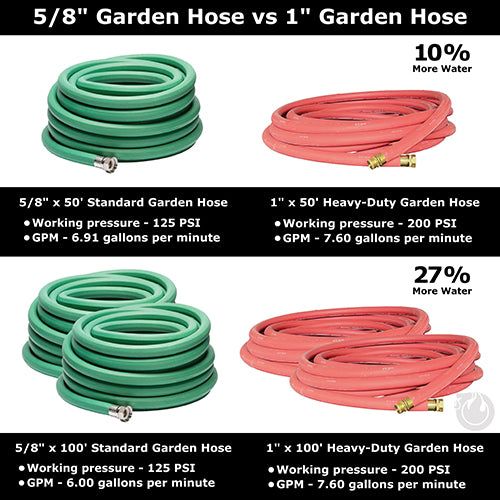
Image Source: firehosedirect.com
Deciphering Your Garden Hose’s GPM
So, you’re wondering, “How much water can my garden hose actually push out?” The hose GPM calculator isn’t a physical tool you buy; it’s more about understanding the factors that influence your hose’s output. Let’s break down what determines your water flow rate garden hose.
Factors Influencing GPM
Several elements play a significant role in how many gallons per minute your garden hose can deliver. Think of these as the ingredients in your watering recipe:
- Water Pressure (PSI): This is arguably the most critical factor. Water pressure, measured in Pounds per Square Inch (PSI), is the force pushing the water through your pipes and out of the hose. Higher PSI generally means higher GPM. Your home’s water pressure is determined by your municipal supply or well system.
- Hose Diameter: Wider hoses allow more water to flow through them than narrower ones. A standard garden hose is typically 5/8 inch in diameter, but you can find them in 1/2 inch, 3/4 inch, and even 1-inch diameters.
- 1/2 inch hose: Usually delivers less GPM, often in the 3-6 GPM range.
- 5/8 inch hose: The most common, typically yielding 7-12 GPM.
- 3/4 inch hose: Offers a higher flow, often 15-20+ GPM.
- 1 inch hose: For serious watering needs, providing 30+ GPM.
- Hose Length: The longer the hose, the more friction there is between the water and the inside of the hose. This friction, called “friction loss,” reduces water pressure and, consequently, GPM. A very long hose (over 100 feet) can significantly impact your flow rate.
- Hose Material and Smoothness: Smoother interior surfaces offer less resistance to water flow. Old, rough hoses can impede the GPM.
- Kinks and Obstructions: Any kinks, bends, or blockages in the hose will dramatically reduce the hose water output.
- Faucet Flow Rate: The GPM can also be limited by the maximum flow rate from your outdoor faucet (spigot).
- Nozzle Type: While the hose itself has a GPM capacity, the nozzle you use can restrict or enhance the flow. Some adjustable nozzles have a wide opening that allows for higher GPM when set to a “shower” or “fan” setting, while others might be designed for lower flow.
Typical Garden Hose GPM Estimates
To give you a clearer picture, here’s a look at the typical garden hose GPM for common sizes, assuming average household water pressure (around 40-60 PSI):
| Hose Diameter | Approximate GPM Range (at 40-60 PSI) |
|---|---|
| 1/2 inch | 3 – 6 GPM |
| 5/8 inch | 7 – 12 GPM |
| 3/4 inch | 15 – 20 GPM |
| 1 inch | 30+ GPM |
These are estimates. Your actual GPM can vary based on the factors mentioned above.
How to Measure Your Garden Hose’s GPM
If you need a precise number for your garden hose flow rate, you can perform a simple test. This is especially useful if you’re planning to use sprinklers or other water-intensive attachments.
The Bucket Test Method
This is a straightforward way to calculate your water flow rate garden hose without special equipment.
What You’ll Need:
- A 5-gallon bucket (or any bucket of a known volume).
- A stopwatch or timer on your phone.
- Your garden hose with the nozzle removed (or set to its widest, unobstructed flow).
- A way to open and close the faucet quickly.
Steps:
- Place the bucket directly under the end of the hose.
- Turn on the water at the faucet to full blast.
- Start the timer the moment the water starts flowing into the bucket.
- Stop the timer as soon as the bucket is full.
- Record the time it took to fill the bucket.
-
Calculate the GPM:
-
If you used a 5-gallon bucket:
- GPM = 5 gallons / (time in seconds / 60 seconds per minute)
- Example: If it took 30 seconds to fill the 5-gallon bucket:
- GPM = 5 / (30 / 60) = 5 / 0.5 = 10 GPM
-
If you used a different sized bucket (e.g., V = volume in gallons):
- GPM = V / (time in seconds / 60)
-
Why Knowing Your GPM Matters
Understanding how much water garden hose delivers is essential for several reasons:
- Efficient Watering: Knowing your GPM helps you determine how long to water different areas of your garden. Overwatering or underwatering can harm plants.
- Sprinkler Selection: Sprinklers are rated by their GPM requirements and the area they cover. Using a sprinkler with a GPM requirement that exceeds your hose’s output will result in poor performance, low coverage, and inefficient watering. Conversely, a sprinkler with too low a GPM for your hose might be wasted potential. Matching your hose’s GPM garden hose capacity to your sprinkler’s needs is key for effective lawn care.
- Water Conservation: By knowing your flow rate, you can water more precisely, reducing water waste.
- Hose and Sprayer Performance: If you have a high-pressure washer attachment or a specific watering wand, knowing your GPM ensures it operates as intended.
- Filling Needs: Whether it’s a pool, a pond, or a watering tank, GPM dictates how quickly you can fill it.
Optimizing Your Garden Hose’s Water Output
If your current GPM isn’t meeting your needs, there are several ways to improve your garden hose flow rate.
H3: Enhancing Water Pressure
The most direct way to increase GPM is to increase water pressure.
- Check Faucet Settings: Ensure your outdoor faucet is fully open. Sometimes, the handle might not be turned all the way.
- Inspect for Leaks: Leaks anywhere in the system before the hose, including underground pipes or connections, will reduce pressure.
- Pressure Reducer Valve: If your home has excessively high water pressure (over 80 PSI), a pressure-reducing valve (PRV) might be installed. While these protect your plumbing, ensure it’s functioning correctly. If it’s faulty, it could be limiting your flow. You might need a plumber to inspect or adjust it.
- Water Pump (Rarely for Garden Hoses): In some specialized situations, a dedicated water pump might be used, but this is uncommon for typical garden hose use.
H3: Improving Hose Efficiency
You can also maximize the water flow your hose is capable of.
- Use the Right Diameter Hose: If you consistently need more water, consider upgrading to a wider diameter hose (e.g., from 5/8 inch to 3/4 inch). This will significantly boost your hose water output.
- Minimize Hose Length: If possible, use the shortest hose necessary for the job. If you have a very long hose, consider splitting it into shorter sections or using a higher-quality hose with a smoother interior.
- Avoid Kinks: Regularly check your hose for kinks and straighten them out immediately. Kinks are a major GPM killer.
- Clean the Hose: Over time, sediment can build up inside a hose, reducing its internal diameter and smoothness. Flushing the hose with high pressure can help.
- Use High-Quality Hoses: Invest in hoses made from durable materials with smooth interiors. Look for hoses designed for higher flow rates.
H3: Selecting the Right Nozzle and Attachments
Your nozzle choice significantly impacts the final Gallons per minute for watering.
- Adjustable Nozzles: Many adjustable nozzles have a “jet” or “shower” setting that offers less restriction. Experiment with different settings to find the one that provides the best flow for your needs.
- Sprinkler GPM Requirements: When choosing sprinklers, always check their sprinkler GPM requirements.
- Impact Sprinklers: These often require higher GPM and pressure to operate effectively.
- Oscillating Sprinklers: These can work with a wider range of GPM but will cover a larger area with more water.
- Soaker Hoses/Drip Irrigation: These are designed for low-flow, slow watering and typically have very low GPM requirements. They are excellent for water conservation.
- Hose End Sprayers: For applying fertilizers or pesticides, ensure the sprayer’s GPM is compatible with your hose.
H4: Irrigation Hose Flow Considerations
For more extensive watering systems, understanding irrigation hose flow is even more critical. Drip irrigation systems, for instance, rely on low GPM at each emitter to deliver water directly to the plant roots. A standard garden hose connected to a drip system would need to be regulated to a much lower flow rate to prevent damage to the emitters or the system itself. This is often achieved with pressure regulators and specific drip emitters designed for low flow.
H5: Matching Your Hose to Your Task
- Light Gardening: A 1/2 inch or 5/8 inch hose with moderate GPM is usually sufficient for watering flower beds or vegetable gardens by hand.
- Lawn Watering: For effective lawn coverage with sprinklers, a 5/8 inch or 3/4 inch hose is recommended to ensure sprinklers receive adequate water.
- Washing Cars or Patios: A higher GPM can be useful here for a more powerful cleaning stream.
- Filling Pools: For larger tasks like filling a pool, a larger diameter hose (3/4 inch or 1 inch) will significantly reduce the time required.
Frequently Asked Questions (FAQ)
Q: What is considered good GPM for a garden hose?
A: A typical garden hose GPM for a standard 5/8 inch hose is around 7-12 GPM at average household pressure. Anything within this range is generally considered good for most common watering tasks.
Q: Can I increase my garden hose’s GPM?
A: Yes, you can improve your garden hose flow rate by ensuring your faucet is fully open, using a wider diameter hose, minimizing hose length, avoiding kinks, and choosing a nozzle that doesn’t overly restrict flow.
Q: How does water pressure affect GPM?
A: Water pressure (PSI) is the force pushing water. Higher pressure generally leads to higher GPM. If your pressure is low, your hose’s hose water output will also be low, regardless of its diameter.
Q: How do I know if my sprinkler needs more GPM than my hose provides?
A: Check the sprinkler GPM requirements on the sprinkler’s packaging or manual. If your hose’s measured GPM (using the bucket test) is lower than the sprinkler’s requirement, the sprinkler will not perform as intended, likely resulting in poor coverage or not rotating properly.
Q: Is a longer hose bad for GPM?
A: Yes, a longer hose can reduce GPM due to increased friction loss. The longer the hose, the more pressure is lost along its length.
Q: What’s the difference between GPM and PSI?
A: PSI (Pounds per Square Inch) measures the force of the water, while GPM (Gallons Per Minute) measures the volume of water delivered over time. You need both sufficient PSI and an adequate hose capacity to achieve a high GPM.
By grasping the factors that influence your garden hose flow rate and performing simple tests, you can ensure you’re getting the most efficient and effective watering possible for your garden and other outdoor needs. Knowing how much water garden hose delivers empowers you to make informed choices about your watering tools and techniques.