
A standard garden hose typically delivers between 5 to 12 gallons per minute (GPM). This rate can vary greatly depending on factors like water pressure, hose diameter, and nozzle type.
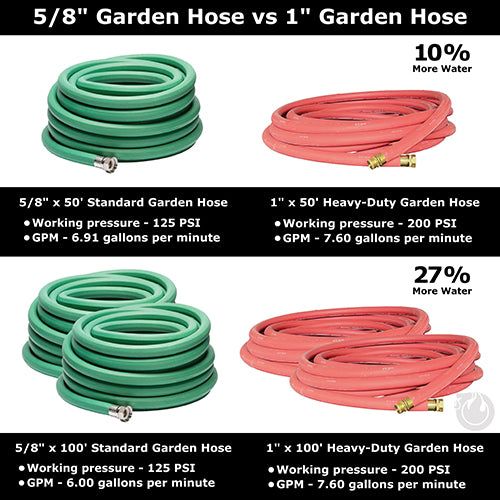
Image Source: firehosedirect.com
Deciphering Your Garden Hose’s Water Output
Have you ever wondered how much water your garden hose actually sprays? It’s a common question for anyone tending to their garden, washing their car, or filling a kiddie pool. The amount of water you get from your hose is measured in gallons per minute (GPM), which tells you the GPM water flow. Knowing this can help you water more efficiently, choose the right tools for your tasks, and even save water.
What Affects Your Hose’s GPM?
Several elements work together to determine the garden hose flow rate. It’s not as simple as just turning on the tap. Think of it like a system where each part plays a role in how much water comes out.
Water Pressure: The Driving Force
The most significant factor influencing your hose’s water output hose is water pressure. This is the force pushing the water through your pipes.
- Municipal Supply Pressure: In most homes, water pressure is supplied by your local water utility. The typical range for residential water pressure is between 40 to 60 pounds per square inch (PSI). However, this can vary. Some areas might have higher or lower pressure.
- Well Water Systems: If you rely on a well, your water pressure will depend on your pump and pressure tank settings. These can often be adjusted.
- High-Rise Buildings: Buildings with many floors might have booster pumps to ensure adequate pressure reaches higher levels.
How Pressure Impacts GPM: Higher water pressure generally means a higher gallons per minute sprinkler will be able to operate effectively and a greater water volume hose can be delivered. Imagine pushing water through a pipe; the harder you push, the more water you can move in the same amount of time.
Measuring Your Home’s Water Pressure: You can get a simple water pressure gauge that screws onto an outdoor faucet. This will give you a reading in PSI.
Hose Diameter: The Waterway’s Size
The diameter of your garden hose is another critical component in determining its hose size water flow. Hoses come in different diameters, typically ranging from 1/2 inch to 3/4 inch, with 5/8 inch being the most common.
- 1/2 Inch Hoses: These are generally lighter and easier to handle but offer less water flow. They are suitable for light watering tasks or when water pressure is already low.
- 5/8 Inch Hoses: This is the standard size for most home gardens. They offer a good balance between ease of use and a decent water flow rate.
- 3/4 Inch Hoses: These are the largest and offer the highest water flow. They are ideal for tasks requiring a lot of water quickly, like filling large tanks or using powerful pressure washers.
The Flow Relationship: A wider hose allows more water to pass through it at any given time. Think of it like a highway: a wider highway can handle more cars moving at the same time than a narrow road. So, a larger hose diameter flow directly relates to a higher potential GPM.
Hose Length: Distance Matters
The length of your hose also plays a role, though often less significant than pressure or diameter.
- Friction Loss: As water travels through a hose, it encounters friction against the inner walls. The longer the hose, the more friction there is. This friction can reduce the water pressure and, consequently, the GPM at the nozzle.
- Impact on GPM: While a longer hose won’t necessarily reduce your GPM by a fixed amount, it can contribute to a slight decrease in flow, especially if the hose is also of a smaller diameter or the water pressure is already marginal.
Nozzle Type: Controlling the Spray
The nozzle at the end of your hose can dramatically change the water output hose, even with the same water pressure and hose.
- Adjustable Nozzles: These allow you to change the spray pattern, from a fine mist to a strong jet. A narrower, more concentrated stream will have a higher velocity, but the overall GPM might not change drastically unless the nozzle is specifically designed to restrict or enhance flow.
- Shower Nozzles: These disperse water over a wider area, often at a lower pressure, which can make plants look like they are receiving a lot of water, but the actual GPM might be lower than a focused jet.
- Sprinklers: Different types of sprinklers have varying GPM requirements. A gentle oscillating sprinkler might need less GPM than a powerful impact sprinkler designed to cover a large area. The gallons per minute sprinkler is designed to work within a specific water pressure hose GPM range for optimal coverage.
Nozzle Restriction: Some nozzles, especially older or simpler ones, can restrict the flow of water, lowering the GPM. Conversely, a well-designed, low-restriction nozzle can help maintain a higher GPM.
Calculating Your Garden Hose’s GPM
While many factors influence GPM, you can get a good estimate of your garden hose flow rate with a simple test.
The Bucket Test: A Simple Measurement
The bucket test is the easiest way to determine your hose’s water volume hose.
What You’ll Need:
- A bucket with a known volume (e.g., a 5-gallon bucket).
- A stopwatch or your phone’s timer.
- Your garden hose with the nozzle attached (or without, if you want to measure raw hose output).
Steps:
- Find a Full Bucket: Place your bucket under the hose.
- Turn on the Water: Open the faucet completely.
- Start the Timer: As soon as the water starts filling the bucket, start your timer.
- Stop the Timer: When the bucket is full, stop the timer immediately.
- Record the Time: Note down how many seconds it took to fill the bucket.
The Calculation:
- Convert Time to Minutes: Divide the number of seconds by 60.
- Example: If it took 30 seconds, that’s 30 / 60 = 0.5 minutes.
- Calculate GPM: Divide the bucket’s volume (in gallons) by the time it took to fill (in minutes).
- Formula: GPM = Bucket Volume (gallons) / Time to Fill (minutes)
- Example: If you used a 5-gallon bucket and it took 0.5 minutes to fill:
GPM = 5 gallons / 0.5 minutes = 10 GPM
This test gives you a practical understanding of your faucet flow rate when used with your hose.
Typical GPM Ranges for Different Hose Sizes and Pressures
Let’s break down what you might expect for hose diameter flow and water pressure hose GPM.
| Hose Diameter | Typical Water Pressure (PSI) | Estimated GPM | Common Uses |
|---|---|---|---|
| 1/2 inch | 40-60 | 3-6 | Light watering, small gardens, car washing |
| 5/8 inch | 40-60 | 5-10 | General garden use, lawn care, filling pools |
| 3/4 inch | 40-60 | 8-15+ | Heavy-duty tasks, large areas, high-flow needs |
Important Considerations:
- These are estimates. Your actual outdoor faucet GPM can be higher or lower.
- Higher pressure will always increase GPM for any given hose size.
- Longer hoses or those with kinks will reduce GPM.
Why Knowing Your Hose’s GPM Matters
Understanding your hose’s GPM is more than just a number; it has practical benefits for your home and garden.
Efficient Watering
- Preventing Overwatering: Knowing your GPM helps you time your watering correctly. If your hose delivers 10 gallons per minute, and your plant needs 50 gallons, you know it will take 5 minutes to provide that amount. This prevents overwatering, which can damage roots and waste water.
- Ensuring Adequate Hydration: Conversely, if your hose’s GPM is low, you can adjust your watering schedule to ensure plants get enough water, especially during hot spells.
Choosing the Right Sprinkler
- Sprinkler Compatibility: Many sprinklers are designed to operate efficiently within a specific GPM range and water pressure. Using a sprinkler with a GPM requirement that’s too high for your hose setup will result in poor performance (e.g., weak spray, uneven coverage). The gallons per minute sprinkler label is key here.
- Optimizing Coverage: Matching your sprinkler’s GPM needs to your hose’s GPM output ensures you get the best possible watering for your lawn or garden.
Conserving Water
- Targeted Watering: By knowing your flow rate, you can water precisely what needs it, for the duration it needs it. This minimizes runoff and evaporation, saving water.
- Identifying Leaks: A sudden drop in GPM could indicate a leak in your hose, faucet, or underground pipe.
Time Savings
- Faster Filling: If you need to fill a large container, like a rain barrel or a swimming pool, knowing your GPM helps you estimate how long it will take. A higher GPM means less waiting time.
Common Issues Affecting GPM and Solutions
Sometimes, your hose just doesn’t seem to deliver the water it used to. Here are common problems and how to fix them.
Low Water Pressure at the Source
- Problem: The water pressure from your municipal supply or well pump is simply too low.
- Solution:
- Check with your neighbors to see if they are experiencing similar issues. If so, it might be a city-wide problem.
- If you have a well, check your pressure tank and pump. You may need to adjust the pressure switch or call a well professional.
- Consider installing a booster pump for your entire house if consistently low pressure is a problem.
Clogged Faucet Aerator or Sprayer Heads
- Problem: Mineral deposits or debris can clog the openings in your faucet or sprinkler heads, restricting water flow.
- Solution:
- Remove and clean faucet aerators. Soak them in vinegar to dissolve mineral buildup.
- Clean any debris from sprinkler heads.
Kinked or Damaged Hose
- Problem: A kink in the hose or a damaged section can severely restrict hose diameter flow.
- Solution:
- Unroll your hose carefully, ensuring there are no kinks.
- If the hose is damaged, you might need to cut out the damaged section and use hose repair fittings, or simply replace the hose.
Old or Narrower Hose
- Problem: Very old hoses can become stiff and develop internal blockages. Hoses with a smaller diameter will naturally have less water volume hose.
- Solution:
- Consider upgrading to a newer, good-quality hose, preferably with a 5/8-inch diameter or larger for better flow.
Faucet Issues
- Problem: The faucet valve itself might not be opening fully, or it could be worn out.
- Solution:
- Ensure the faucet is turned on all the way.
- If the faucet is old, the internal washer or stem might need replacing, which can improve the faucet flow rate.
GPM of Specific Garden Tools
It’s not just the hose; other tools also have their own GPM characteristics.
Garden Hose Nozzles
As mentioned, nozzles can vary widely. A simple on/off brass nozzle might have very little restriction, allowing the hose’s full GPM to pass. A high-end adjustable spray nozzle might have different GPM depending on the setting. A powerful jet setting will focus the water into a high-speed stream, but the total GPM might be similar to a wider spray if the nozzle’s internal design doesn’t restrict flow.
Sprinklers
- Impact Sprinklers: These often require higher water pressure and GPM to operate their oscillating mechanism and deliver water over a large distance. They can range from 3 GPM for small models to over 15 GPM for large, professional ones.
- Oscillating Sprinklers: These are common for rectangular lawns and typically require 3-7 GPM.
- Soaker Hoses: These porous hoses weep water slowly along their entire length, delivering water at a much lower rate than a standard hose, often measured in gallons per hour rather than minute. They are ideal for deep watering without surface runoff.
- Drip Irrigation: This is the most water-efficient method, delivering water directly to the plant roots drop by drop. The GPM for drip systems is extremely low and measured by the emitter’s flow rate (e.g., 0.5 gallons per hour).
Water Pressure and Hose Size: A Closer Look
Let’s dive deeper into the relationship between water pressure hose GPM and hose size water flow.
Imagine water flowing through a pipe. The pressure is the push, and the flow rate is how much passes.
- Pressure: Measured in PSI (pounds per square inch).
- Flow Rate (GPM): Measured in gallons per minute.
The Formula for Flow:
While a precise formula for garden hoses is complex due to many variables, a simplified version of the Darcy-Weisbach equation used in fluid dynamics shows that flow rate is proportional to the square root of the pressure difference and the diameter of the pipe (hose) to the power of 2.5.
- Simplified Idea:
- Doubling the pressure doesn’t double the flow; it increases it by about 40% (square root of 2).
- Increasing the hose diameter has a significant impact. Going from a 1/2 inch to a 3/4 inch hose (a 50% increase in diameter) can more than double the potential flow rate, assuming pressure is not the limiting factor.
Example Scenario:
- Hose A: 1/2 inch diameter, 50 feet long, 50 PSI supply. Estimated GPM: 4 GPM.
- Hose B: 5/8 inch diameter, 50 feet long, 50 PSI supply. Estimated GPM: 7 GPM.
- Hose C: 5/8 inch diameter, 100 feet long, 50 PSI supply. Estimated GPM: 6.5 GPM (due to increased friction).
- Hose D: 5/8 inch diameter, 50 feet long, 70 PSI supply. Estimated GPM: 8.5 GPM (due to higher pressure).
These are illustrative examples. The actual outdoor faucet GPM will depend on the specific conditions.
Frequently Asked Questions (FAQ)
Q1: What is the average GPM for a standard garden hose?
A1: A typical garden hose delivers between 5 to 12 gallons per minute (GPM).
Q2: Can I increase my garden hose’s GPM?
A2: Yes, you can increase your garden hose’s GPM by increasing water pressure (if possible), using a wider diameter hose (e.g., 5/8″ or 3/4″), using a shorter hose, or ensuring there are no kinks or blockages.
Q3: How does hose length affect GPM?
A3: Longer hoses can slightly decrease GPM due to increased friction loss as water travels through the hose.
Q4: What is considered good water pressure for a garden hose?
A4: Good water pressure is generally between 40 to 60 PSI. Higher pressure will result in a higher GPM.
Q5: How do I find out my faucet’s GPM?
A5: You can use the bucket test described in this article. Fill a bucket of known volume with your hose and time how long it takes.
Q6: Is a higher GPM always better?
A6: Not necessarily. For gentle plant watering, a lower, more controlled flow might be better to prevent soil erosion. For tasks like filling a pool or powering certain tools, a higher GPM is beneficial. It depends on the task.
Q7: My sprinkler isn’t working well. Could it be my hose’s GPM?
A7: Yes, it’s possible. Check the sprinkler’s recommended GPM and water pressure requirements. If your hose’s GPM or pressure is too low, the sprinkler won’t perform optimally.
By paying attention to these details, you can ensure your garden hose is working for you, delivering the right amount of water efficiently and effectively for all your outdoor needs.