
So, you’re wondering how many wheelbarrow loads it takes to move a cubic yard of dirt? The answer is approximately 7 to 10 wheelbarrow loads, but it depends on a few key factors. This article will break down the math for you, explore different wheelbarrow capacities, and help you plan your dirt-hauling tasks for everything from small landscaping projects to larger construction project needs.
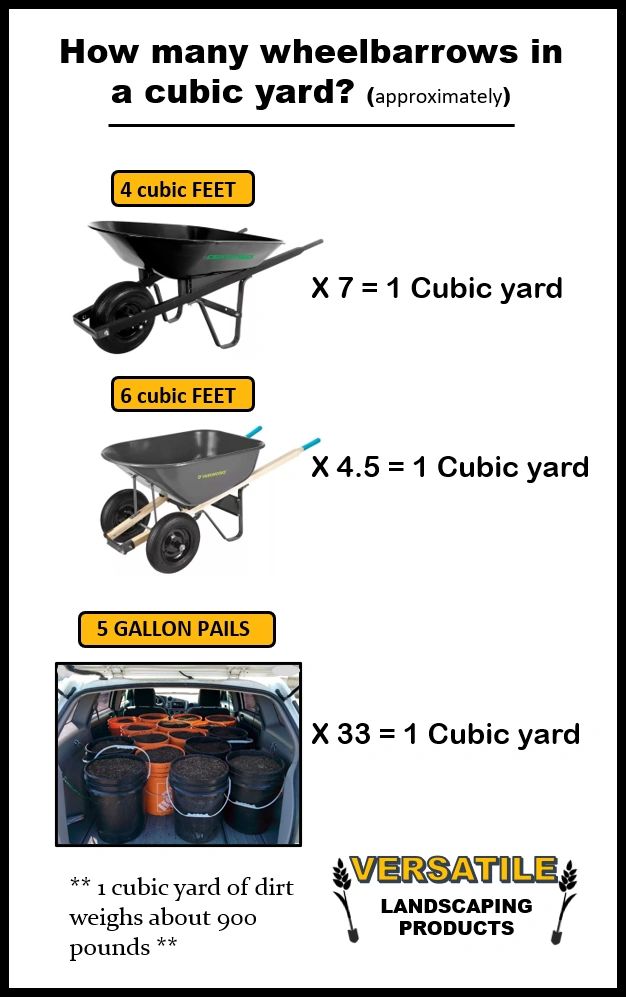
Image Source: img1.wsimg.com
Deciphering Dirt Volume: It’s All About the Cubic Yard
When we talk about moving dirt, especially for backyard projects or DIY landscaping, the standard unit of measurement is the cubic yard. A cubic yard is a volume of space that is three feet long, three feet wide, and three feet tall. Imagine a cube with each side measuring one yard. That’s one cubic yard.
- 1 cubic yard = 27 cubic feet (since 3 feet x 3 feet x 3 feet = 27 cubic feet)
This is a fundamental concept for any soil calculation you might undertake. Whether you’re filling a garden bed, leveling an area, or removing excess soil from a construction project, knowing your dirt volume is crucial.
Fathoming Wheelbarrow Capacity: Not All Carts Are Created Equal
The biggest variable in our “how many wheelbarrows” question is the wheelbarrow capacity. Wheelbarrows come in various sizes and designs, affecting how much dirt each can hold.
Common Wheelbarrow Types and Their Capacities
Wheelbarrows are generally categorized by their basin material and size.
- Plastic Wheelbarrows: These are often lighter and more affordable. They are great for typical homeowner use and small landscaping projects.
- Typical Capacity: 4 to 6 cubic feet.
- Steel Wheelbarrows: These are sturdier and can handle heavier loads, making them suitable for more demanding backyard projects or even small construction tasks.
- Typical Capacity: 6 to 10 cubic feet.
- Heavy-Duty/Contractor Wheelbarrows: Built for extreme durability, these can often hold more and withstand rougher use.
- Typical Capacity: 8 to 12 cubic feet, sometimes even more.
It’s important to note that the stated capacity is usually the nominal capacity, often measured in cubic feet. For our calculations, we’ll need to convert this to cubic yards.
Converting Cubic Feet to Cubic Yards
Since 1 cubic yard = 27 cubic feet, we can easily convert wheelbarrow capacities:
- 4 cubic feet wheelbarrow: 4 / 27 ≈ 0.15 cubic yards
- 6 cubic feet wheelbarrow: 6 / 27 ≈ 0.22 cubic yards
- 8 cubic feet wheelbarrow: 8 / 27 ≈ 0.30 cubic yards
- 10 cubic feet wheelbarrow: 10 / 27 ≈ 0.37 cubic yards
Estimating How Much Dirt a Wheelbarrow Can Carry
While the wheelbarrow might have a stated capacity, you rarely fill it to the brim and perfectly level it. For practical hauling, especially of loose material like dirt, you might only fill it about 75% to 80% of its maximum capacity. This is to prevent spillage and make it easier to maneuver.
Let’s adjust our estimates based on this practical filling:
| Wheelbarrow Size (Cubic Feet) | Nominal Cubic Yards | Practical Cubic Yards (80% Full) |
|---|---|---|
| 4 | 0.15 | 0.12 |
| 6 | 0.22 | 0.18 |
| 8 | 0.30 | 0.24 |
| 10 | 0.37 | 0.30 |
The Math Behind the Loads: Calculating Wheelbarrow Trips
Now that we know how much dirt a cubic yard is and how much a wheelbarrow can carry, we can do the math.
Formula:
Number of Wheelbarrow Loads = Total Dirt Volume (in cubic yards) / Wheelbarrow Capacity (in cubic yards per load)
Let’s use our practical capacities to answer the original question: How many wheelbarrows in a yard of dirt?
Calculations for Different Wheelbarrow Sizes
We’ll assume we need to move 1 cubic yard of dirt.
-
Using a 4 cubic feet (0.15 cubic yards) wheelbarrow:
1 cubic yard / 0.15 cubic yards per load = 6.67 loads- So, about 7 wheelbarrow loads.
-
Using a 6 cubic feet (0.22 cubic yards) wheelbarrow:
1 cubic yard / 0.22 cubic yards per load = 4.55 loads- So, about 5 wheelbarrow loads.
-
Using an 8 cubic feet (0.30 cubic yards) wheelbarrow:
1 cubic yard / 0.30 cubic yards per load = 3.33 loads- So, about 4 wheelbarrow loads.
-
Using a 10 cubic feet (0.37 cubic yards) wheelbarrow:
1 cubic yard / 0.37 cubic yards per load = 2.70 loads- So, about 3 wheelbarrow loads.
This might seem like a different range than our initial estimate. The discrepancy comes from the “practical” vs. “nominal” capacity and how full people actually fill their wheelbarrows.
Let’s re-evaluate with a more common, less precise way people think about it, often aiming for a “full” but manageable load:
If we assume people fill their wheelbarrows to about 80% of their stated capacity, and use rounded-up cubic foot capacities for simplicity:
- A 5 cubic foot wheelbarrow (very common size): 1 cubic yard / (5 cf / 27 cf/cy * 0.8 practical fill) = 1 / (0.185 * 0.8) = 1 / 0.148 ≈ 6.75 loads (so, 7 loads)
- A 6.5 cubic foot wheelbarrow: 1 cubic yard / (6.5 cf / 27 cf/cy * 0.8) = 1 / (0.24 * 0.8) = 1 / 0.192 ≈ 5.2 loads (so, 6 loads)
- An 8 cubic foot wheelbarrow: 1 cubic yard / (8 cf / 27 cf/cy * 0.8) = 1 / (0.30 * 0.8) = 1 / 0.24 ≈ 4.17 loads (so, 5 loads)
- A 10 cubic foot wheelbarrow: 1 cubic yard / (10 cf / 27 cf/cy * 0.8) = 1 / (0.37 * 0.8) = 1 / 0.296 ≈ 3.38 loads (so, 4 loads)
So, a commonly accepted answer for how many wheelbarrows in a yard of dirt, using average-sized wheelbarrows filled practically, is typically 4 to 7 loads.
Factors Influencing Your Dirt-Hauling Efforts
Beyond the wheelbarrow capacity, several other elements will affect the number of trips you make.
Soil Type and Density
The type of dirt you’re moving significantly impacts its weight and how much you can comfortably fit in your wheelbarrow.
- Wet Clay: This is heavy and sticky. It will compact easily, meaning you might fit less volume per load, and the weight can be substantial.
- Dry Loam: This is a good all-around soil. It’s relatively easy to shovel and has a moderate density.
- Sandy Soil: This can be lighter than loam but also more prone to shifting and falling out if not loaded carefully.
- Gravel or Aggregate: These materials are often denser and heavier than soil, meaning fewer cubic feet will be a full load.
Weight Comparison (Approximate, per cubic yard):
| Soil Type | Weight (lbs/cubic yard) |
|---|---|
| Dry Sand | 2700 |
| Dry Topsoil | 2200 |
| Wet Topsoil | 2700 |
| Wet Clay | 3200 |
| Gravel | 3500 |
| Packed Dirt | 3000 |
Consider that a typical person can comfortably push and lift a wheelbarrow filled with 150-250 lbs of material. A cubic yard of wet clay can weigh over 3000 lbs! This means you’ll be loading by volume, not by weight, and you’ll need to be realistic about how much you can actually move per trip.
The Terrain and Distance
The distance you need to haul the dirt and the condition of the ground make a big difference.
- Level Ground, Short Distance: You can fill your wheelbarrow more consistently and move faster.
- Sloping Ground, Long Distance: Each trip will be more tiring, and you might fill your wheelbarrow less to make it manageable. This increases the number of trips.
- Obstacles: Navigating stairs, narrow paths, or rough terrain will slow you down and can limit how full you can safely load your wheelbarrow.
Your Physical Strength and Stamina
Let’s be honest, hauling dirt is hard work! Your personal ability to push, lift, and maneuver a loaded wheelbarrow will dictate how much you can carry and how many trips you can make in a day. For larger jobs, breaking them down into smaller, manageable sessions is key for DIY landscaping and backyard projects.
Planning Your Dirt-Hauling Project
Knowing how many wheelbarrow loads are in a cubic yard of dirt is crucial for effective planning.
Estimating Your Dirt Needs
Before you start shoveling, you need to know how much dirt you’re dealing with.
- Filling a Raised Bed: Calculate the volume of the bed (length x width x height) in feet, then convert to cubic yards.
- Example: A raised bed 4 ft long, 3 ft wide, and 1 ft high = 12 cubic feet.
- 12 cubic feet / 27 cubic feet per cubic yard = 0.44 cubic yards.
- Using an 8 cubic foot wheelbarrow (0.30 cubic yards practical): 0.44 cy / 0.30 cy/load ≈ 1.5 loads. So, about 2 loads.
- Leveling an Area: Measure the area (length x width) and estimate the average depth of fill needed. Multiply these to get cubic feet, then convert to cubic yards.
- Excavating: Measure the area and depth of the excavation to determine the cubic yards of dirt to be removed. This is common for foundation work or creating new garden spaces.
Using Online Calculators and Tools
Many online resources can help with dirt volume calculations. Simply search for “cubic yard calculator” or “dirt volume calculator.” You’ll input your dimensions (length, width, depth), and they’ll provide the volume in cubic yards.
Making the Most of Each Load
- Use the Right Shovel: A pointed shovel is good for breaking up soil, while a square shovel is better for scooping and loading.
- Load Smartly: Load from the bottom up, distributing the weight evenly. Don’t overload the wheelbarrow; it’s better to take an extra trip than to strain yourself or spill your load.
- Keep the Wheelbarrow Clean: Dirt can stick to the basin, reducing its effective capacity over time.
When is Hauling Dirt a Big Job?
For small landscaping projects or backyard projects, a few cubic yards of dirt might be manageable with a single wheelbarrow. However, for larger construction projects, or if you’re significantly altering your landscape, the sheer volume of dirt can be overwhelming for just one person and one wheelbarrow.
- Home Renovations: Digging for a new patio, deck footings, or a retaining wall can generate significant amounts of dirt.
- Landscaping Overhauls: Adding a berm, digging a large pond, or creating a substantial flower bed might require many cubic yards.
- New Construction: Even small structures like sheds or garages can involve moving several cubic yards of soil.
In these scenarios, relying solely on a wheelbarrow might take days or even weeks and could be physically draining.
When to Consider Alternatives
If your soil calculation indicates you need to move more than, say, 5-10 cubic yards of dirt, or if the hauling distance is significant, you might want to consider alternatives or supplements to your wheelbarrow:
- Larger Wheelbarrows: Investing in a higher capacity wheelbarrow can cut down on the number of trips.
- Powered Wheelbarrows/Motorized Carts: These are essentially self-propelled wheelbarrows and can be a lifesaver for larger volumes or difficult terrain.
- Rent a Skid Steer or Mini Excavator: For very large jobs, renting heavy equipment is the most efficient and practical solution.
- Bulk Delivery vs. Hauling Away: Sometimes, it’s more efficient to have bulk material delivered rather than hauling it yourself. Conversely, if you’re removing dirt, hiring a service to haul it away in a truck or trailer can save you immense effort.
Frequently Asked Questions (FAQ)
Here are some common questions about moving dirt with a wheelbarrow:
Q1: What is the average capacity of a wheelbarrow for dirt?
A1: The average capacity of a typical homeowner’s wheelbarrow is between 5 and 8 cubic feet.
Q2: Can I move a cubic yard of dirt with just one wheelbarrow?
A2: Yes, but it will take multiple trips. As calculated, it typically takes between 3 to 7 loads, depending on the wheelbarrow’s size.
Q3: How much does a cubic yard of dirt weigh?
A3: The weight varies greatly by moisture content and soil type, but a cubic yard of dirt can weigh anywhere from 2,200 to 3,200 pounds or more.
Q4: What’s the best way to fill a wheelbarrow for hauling dirt?
A4: Use a shovel to load the dirt from the bottom up, distributing the weight evenly. Avoid overfilling, and aim for about 75-80% capacity for easier handling and to prevent spillage.
Q5: How do I calculate cubic yards for my project?
A5: Measure the length, width, and depth of the area in feet. Multiply these numbers to get cubic feet. Then, divide the total cubic feet by 27 to convert it into cubic yards.
Q6: Is hauling dirt with a wheelbarrow a good workout?
A6: Yes, it’s an excellent full-body workout! It engages your arms, back, core, and legs. However, it’s important to use proper lifting techniques to avoid injury.
Q7: How many wheelbarrows of gravel in a yard?
A7: Gravel is typically denser than soil. A cubic yard of gravel can weigh more, often around 3,500 pounds. This means you’ll likely fit less volume per wheelbarrow load than you would with dirt, so it might take slightly more trips for the same volume compared to dirt. If your wheelbarrow holds 0.2 cubic yards practically, it would take 1 / 0.2 = 5 loads for a cubic yard of gravel, assuming you can load it practically without spillage.
By now, you should have a clear picture of how many wheelbarrow loads make up a cubic yard of dirt and the factors that influence this number. Happy hauling!